In 1910, women directed roughly 10% of all American films. By 1929, they had virtually disappeared from the director’s chair. This isn’t a story of gradual progress it’s a story of erasure.
Alice Guy-Blaché, Lois Weber, Dorothy Arzner, and dozens of other women built the language of cinema itself. They invented techniques, tackled bold subjects, and ran their own studios. Then the industry consolidated, sound arrived, and history books wrote them out.
Their films survive in fragments, their names survive in archives. Here’s what they achieved and how they were forgotten.
The First Narrative Filmmaker Was a Woman
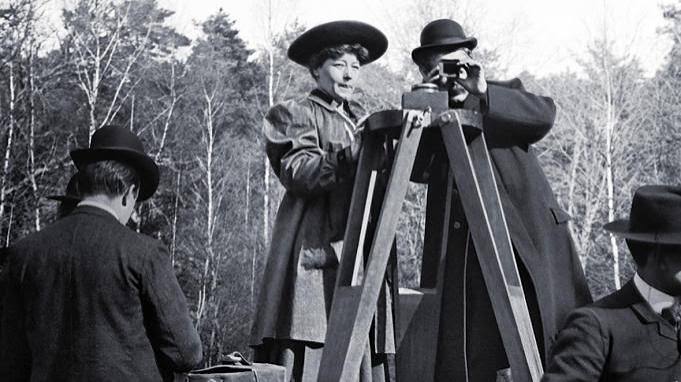
In 1896, a 23-year-old secretary at Gaumont in Paris named Alice Guy-Blaché directed La Fée aux Choux (The Cabbage Fairy). It wasn’t just the first film by a woman—it was one of the first narrative films ever made. At the time, cinema was mostly about recording real-life scenes: trains pulling into stations, workers leaving factories. Guy-Blaché told a story.
She went on to direct over 1,000 films, including The Life of Christ (1906), a sprawling epic with hundreds of extras and elaborate sets. In 1910, she moved to the United States and founded Solax Studios in Fort Lee, New Jersey—one of the largest pre-Hollywood studios in America. She wrote, produced, and directed, handling every aspect of production with an authority that made her a force in the industry.
But by the 1950s, her work was so thoroughly forgotten that when film historian Anthony Slide rediscovered her in the 1970s, the public had no idea who she was. She received the French Legion of Honor in 1953, but her name remained absent from most film histories until decades later.
The Highest-Paid Director at Universal Was a Woman
Lois Weber didn’t just direct movies—she used them to argue. At Universal Studios in the 1910s, she was one of the highest-paid directors, male or female. Her films tackled issues that were considered too hot for the screen: capital punishment in The Blot (1921), birth control in Where Are My Children? (1916), and poverty in multiple works. She wrote, directed, and often starred in her own films, giving her complete creative control.
Weber also made history as the first American woman to direct a feature-length film, The Merchant of Venice (1914). She mentored Frances Marion, who would become Hollywood’s most celebrated screenwriter. But her career collapsed in the 1920s as studio consolidation pushed women out. By the end of the decade, she was nearly unemployable.
The Only Woman to Survive the Sound Transition
Dorothy Arzner holds a unique distinction: she’s the only woman who directed films in Hollywood continuously through the transition to sound. Between 1927 and 1943, she made 20 films, including Christopher Strong (1933) and Dance, Girl, Dance (1940). Her films featured strong female protagonists, a rarity for the time.
She also solved a practical problem that shaped film technology. On the set of The Wild Party (1929), she needed to record dialogue while allowing the actors to move freely. Her solution—a boom microphone on a fishing rod—became standard equipment. Arzner was also openly lesbian at a time when that was professionally dangerous, and her films often explored gender dynamics with subtlety and subversion.
After retiring from directing, she taught at UCLA, where she mentored a young Francis Ford Coppola.
The Avant-Garde Theorist
Not all early women directors worked in Hollywood. Germaine Dulac was a French filmmaker and theorist who pushed cinema toward abstraction. Her 1923 film The Smiling Madame Beudet is a landmark of feminist and impressionist cinema, depicting a woman trapped in a loveless marriage through visual metaphors rather than dialogue. Dulac wrote extensively about cinema as a pure art form, arguing that film should move beyond storytelling to evoke emotion through rhythm and image. She was a key figure in the French impressionist and surrealist movements.
The Comedian Who Directed Chaplin
Mabel Normand was one of the most popular comediennes of the silent era—a star of Mack Sennett’s slapstick comedies. But she also directed. In 1914, she co-directed Mabel at the Wheel with Charlie Chaplin and directed Mabel’s Blunder. Her work behind the camera is often overshadowed by her fame in front of it, but she was one of the few women who moved between acting and directing with ease.
The Numbers: Rise and Fall
Women’s presence in early cinema wasn’t marginal—it was foundational. In 1910, women directed roughly 10% of all American films. By 1920, that number had dropped to around 2%. By 1929, with the arrival of synchronized sound, women directors had essentially vanished from Hollywood. To put that in perspective, in 2023, women directed 16% of the top 250 grossing films—a figure considered a historic high. The silent era’s 10% was higher than anything Hollywood would see again for a century.
Why Women Thrived in Early Film
The film industry in the 1900s and 1910s was wide open. It was new, unregulated, and not yet considered respectable. Because it was seen as a novelty or working-class entertainment, it attracted few gatekeepers. Anyone with ambition and a camera could enter. Many studios were family-run, so wives and daughters naturally participated. The technical skills of silent filmmaking—cranking a camera, editing—were not yet gendered. And acting was one of the few public careers considered acceptable for women, so many actresses moved into directing.
The Rise of the Studio System and Erasure
As films grew longer and more expensive, production consolidated into large studios. These corporations were hierarchical and male-dominated. Distribution and exhibition required capital connections that women often lacked. The star system elevated male directors as “auteurs,” while women’s contributions were erased or attributed to their male colleagues.
The arrival of sound in the late 1920s was the final blow. It required new technical expertise and massive investment. Studios used the disruption to purge “risky” personnel—including women directors. Many were pushed into screenwriting, editing, or costume design, roles seen as “supportive” rather than “creative.”
Erasure wasn’t accidental. Film archives and histories were built by men who favored male directors. Many of women’s films were lost, destroyed, or misattributed. When they survived, they were often credited to male collaborators or dismissed as “domestic” or “sentimental.” The term “auteur” was applied to men like D.W. Griffith, while Alice Guy-Blaché was forgotten until the 1970s.
The Women Who Kept Working
Some women sustained careers by adapting. Frances Marion wrote over 300 films, becoming one of the most powerful screenwriters in Hollywood. Cleo Madison directed and starred in serials at Universal. Ruth Stonehouse directed over 40 shorts at Essanay. Elsie Jane Wilson and Ida May Park directed features at Universal in the late 1910s. They worked within the system, but the director’s chair was increasingly closed to them.
Why Their Stories Matter Today
These women didn’t just participate in early cinema—they shaped it. Alice Guy-Blaché invented narrative filmmaking. Lois Weber made socially conscious art decades before it was fashionable. Dorothy Arzner pioneered technology and told stories from a female perspective. Germaine Dulac expanded cinema’s visual vocabulary.
Their erasure is a warning: progress in the film industry is not linear. Women’s participation has been deliberately rolled back before. The 10% of 1910 was higher than the industry achieved for over a century. Remembering these directors isn’t just about honoring the past—it’s about understanding how easily women can be written out of history, and how fragile their gains can be.
The forgotten women of early cinema didn’t fail—they were erased. Alice Guy-Blaché, Lois Weber, Dorothy Arzner, and dozens of others built the foundations of filmmaking, only to be written out of the story. Their films may be lost, but their influence is not. The next time you watch a movie, remember that a woman helped invent the language of cinema.
Summary
- Alice Guy-Blaché directed the first narrative film in 1896 and founded Solax Studios, but her work was forgotten until the 1970s.
- Lois Weber was the highest-paid director at Universal in the 1910s, tackling social issues like birth control and capital punishment.
- Dorothy Arzner was the only woman to direct through the transition to sound, inventing the boom microphone.
- Women directed 10% of American films in 1910, but by 1929 they were virtually absent from the director’s chair.
- The rise of the studio system and the sound transition were used to purge women from directing roles.
FAQ
Q: Who was the first female filmmaker?
A: Alice Guy-Blaché is widely credited as the first female filmmaker. She directed La Fée aux Choux in 1896, one of the first narrative films.
Q: How many films did Alice Guy-Blaché direct?
A: She directed over 1,000 films throughout her career, including The Life of Christ (1906), one of the first epic-scale productions.
Q: Why did women stop directing in Hollywood?
A: The consolidation of the studio system and the transition to sound in the late 1920s led to women being pushed out. Studios used the disruption to purge “risky” personnel, and women were often moved to screenwriting or other roles.
Q: What was Dorothy Arzner’s major technical contribution?
A: She invented the boom microphone on the set of The Wild Party (1929) to solve a sound recording problem.
Q: Is the percentage of women directors today higher than in the silent era?
A: In 2023, women directed 16% of the top 250 grossing films, which is higher than the 10% of 1910, but it took over a century to surpass that earlier figure.