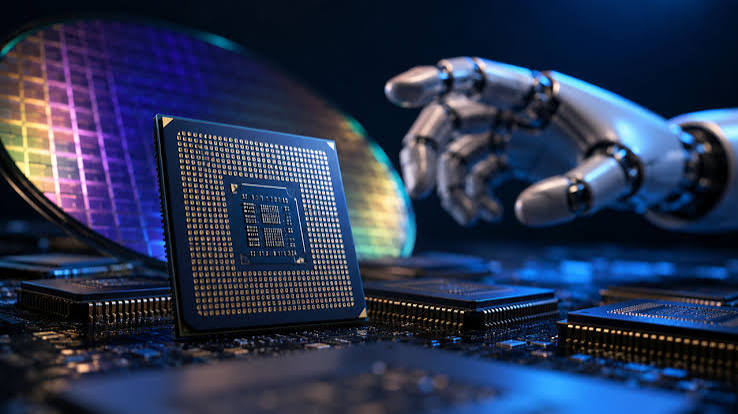
In 2023, a single request to ChatGPT triggered a cascade of computing demand that reshaped the global semiconductor industry. Training a model like GPT-4 can require around 25,000 NVIDIA A100 GPUs running for months a level of compute that was almost unimaginable for most organizations just a few years ago. This surge has transformed the chip shortage from a pandemic-era inconvenience into a structural bottleneck that will define the next decade of technology.
The story of the chip shortage is not a simple one. It began in late 2020 with empty car lots and PlayStations, but it has evolved into something far more complex: a race to secure the most advanced chips on Earth, a geopolitical tug-of-war, and a multi-trillion-dollar investment boom. Understanding this shift is essential for anyone trying to make sense of the AI revolution—and its limits.
From Consumer Gadgets to AI Accelerators
The first wave of the chip shortage, which began in late 2020, was a classic supply-demand shock. Pandemic lockdowns sent millions of people scrambling for laptops, webcams, and gaming consoles, while factory shutdowns and logistics snarls crippled production. Automakers, which had canceled orders during the initial downturn, found themselves at the back of the line when demand rebounded. The result was a shortage that hit everything from pickup trucks to washing machines.
By 2022, that crisis had largely eased. Consumer demand cooled, and the industry began to catch its breath. But just as the old problem was fading, a new one emerged: the generative AI boom. When OpenAI released ChatGPT in late 2022, it ignited an arms race among tech giants to build ever-larger language models. These models require thousands of specialized chips called GPUs, which are far more powerful for AI workloads than traditional CPUs. NVIDIA, which controls roughly 80–95% of the AI accelerator market, suddenly found itself at the center of the world’s most critical supply chain.
The nature of the shortage has fundamentally changed. It is no longer about getting a chip for your car or your phone—it’s about getting the most advanced GPUs and memory chips to power AI. Lead times for these components can stretch 12 to 18 months, and some orders placed in 2023 are only being fulfilled in 2025. The bottleneck has moved from manufacturing capacity to advanced packaging, particularly TSMC’s CoWoS technology, which is essential for stacking memory and logic chips together.
The New Geography of Chip Manufacturing
The semiconductor supply chain is extraordinarily concentrated. TSMC, based in Taiwan, produces about 90% of the world’s most advanced chips (those with nodes below 7 nanometers). ASML, a Dutch company, has a near-monopoly on the extreme ultraviolet (EUV) lithography machines needed to etch these tiny features. This concentration creates a massive strategic vulnerability—and it has sparked an unprecedented wave of government intervention.
The US CHIPS Act, passed in 2022, allocated $52.7 billion in subsidies to encourage domestic fabrication. TSMC, Intel, and Samsung are all building new fabs in the US, though construction takes three to five years and costs over $20 billion per leading-edge facility. The EU Chips Act aims to double Europe’s market share with €43 billion in investments. Japan, South Korea, India, and China are all pouring money into domestic capacity. Japan’s Rapidus project is attempting to leapfrog to 2nm chips by 2027, a bold bet that could reshape the industry.
But these efforts are not a quick fix. A chip fab is a capital-intensive, slow-moving beast. Even with government backing, new capacity won’t come online until 2025 or later. Meanwhile, export controls—imposed by the US in October 2022, October 2023, and January 2025—have restricted China’s access to advanced chips and equipment, fragmenting the global market. NVIDIA, for example, lost roughly $5 billion in China sales in 2023 as a result of these restrictions.
The AI Bubble Question
Is the AI-driven chip shortage a structural reality or a speculative bubble? The answer depends on who you ask.
The bullish case is straightforward: AI demand is real and growing. Hyperscale cloud providers—Microsoft, Google, Amazon, and Meta—are spending over $100 billion per year on capital expenditures, much of it on AI infrastructure. Training and running LLMs requires enormous compute, and as AI is deployed in everything from search to autonomous vehicles, that demand will only increase. The AI chip market is expected to grow from roughly $50 billion in 2023 to over $300 billion by 2030, according to estimates from firms like Gartner and McKinsey. If that forecast holds, the shortage will persist for years.
The bear case is equally compelling. AI capex is speculative. If the ROI on these massive investments doesn’t materialize—if AI applications fail to generate sufficient revenue—then orders will be canceled. We could see a glut of chips by 2026 or 2027, reminiscent of the fiber-optic bubble in 2000. Analysts at SemiAnalysis and Morgan Stanley have warned that hyperscalers are over-ordering GPUs, creating a false sense of scarcity. Some AI startups are already feeling the pain, unable to access the chips they need, while others are pivoting to smaller, more efficient models that require less compute.
The truth likely lies in between. The demand for AI compute is real, but it may not grow at the dizzying pace of the last two years. The shortage is not a monolithic event—different segments of the chip market are experiencing different dynamics. Advanced AI chips are scarce; older, less advanced chips are not. Memory, especially HBM (High Bandwidth Memory), is particularly constrained, with only SK Hynix, Samsung, and Micron capable of producing it. The shortage is real, but it is also uneven.
Who Wins and Who Loses?
The chip shortage has been a windfall for NVIDIA, which saw its market value soar past $1 trillion in 2023. But for many others, it’s been a crisis. AI startups and researchers without deep pockets are struggling to access GPUs. Cloud providers are rationing compute, forcing some startups to optimize their models for inference or train on smaller, open-source models like Llama and Mistral. These models reduce the need for massive training runs, but they still require inference hardware to run at scale.
There’s also a human cost. AI data centers consume enormous amounts of electricity—projected to reach 4–8% of US electricity by 2030—and fabs use millions of gallons of water daily. New manufacturing facilities face local opposition over environmental concerns. The shortage exacerbates the digital divide, as only wealthy nations and corporations can access cutting-edge AI.
The second-order effects are rippling through industries far beyond tech. Automakers are redesigning their supply chains, embracing long-term contracts and vertical integration to secure the chips needed for EVs and autonomous driving. Consumer electronics companies are facing longer product cycles. The shortage has become a lens through which we see the fragility of global supply chains and the geopolitical stakes of technology.
What Comes Next?
The chip shortage is not a single event with a clear end date. It is a structural feature of the AI era. The industry is responding—with massive investments, new fabs, and innovative packaging technologies—but the timeline is measured in years. In the meantime, the shortage will continue to shape everything from the cost of AI services to the balance of power between nations.
For technologists and investors, the key takeaway is that the chip shortage is not just a problem to be solved; it’s a defining condition of the current technological landscape. Those who understand its dynamics—the concentration of supply, the geopolitical pressures, the speculative risks—will be better positioned to navigate the uncertainty. The chips are down, and the world is betting on them.
The AI chip shortage is a story of unprecedented demand, structural bottlenecks, and geopolitical tension. It has transformed the semiconductor industry from a quiet backbone of modern life into the most contested resource of the digital age. Whether the current boom is a bubble or the beginning of a new industrial era, one thing is certain: the scarcity of advanced chips will continue to shape the trajectory of AI, the fortunes of companies, and the strategies of governments for years to come.
Summary
- The chip shortage has shifted from consumer electronics to AI-specific high-end chips (GPUs, HBM memory) since the generative AI boom in 2023.
- NVIDIA controls ~80–95% of the AI accelerator market, and TSMC produces ~90% of advanced chips, creating extreme supply concentration.
- Lead times for advanced AI chips are 12–18 months, with some orders taking over two years to fulfill.
- Government initiatives like the US CHIPS Act and EU Chips Act aim to diversify supply, but new fabs take 3–5 years to build.
- The debate between a ‘structural shortage’ and an ‘AI bubble’ remains unresolved; a potential glut by 2026–2027 is a real possibility if AI investments don’t yield returns.
FAQ
Q: Why is the chip shortage specifically about AI?
A: AI workloads, particularly training large language models, require thousands of parallel processors like GPUs. The generative AI boom created unprecedented demand for these chips, which are more complex to manufacture than traditional CPUs.
Q: How long will the AI chip shortage last?
A: Most experts expect the shortage to persist through 2025 and possibly beyond. New manufacturing capacity is coming online, but it takes 3–5 years to build a fab, and demand continues to grow.
Q: What is HBM, and why is it so constrained?
A: HBM (High Bandwidth Memory) is a type of memory that sits close to AI processors, enabling faster data transfer. Only a few companies (SK Hynix, Samsung, Micron) produce it, and it’s essential for high-performance AI systems.
Q: How are companies coping with the chip shortage?
A: Companies are using several strategies: optimizing models for efficiency, using open-source models that require less compute, signing long-term supply contracts, and some are even designing their own custom chips (like Google’s TPU or AWS Trainium).
Q: Could the chip shortage lead to a bubble burst?
A: There’s a risk. If AI investments don’t generate sufficient returns, hyperscalers could cancel orders, leading to a glut of chips by 2026–2027, similar to the dot-com fiber crash. However, many analysts believe AI demand is structural and will continue to grow.