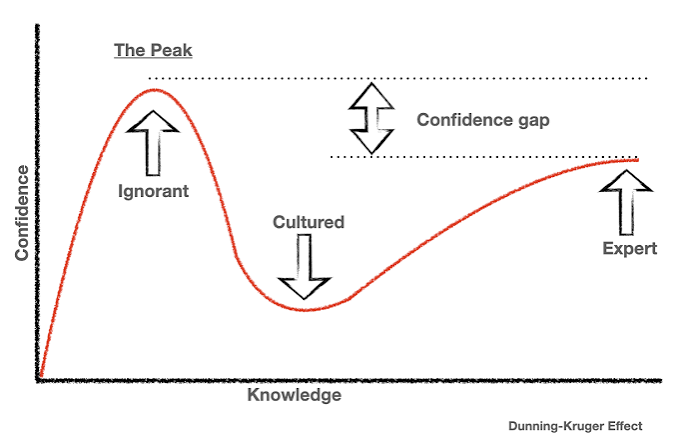
You’ve probably heard of the Dunning-Kruger effect: the idea that incompetent people are too ignorant to know they’re incompetent, so they overestimate their abilities. It’s become a cultural touchstone, used to explain everything from bad drivers to political pundits. But what if this famous phenomenon is not a quirk of the human mind, but rather a quirk of statistics? A 2020 paper suggests just that, arguing that the Dunning-Kruger effect may be largely a data artefact—a mirage created by the way we analyze numbers, not a real psychological bias.
This isn’t just academic squabbling. The Dunning-Kruger effect has been cited in countless articles, books, and management seminars. If it’s not real, we might need to rethink some of our assumptions about self-awareness and competence. But before we throw the concept out, let’s dive into the debate. We’ll explore the original research, the statistical critique, and what both sides have to say. By the end, you’ll have a clearer picture of whether the Dunning-Kruger effect is a genuine insight into human nature or a statistical illusion that has fooled us all.
The Original Dunning-Kruger Effect: A Quick Recap
In 1999, psychologists Justin Kruger and David Dunning published a landmark study titled “Unskilled and unaware of it.” They asked participants to take tests in logic, grammar, and humor, and then asked them to rate their own performance. The results were striking: those who scored in the bottom quartile (the lowest 25%) rated themselves as being in the 60th to 70th percentile—meaning they thought they were above average, when in fact they were well below. Conversely, those in the top quartile often underestimated their performance, rating themselves slightly below where they actually fell.
The explanation Dunning and Kruger offered was that the same cognitive deficits that cause poor performance also prevent people from recognizing their incompetence. In other words, if you lack the skills to do something well, you also lack the skills to know you’re doing it badly. This “double burden” of ignorance became the core of the Dunning-Kruger effect, and it quickly entered popular culture as a meme, a management training talking point, and a way to explain everything from political polarization to vaccine hesitancy.
The 2020 Critique: A Statistical Artefact?
Fast forward to 2020, and a team of researchers from Carnegie Mellon University and the University of Toronto published a paper with a provocative title: “The Dunning-Kruger effect is probably not real.” Their argument was not that the original studies were fabricated, but that the pattern of results could be explained by statistical artefacts—specifically, regression to the mean and measurement error—without any need for a psychological bias.
Let’s break down these concepts with an analogy. Imagine you’re a basketball coach trying to evaluate your players’ shooting ability. You have them take a series of shots, and you also ask them to rate how good they think they are. Both measures are imperfect: a player might have an off day (measurement error), and if you pick the worst performers from one day, they’re likely to do better the next time just by chance (regression to the mean).
Now, suppose you compare the players’ self-ratings to their actual performance. The players who scored lowest on the shooting test might have had a particularly bad day, but their self-rating reflects their overall ability, which is probably higher than that one bad performance. So they appear to overestimate themselves. Conversely, the top performers might have had a lucky day, but their self-rating is based on their average ability, which is lower than that one great performance. So they appear to underestimate themselves. The result? A pattern that looks exactly like the Dunning-Kruger effect, but it’s purely a statistical illusion.
The 2020 researchers ran simulations to show that random data with no true bias can produce the classic Dunning-Kruger “inverted U” pattern when analyzed the same way. They argued that when you control for these statistical artefacts, the effect size shrinks dramatically or disappears entirely.
The Defense: Dunning and Kruger Respond
David Dunning and Justin Kruger have not taken this critique lying down. They’ve defended their original findings on several fronts:
First, they argue that the statistical critique is not new. In their original 1999 paper, they addressed concerns about regression to the mean and designed their studies to minimize its impact. For example, they used quartile splits and multiple measures to ensure that the effect wasn’t just a statistical fluke.
Second, they point to subsequent research that has replicated the effect using different methodologies. For instance, studies using peer ratings (where others assess a person’s competence) have shown that poor performers are indeed unaware of their deficiencies. Longitudinal designs, which track people over time, have also found evidence consistent with the cognitive explanation.
Third, they argue that the statistical critique explains some of the pattern but not all of it. Even after controlling for regression artefacts, a residual effect remains that suggests a real cognitive bias. In other words, the Dunning-Kruger effect is not just a mirage; there’s something real underneath.
The Broader Context: The Replication Crisis
The 2020 critique is part of a larger movement in psychology known as the “replication crisis.” Over the past decade, researchers have found that many famous psychological findings don’t hold up when re-tested with larger samples and more rigorous methods. The Dunning-Kruger effect is one of the most widely cited findings, so it’s no surprise that it has come under scrutiny.
This debate highlights the importance of statistical literacy. When we hear about a study, we often assume the results are straightforward. But in reality, data can be messy, and the way we analyze it can create patterns that don’t reflect reality. The Dunning-Kruger controversy is a perfect example of why we need to be cautious about accepting psychological findings at face value.
What Does This Mean for You?
So, is the Dunning-Kruger effect real or not? The honest answer is: it’s complicated. The 2020 critique raises valid methodological concerns, but it doesn’t definitively prove that the effect is entirely a statistical artefact. Dunning and Kruger’s defense also has merit, and the weight of evidence from other studies suggests that there is at least some cognitive bias at play.
However, the debate has a practical takeaway: we should be humble about our own abilities, but also humble about our confidence in psychological research. The Dunning-Kruger effect may not be as robust as we thought, but the underlying idea—that people often have poor insight into their own competence—still resonates with many real-world experiences. Whether it’s a statistical illusion or a genuine bias, the lesson remains: we could all benefit from seeking feedback and being open to the possibility that we might not be as good as we think.
The Dunning-Kruger effect is a fascinating phenomenon, but its status as a real cognitive bias is now under question. The 2020 statistical critique shows that the pattern can emerge from data artefacts alone, but the original authors and subsequent research suggest there’s more to the story. As with many scientific debates, the truth likely lies somewhere in between. For now, the Dunning-Kruger effect remains a useful reminder of the limits of self-awareness—whether it’s a quirk of the mind or a quirk of numbers.
Summary
- The Dunning-Kruger effect, proposed in 1999, suggests that incompetent people overestimate their abilities, while competent people underestimate them.
- A 2020 paper argued that this effect may be a statistical artefact, caused by regression to the mean and measurement error, not a real cognitive bias.
- The original authors defend their findings, citing methodological precautions and subsequent replications.
- The debate is part of the broader replication crisis in psychology, highlighting the need for rigorous statistical analysis.
- The practical takeaway: be humble about your abilities and about the robustness of psychological research.
FAQ
Q: What is the Dunning-Kruger effect?
A: The Dunning-Kruger effect is a cognitive bias where people with low ability at a task overestimate their ability, while people with high ability underestimate it. It was first described by Justin Kruger and David Dunning in 1999.
Q: Why do some researchers think it’s a statistical artefact?
A: A 2020 paper argued that the pattern can be explained by regression to the mean and measurement error. When you compare self-assessments to performance, extreme scores are likely to be partly due to chance, creating an apparent over/underestimation pattern without any real bias.
Q: Did Dunning and Kruger respond to the critique?
A: Yes, they defended their original findings, saying they had already addressed regression artefacts in their original study, and that subsequent research using different methods (like peer ratings) supports the cognitive explanation.
Q: Is the Dunning-Kruger effect still considered real?
A: The scientific community is divided. The 2020 critique raises valid concerns, but many researchers believe there is still evidence for a genuine effect. The debate is ongoing, and more research is needed to settle it.
Q: What can we learn from this debate?
A: It reminds us to be critical of psychological findings and to understand that statistical analysis can sometimes create illusions. It also reinforces the importance of seeking feedback and being open to learning about our own limitations.