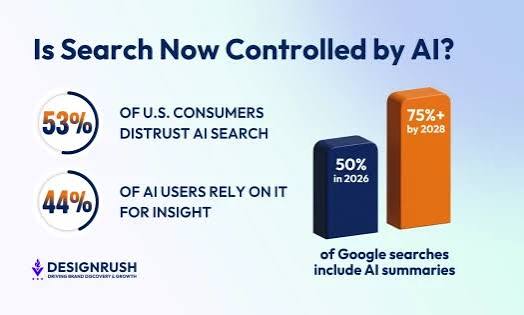
Tag: search engines

  • The Search Engine Shake-Up: How AI, Antitrust, and New Rivals Are Redrawing the Map

    The Search Engine Shake-Up: How AI, Antitrust, and New Rivals Are Redrawing the Map

    For two decades, Google has been the front door to the internet. Type a query, get ten blue links, click, done. But that door is now creaking under the weight of generative AI, antitrust rulings, and a generation that would rather ask TikTok for a restaurant recommendation than Google. The search engine is no longer a static utility; it’s a battlefield where the next decade of information access is being decided.

    The numbers tell the story. Google still handles over 8.5 billion searches a day, but its market share has slipped below 90% for the first time in years. Meanwhile, ChatGPT reached 100 million weekly users in two years, and Perplexity an AI-native answer engine—has carved out 10 million monthly users. The queries aren’t disappearing; they’re just going elsewhere. And when they do stay, they often don’t lead to a click at all. Zero-click searches are on the rise, and that has publishers and advertisers alike scrambling.

    The End of the Ten Blue Links

    For most of search’s history, the goal was to send you to a website. Google’s PageRank, launched in 1998, was a clever way to rank pages by their backlinks, and it worked beautifully—so well that it made Google the default gateway to the web. But over the years, the search engine has been slowly answering more questions itself. Featured snippets, knowledge panels, and ‘people also ask’ boxes were early steps toward keeping you on the page.

    Generative AI is the logical endpoint. Instead of a list of links, you get a synthesized paragraph, assembled from multiple sources and written in natural language. Google’s AI Overviews, Microsoft’s Copilot, and Perplexity’s cited answers all do this. The shift is profound: search is no longer about finding a website; it’s about getting an answer. That’s a better experience for many queries, but it’s a nightmare for the publishers who relied on referral traffic to fund their work.

    The Economic Engine Under Stress

    Search engines are, at their core, advertising businesses. Google’s search ads generate over $175 billion annually. That revenue subsidizes the free access we all enjoy. But AI answers threaten the model. If a user gets their answer directly on the search results page, they never click on an ad, and they never visit the website that might have shown them an ad. The click-through rate on organic results has already declined to under 50% for many query types, and AI integration accelerates that trend.

    Microsoft, which partnered with OpenAI to make Bing’s AI search a reality, is betting that the future is conversational and ad-supported in new ways. But the tension is real: every AI-generated answer is a potential ad impression lost. The economic model that funded the internet’s index for two decades is being pulled in two directions—user experience and revenue. How that resolves will shape everything from content creation to the survival of independent media.

    The Antitrust Hammer Falls

    Google’s dominance hasn’t just been a matter of superior algorithms. In August 2024, a federal judge ruled that Google illegally maintained a monopoly in search and text advertising. The remedies are still being determined, but the implications are enormous. If Google is forced to change its default search deals—like the one that makes it the default on iPhones—then Bing, DuckDuckGo, or even a newcomer could gain ground.

    The EU has already acted. The Digital Markets Act designates Google as a ‘gatekeeper,’ requiring choice screens and prohibiting self-preferencing. These regulations are designed to crack open the market, but they also create uncertainty. Will they fragment the search landscape into regional silos? Or will they foster a new wave of innovation?

    Either way, the era of Google as the unchallenged monarch is over. The question is who benefits from the power vacuum: Microsoft, a privacy-focused upstart, or an AI-native answer engine we haven’t met yet.

    The New Rivals: Vertical and Niche

    Google isn’t just losing ground to AI chatbots. It’s losing ground to specialized search engines that do one thing better. For product searches, people go to Amazon. For video, they go to YouTube. For authentic community answers, Reddit has become the default, so much so that Google now pays Reddit to license its data for AI training. For younger demographics, TikTok has replaced Google entirely as the discovery engine for restaurants, fashion, and even news.

    These vertical players don’t aim to replace Google wholesale; they just siphon off the most lucrative and frequent queries. And then there’s the niche players: DuckDuckGo and Brave Search for privacy, Kagi for a paid, ad-free experience. They’re small—Kagi has maybe 50,000 users—but they represent a growing demand for alternatives to the surveillance economy.

    The Trust Problem: Hallucinations and the Black Box

    AI search engines have a problem: they make things up. Large language models are prone to hallucination—presenting false information with complete confidence. Google’s AI Overviews famously recommended putting glue on pizza and cited satirical sources as fact. These are edge cases, but they illustrate the deeper issue: users can’t audit how an answer is generated. With a list of links, you can see the source and judge its credibility. With an AI paragraph, you get an opaque synthesis.

    Proponents argue that AI can be more accurate because it can synthesize across languages and formats, and that it can attribute sources, as Perplexity does. But the ‘black box’ problem remains. When a model is trained on biased or incorrect data, it amplifies those biases. And when the incentives are to keep you on the page, there’s a risk that AI answers will be optimized for engagement rather than accuracy.

    The Publisher’s Dilemma: Adapt or Die

    For websites, the rise of AI search is an existential threat. If Google’s AI Overviews answer your query, you’ll never see the click. Small and independent publishers are most vulnerable—they don’t have the bargaining power to strike licensing deals with AI companies. Large media companies are racing to sign agreements, like the one between OpenAI and The Associated Press, to ensure their content is used in AI training and cited in outputs.

    But there’s a counterargument: AI search could drive more queries overall, because it lowers the friction of asking a question. And it could surface long-tail content that users would never have found through a traditional search. The problem is that these benefits are speculative, while the loss of referral traffic is immediate. Publishers are being forced to adapt—focusing on newsletters, subscriptions, and direct traffic—or face extinction.

    The Privacy Tightrope

    Personalized AI search requires data—lots of it. The more the AI knows about you, the better it can answer your questions. But that’s a privacy nightmare. The trade-off between convenience and surveillance is intensifying. Privacy-focused engines like DuckDuckGo and Brave are growing, but they’re a tiny fraction of the market. And the AI era may only widen the gap: if you want the best AI answers, you might have to let the AI into your life.

    The EU AI Act and other regulations are trying to set boundaries, but the technology is moving faster than the law. The core question is whether we can have the benefits of personalized, conversational search without surrendering our privacy. The answer, so far, is unclear.

    The search engine is not dying; it’s mutating. The next decade will see a multi-front war: Google fighting to keep its ad empire, AI startups pushing for a post-link world, verticals carving out their niches, and regulators reshaping the battlefield. The winners will be those who can balance the demand for fast, accurate answers with the need to sustain the web’s open ecosystem. But the web that emerges may look nothing like the one we know. Search’s future is not a single product—it’s a fragmented, personalized, and increasingly AI-driven landscape.

    Summary

    • Google still dominates with 8.5 billion searches a day, but its share is eroding due to AI, antitrust, and vertical rivals.
    • AI search engines like Perplexity and Google’s AI Overviews shift from links to synthesized answers, threatening the ad-based economic model.
    • The August 2024 antitrust ruling against Google could force changes in default search deals, opening the door for competitors.
    • Vertical searches (Amazon, TikTok, Reddit) siphon off high-value queries, while privacy-focused alternatives gain niche followings.
    • Trust and accuracy are major challenges: LLM hallucinations and black-box algorithms undermine confidence in AI answers.

    FAQ

    Q: Will Google be replaced by AI search engines?
    A: Not overnight. Google still holds ~90% market share and has deep pockets, but AI-native engines like Perplexity are growing. The more likely outcome is a hybrid: Google and Bing integrate AI, while niche players carve out specific use cases.

    Q: How will AI search affect website traffic?
    A: It could reduce referral traffic significantly because AI answers often keep users on the search page. Publishers may need to diversify traffic sources, build direct audiences, or strike licensing deals with AI companies.

    Q: What is a ‘zero-click search’?
    A: A search where the user finds the answer directly on the search results page—via a featured snippet, knowledge panel, or AI overview—without clicking any organic result. This is increasingly common and is a major concern for publishers.

    Q: Are AI search engines accurate?
    A: They can be, but they are prone to hallucination—confidently giving false information. They also lack transparency in how answers are generated. Users should verify critical information from primary sources.

    Q: What can I do to protect my privacy in the age of AI search?
    A: Use privacy-focused engines like DuckDuckGo or Brave, consider paid options like Kagi, and be mindful of the data you share with AI assistants. Remember that personalized AI often requires more personal data.

  • Can You Trust AI Search? The Real Risks of Hallucination and Bias

    Can You Trust AI Search? The Real Risks of Hallucination and Bias

    When you ask an AI search engine a question, you’re not getting a list of links anymore. You’re getting an answer a confident, well-written paragraph that might be completely wrong. That’s the trade-off of the new generation of search: convenience over verification.

    AI search tools like Google’s AI Overviews, Perplexity, and OpenAI’s SearchGPT are reshaping how we find information. But independent tests show these systems can hallucinate making up facts at rates from 3% to 27%, depending on the task. And they carry built-in biases from the data they’re trained on. Here’s what that means for you, and how to navigate a world where the search engine isn’t always right.

    The Shift from Links to Answers

    For two decades, search meant “ten blue links.” You’d type a query, scan the results, and click through to sources you judged credible. AI search changes that. Instead of links, you get a synthesized answer—a paragraph or a conversational reply, drafted on the spot.

    That’s faster. But it also removes a critical step: your own judgment about which sources to trust. When the AI presents an answer with confidence, you’re less likely to question it. And that’s where the problems begin.

    Why AI Search Hallucinates

    LLMs are probabilistic text generators. They don’t have a database of facts; they predict the next word based on patterns in their training data. That means they can produce fluent, authoritative-sounding sentences that are factually wrong. This is called hallucination.

    Vectara’s studies (2023–2024) found hallucination rates between 3% and 27% on summarization tasks. For factual question-answering, error rates can be even higher in niche areas like medical conditions or local laws. Even with retrieval-augmented generation (RAG), which tries to ground answers in retrieved documents, errors persist when retrieval fails or the model misinterprets the source.

    The Bias Problem

    LLMs learn from human text, and human text is full of bias. Research from Stanford and MIT shows measurable demographic, political, and cultural biases in model outputs. For instance, models may associate certain jobs with specific genders or show political leanings on contentious topics.

    Bias isn’t a bug—it’s a feature of statistical learning from imperfect data. And while companies use techniques like RLHF to align models, those processes can introduce their own value judgments. The result is that AI search answers can subtly (or not so subtly) skew your worldview.

    Real-World Consequences

    A hallucinated answer about a medication’s dosage could be dangerous. A biased summary of a news event could misinform your opinion. Surveys from Pew Research show 60–70% of Americans worry about AI-generated misinformation in search. That concern is justified.

    In 2023, a lawyer used AI search to find legal precedents and submitted fake cases to court. The AI had invented them. That’s an extreme example, but it illustrates the stakes: when we trust these systems for health, finance, or legal decisions, errors have consequences.

    What Providers Are Doing

    Google’s own documentation warns that AI Overviews may “hallucinate” and advises verifying critical information. OpenAI’s system cards disclose known failure modes. Companies are investing in safety, but they’re also racing to deploy features. Economic pressure to appear “smart” can incentivize overconfident answers rather than cautious hedging.

    How to Use AI Search Wisely

    Don’t stop using it—just use it as a starting point, not the final word. For critical information, click through to primary sources. Treat AI answers as “drafts” to be verified, just as providers suggest. And be aware of the bias: seek out multiple perspectives on contentious topics.

    The Regulatory Landscape

    The EU AI Act, in force since August 2024, imposes transparency obligations on general-purpose AI. The U.S. has no comprehensive federal law, but the White House Executive Order on AI (October 2023) addresses trustworthiness. Regulation is catching up, but it can’t solve the technical problems of hallucination and bias—only careful engineering and user vigilance can.

    AI search is a powerful tool, but it’s not a reliable oracle. The same features that make it useful—fluency, confidence, synthesis—are the ones that make it dangerous. By understanding the risks of hallucination and bias, and by verifying critical information, you can harness the benefits without falling for the fabrications.

    Summary

    • AI search engines generate answers instead of links, which can be faster but harder to verify.
    • Hallucination rates range from 3% to 27% depending on the task and model.
    • Bias is baked into training data and can influence answers on sensitive topics.
    • Providers acknowledge limitations, but economic pressure leads to overconfident outputs.
    • Always verify critical information from primary sources.

    FAQ

    Q: What is AI search?
    A: AI search refers to search engines that use large language models to generate direct answers or summaries rather than returning a list of links. Examples include Google’s AI Overviews, Microsoft Copilot, Perplexity AI, and OpenAI’s SearchGPT.

    Q: How common are hallucinations?
    A: Independent studies, such as those by Vectara, have measured hallucination rates at roughly 3% to 27% for summarization tasks. For factual question-answering, error rates can be higher in niche domains.

    Q: Why does AI search have bias?
    A: LLMs are trained on human-generated text, which contains historical and societal biases. Alignment processes can also introduce value judgments. This leads to measurable demographic, political, and cultural biases in outputs.

    Q: Can I trust AI search for critical information?
    A: No. Providers themselves advise verifying critical information. For health, financial, or legal decisions, always consult primary sources or professionals.

    Q: What is being done about these issues?
    A: Companies are investing in safety and disclosing limitations. The EU AI Act imposes transparency obligations, and the U.S. has issued executive orders on AI trustworthiness. However, hallucination and bias remain unsolved technical challenges.

  • The Rise of ‘I’m Looking For…’: How Exploratory Search Is Changing the Web

    The Rise of ‘I’m Looking For…’: How Exploratory Search Is Changing the Web

    When you type “weather in Tokyo” into a search engine, you know exactly what you want. But when you ask, “I’m looking for a good book to read on a rainy day,” the journey is different. You’re not hunting for a specific page; you’re opening a door to exploration. This kind of query vague, curious, open-ended is becoming increasingly common, and it’s reshaping how we interact with information online.

    Exploratory search isn’t new, but its prevalence is surging. Research from the Journal of the American Society for Information Science and Technology suggests that between 40% and 60% of search sessions involve some degree of exploration, learning, or discovery. That’s a massive portion of the billions of searches conducted daily. And it’s not just about finding facts anymore; it’s about understanding, comparing, and synthesizing.

    What Exactly Is Exploratory Search?

    Gary Marchionini, a professor at the University of North Carolina, formalized the concept in a seminal 2006 paper titled “Exploratory Search: From Finding to Understanding.” He distinguished between three types of search:

    • Lookup: Finding a specific fact or known item, like “Netflix login” or “capital of France.”
    • Learn: Acquiring knowledge, comparing options, or understanding a topic.
    • Investigate: Analyzing, synthesizing, and evaluating information to solve a complex problem.

    The latter two categories—learning and investigating—fall under exploratory search. Instead of a single, well-defined target, you have a broad topic. You might not even know what you’re looking for until you see it. Think of it as browsing in a library, letting your eyes wander across the shelves, versus going straight to the call number.

    Why Is Exploratory Search on the Rise?

    Several factors are fueling this shift. First, there’s the sheer abundance of information. With billions of web pages, users often don’t know how to frame their needs. They need help narrowing down options, not just retrieving a single result. A query like “I’m looking for a career change” is a starting point for a journey, not a transaction.

    Second, social media has trained us to expect serendipity. Platforms like TikTok, Instagram, and Pinterest serve content to us based on our behavior, often surprising us with discoveries we didn’t anticipate. This expectation of discovery has bled into search behavior. We now use search engines not just to find, but to explore and be inspired.

    Third, the rise of voice search and conversational AI has made natural-language queries more common. When you speak to a smart speaker or a chatbot, you naturally phrase things as “I’m looking for…” or “What’s a good…”—longer, more conversational queries that reflect exploratory intent.

    The Generative AI Shift

    Search engines have taken notice. The old model of returning ten blue links is giving way to semantic and generative search. Google’s AI Overviews, Bing’s Copilot, and Perplexity AI are direct responses to users who want synthesis, not just links. These tools generate answers, compare options, and offer follow-up suggestions, effectively inviting users to keep exploring.

    For instance, instead of getting a list of articles about “best hiking gifts,” an AI-powered search might synthesize a paragraph explaining what to look for, then suggest related topics like “gifts for beginner hikers” or “budget-friendly gear.” This turns a one-off query into a conversation, encouraging deeper exploration.

    The UX Challenge: Designing for Discovery

    Exploratory search is cognitively demanding. Users often struggle to articulate what they want, and they may not recognize the right answer when they see it. Traditional search interfaces—designed for precision and speed—don’t handle this well. UX researchers argue that interfaces need to support iteration, comparison, and backtracking.

    Features like faceted navigation, visual previews, and “related searches” help. But the real breakthrough is AI-generated summaries that provide context and overview, giving users a map before they dive in. For example, a search for “I’m looking for a gift for my dad” might surface a summary of popular gift categories, along with product recommendations and reviews—all in one place.

    The Business Angle: High Intent, Low Specificity

    For e-commerce platforms, exploratory search represents a lucrative yet challenging segment. A query like “gift for a friend who likes hiking” signals high purchase intent but low specificity. Retailers are investing in recommendation engines, quiz-based shopping, and AI concierges to capture this demand. Etsy, for instance, uses visual search and personalized recommendations to help users discover unique items they didn’t know they wanted.

    However, there’s a risk: over-personalization can create filter bubbles, limiting genuine discovery. If the algorithm only shows you more of what you’ve already liked, you might never stumble upon something truly new. Balancing personalization with serendipity is a key challenge for businesses.

    The Academic Perspective: Search as Learning

    Information scientists study exploratory search as a learning process. Users don’t just retrieve information; they build knowledge. This has implications for search systems, which should support learning over time. For example, a student researching climate change might start with a broad query, then refine it as they learn more. A good search system would help them track their progress and connect related concepts.

    Marchionini’s framework highlights this: exploratory search is about “finding to understanding.” It’s not just about getting an answer; it’s about gaining insight.

    The rise of “I’m looking for…” signals a fundamental shift in how we interact with information. We’re moving from a model of retrieval—where the user knows exactly what they want—to a model of discovery, where the search engine becomes a thinking partner. As generative AI continues to evolve, exploratory search will only become more prevalent, reshaping search engines from simple tools into guides for learning and exploration.

    Summary

    • Exploratory search involves learning or investigating a topic, not just finding a specific fact.
    • Between 40% and 60% of search sessions involve some degree of exploration.
    • The rise of voice search, social media, and generative AI is fueling the increase.
    • Search engines are adapting with AI Overviews and conversational tools.
    • Businesses see exploratory search as high-intent but low-specificity traffic, leading to new recommendation and discovery features.

    FAQ

    Q: What is exploratory search?
    A: Exploratory search is a search behavior where users don’t have a specific target in mind. Instead, they aim to learn, discover, or explore a topic area, as opposed to lookup searches like finding a specific website or fact.

    Q: How common is exploratory search?
    A: Studies suggest that 40-60% of search sessions involve some degree of exploration, learning, or discovery.

    Q: Why is exploratory search increasing?
    A: Factors include the abundance of information (making it harder to know what you want), the influence of social media’s serendipitous discovery, and the rise of voice search and conversational AI that encourage natural-language queries.

    Q: How are search engines responding?
    A: Search engines are shifting from keyword matching to semantic and generative search. Examples include Google’s AI Overviews, Bing’s Copilot, and Perplexity AI, which provide synthesized answers and follow-up suggestions.

    Q: What are the challenges for businesses?
    A: Exploratory search signals high intent but low specificity. Businesses must use recommendation engines and AI to capture this demand, while avoiding filter bubbles that limit discovery.