Ice cream is more than a dessert it’s a physics playground. Every scoop is a delicate balance of ice, air, fat, and sugar, all dancing at temperatures far below freezing. But have you ever wondered why ice cream melts so quickly on a hot day, or why it turns rock-hard in your freezer? The answers lie in the surprising science of colloids, freezing point depression, and the relentless march of ice crystals.
This isn’t just about satisfying your sweet tooth. Understanding the science can help you make better ice cream at home, choose the best pint at the store, and even appreciate the engineering that goes into every scoop. So, let’s pull back the lid and explore the unexpected science of ice cream.
What Is Ice Cream, Really?
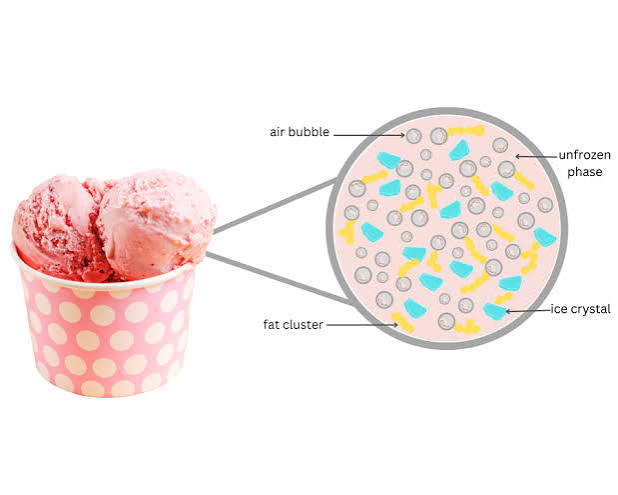
At its core, ice cream is a complex colloidal foam. That’s a fancy way of saying it’s a mixture of four phases: ice crystals, air bubbles, fat globules, and an unfrozen sugar solution. Each plays a critical role in texture, flavor, and melting behavior.
To be called “ice cream” in the U.S., the FDA requires at least 10% milkfat and 20% total milk solids. Premium brands often push fat content to 14–16%, which makes them creamier and slower to melt. But fat alone doesn’t tell the whole story. The amount of air whipped in—called overrun—ranges from 30% in dense, premium ice creams to 100% in economy brands. Air isn’t just a filler; it’s structurally essential. Without it, ice cream would be a hard, icy block.
Stabilizers like guar gum and carrageenan, along with egg yolks (which contain lecithin), help bind water and prevent ice crystals from growing. These ingredients are the unsung heroes that keep your ice cream smooth.
The Freezing Process: Churn and Freeze
Ice cream is made by churning and freezing the mix simultaneously in a barrel freezer at about −5°C to −10°C (23°F to 14°F). Rapid freezing and agitation are crucial because they prevent large ice crystals from forming. After churning, the ice cream is hardened at −25°C to −30°C (−13°F to −22°F) for 12–24 hours.
The ideal serving temperature is around −12°C to −10°C (10°F–14°F). At this range, the fats soften enough to release flavor, but the structure still holds. Home freezers at −18°C (0°F) are much colder, which is why ice cream straight from your freezer is often too hard to scoop. You need to let it warm up a bit.
Why Ice Cream Melts: A Heat-Transfer Puzzle
Melting isn’t just ice turning to water. It’s a heat-transfer problem involving fat networks, air cells, and sugar solutions. The unfrozen sugar solution has a lower freezing point than pure water—a phenomenon called freezing point depression. This is why ice cream is scoopable at temperatures where pure ice is rock-hard.
Fat globules form a network that traps air and slows the drainage of the liquid phase. Higher fat content means slower melting and a creamier mouthfeel. Stabilizers increase the viscosity of the liquid phase, slowing melt and preventing “whey-off”—that watery puddle you sometimes see.
The Physics of the Perfect Scoop
If you’ve ever had icy, gritty ice cream, you know the importance of ice crystal size. Crystals above about 50 micrometers are perceived as gritty. Rapid freezing and agitation keep crystals small, which is why churning is essential.
But even after you buy it, ice cream is under attack. Recrystallization, or Ostwald ripening, is the enemy: small crystals melt and redeposit onto larger ones during temperature fluctuations. Every time your freezer door opens, you’re promoting this process. That’s why ice cream gets icy over time.
Air cells, typically 20–100 micrometers, act as insulation and provide “chew.” Too little air makes ice cream dense and hard; too much makes it foamy and flavorless. Fat globules, about 1–2 micrometers, partially coalesce during churning, forming a network that stabilizes air and slows melt. This is why low-fat ice cream melts faster and feels watery.
Sugar: More Than Just Sweetness
Sugar does more than sweeten; it depresses the freezing point, meaning more sugar results in softer ice cream at a given temperature. Different sugars depress freezing points differently: fructose more than sucrose, glucose less. That’s why “no sugar added” ice creams often use sugar alcohols like erythritol to mimic texture.
The total solids content determines how much water remains unfrozen at serving temperature—typically 30–50% stays liquid. This unfrozen liquid is what keeps ice cream scoopable.
A Brief History of Frozen Desserts
Frozen desserts date back to ancient Persia and China, around 200 BCE–200 CE. Modern ice cream emerged in 17th-century Europe when salt and ice were discovered to lower freezing points below 0°C, enabling the freezing of cream mixtures.
The hand-cranked churn was invented in 1843 by Nancy Johnson, and commercial continuous freezers followed in the 1920s. Food scientists like W.S. Arbuckle later formalized the physics of freezing and aeration, turning ice cream making into a science.
The Food Scientist’s View: Formulation and Glass Transition
Food scientists focus on formulation: balancing fat, sugar, stabilizers, and overrun to hit target texture and melt resistance. They track the freezing curve and draw temperature—how quickly the mix cools and how much ice forms at each stage.
A key concept is the glass transition temperature, around −30°C to −40°C. Below this, the unfrozen phase becomes a glassy solid, halting recrystallization. This is why commercial ice cream is stored very cold.
The Artisan Maker’s View: Custard vs. Philadelphia Style
Artisan makers often use higher fat, lower overrun, and fresh ingredients, but they still must manage the same physics. Custard-based ice creams (with egg yolks) have a richer mouthfeel and different melt properties compared to Philadelphia-style (no eggs).
Liquid nitrogen ice cream freezes in seconds, creating ultra-small crystals—a dramatic demonstration of rapid freezing. But nitro ice cream melts faster because the fat network hasn’t had time to form a stable structure.
The Consumer’s View: Why Cold Suppresses Flavor
Flavor perception is tied to temperature: cold suppresses sweetness and aroma. That’s why ice cream tastes less sweet when frozen and why you might notice more flavor as it melts. This is also why some brands add extra sugar or flavorings to compensate for the cold.
Next time you enjoy a scoop, you’ll know it’s not just a treat—it’s a triumph of chemistry and physics.
Ice cream is a marvel of science, balancing ice, air, fat, and sugar in a delicate dance. From the freezing point depression that keeps it scoopable to the glass transition that halts recrystallization, every spoonful is a lesson in physics. Whether you’re a home cook or a curious eater, understanding these principles can help you choose better ice cream, store it properly, and even craft your own perfect scoop. So, the next time you indulge, take a moment to appreciate the science that makes it possible.
Summary
- Ice cream is a colloidal foam with four phases: ice crystals, air, fat, and unfrozen sugar solution.
- Overrun (air content) ranges from 30% to 100%, affecting texture and melt rate.
- Ice crystal size is crucial; crystals above 50 micrometers feel gritty.
- Recrystallization causes iciness over time due to temperature fluctuations.
- Sugar depresses freezing point, making ice cream scoopable at freezer temperatures.
- Fat networks and stabilizers slow melting and improve mouthfeel.
FAQ
Q: Why does ice cream melt so quickly on a hot day?
A: Melting is a heat-transfer problem. The ice crystals absorb heat from the environment, and the unfrozen sugar solution has a lower freezing point, so it melts faster than pure ice. Fat and stabilizers slow this process by creating a network that holds the structure.
Q: Why does ice cream get icy in the freezer?
A: This is due to recrystallization, or Ostwald ripening. Small ice crystals melt during temperature fluctuations and redeposit onto larger ones, making them grow. Over time, the ice cream becomes icy and gritty.
Q: What is overrun and why does it matter?
A: Overrun is the amount of air whipped into ice cream, expressed as a percentage. It ranges from 30% (dense, premium) to 100% (economy). Air is essential for texture, but too much makes it foamy and flavorless.
Q: Why is low-fat ice cream less creamy?
A: Fat globules form a network that stabilizes air and slows melting. Low-fat ice cream lacks this network, so it melts faster and feels watery.
Q: Why does ice cream taste less sweet when frozen?
A: Cold suppresses sweetness and aroma perception. That’s why ice cream often needs extra sugar or flavorings to taste right when served cold.