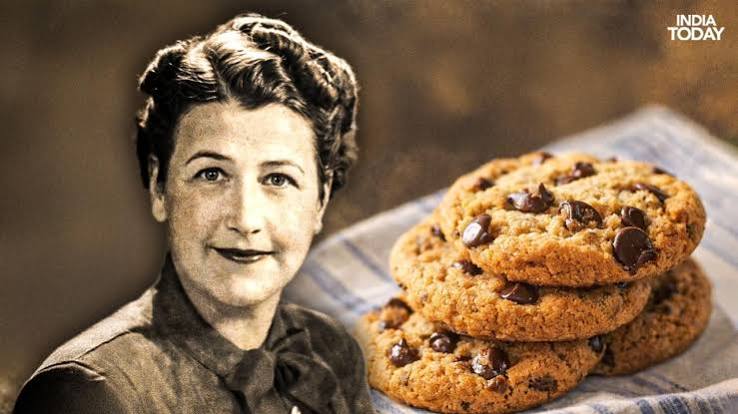
In 1938, a Massachusetts innkeeper named Ruth Wakefield was making a batch of Butter Drop Do cookies for her guests when she made a decision that would change American desserts forever. She chopped up a bar of semi-sweet chocolate, expecting it to melt into the dough as baker’s chocolate would. It didn’t. The result was a cookie studded with soft, gooey chunks of chocolate a happy accident that launched a national obsession.
But was it really an accident? Wakefield, a trained dietitian and meticulous recipe developer, later insisted the cookie was a deliberate invention. Yet the ‘mistake’ narrative, popularized by Nestlé’s marketing, stuck. This is the story of how a roadside inn’s kitchen experiment became the official state cookie of Massachusetts and a symbol of American comfort and how a savvy corporate partnership turned a home recipe into a packaged-product empire.
The Woman Behind the Cookie
Ruth Graves Wakefield was no ordinary housewife. A 1924 graduate of Framingham State Normal School, she was a trained dietitian and food lecturer who ran the Toll House Inn’s kitchen with professional rigor. She and her husband Kenneth had purchased the historic property — a 1709 building on the old Boston-to-Providence stagecoach route — in 1930, restoring it into a cozy roadside inn famous for its home-style cooking.
Wakefield’s kitchen was a laboratory of colonial-era recipes. She adapted and refined dishes, testing variations until they met her standards. The Butter Drop Do cookie, a traditional recipe, was one of her projects. It was during this experimentation that the chocolate chip cookie was born.
The Chocolate That Wouldn’t Melt
The standard story goes like this: Wakefield was making Butter Drop Do cookies, which called for baker’s chocolate. Out of baker’s chocolate, she grabbed a Nestlé semi-sweet chocolate bar, chopped it into pieces, and added it to the dough, assuming it would melt and create a chocolate-flavored cookie. Instead, the chocolate held its shape, leaving discrete chunks scattered through the dough.
But Wakefield challenged that narrative. In later interviews, she claimed she deliberately wanted a cookie with chocolate bits that would remain intact — a textural twist on the traditional recipe. The ‘accident’ story, she said, was a myth. Regardless of which version is true, the result was the same: a cookie with soft, melting pockets of chocolate that guests at the inn loved.
The cookie quickly became a signature offering at the Toll House Inn. Wakefield published the recipe in her 1938 cookbook, Ruth Wakefield’s Toll House Tried and True Recipes, but it was a partnership with Nestlé that catapulted it to national fame.
A Deal with Nestlé
Wakefield sold the recipe to Nestlé in exchange for a lifetime supply of chocolate — not royalties, as is sometimes claimed. Nestlé saw an opportunity. They began scoring their semi-sweet chocolate bars so home bakers could easily chop them into pieces, and in 1939 they introduced Nestlé Toll House Morsels, the first pre-portioned chocolate chips on the market.
The recipe was printed on the back of every package. It was one of the most printed recipes in American history, and it made the chocolate chip cookie a household staple. Nestlé’s marketing savvy didn’t just sell chocolate; it created a category and cemented the Toll House name in the American culinary lexicon.
The original recipe called for ‘two bars of semi-sweet chocolate, cut into pieces the size of a pea’ — not the uniform chips we know today. But the technique worked, and the cookie’s popularity spread.
From Inn to Icon
During World War II, soldiers from Massachusetts who had tasted the cookies at the Toll House Inn wrote home asking for them. The cookies traveled across the country and overseas, becoming a taste of home for troops. After the war, the chocolate chip cookie was firmly entrenched in American culture.
In 1997, Massachusetts named the chocolate chip cookie its official state cookie, a testament to its deep roots in the region.
The Toll House Inn itself burned down in 1984 and was never fully rebuilt as the original, but its legacy lives on in every bag of chocolate chips and every batch of cookies baked from the recipe on the back.
The Accidental Narrative
Why does the ‘accident’ story persist? Because it’s charming, memorable, and good marketing. The idea of a mistake leading to a beloved treat fits a familiar pattern — potato chips, Popsicles, and other foods all have similar origin myths. But Wakefield’s professional background complicates the tale.
She was a trained expert who understood how chocolate behaves in baking. She knew that semi-sweet chocolate wouldn’t melt the same way as baker’s chocolate. The likelihood that she stumbled upon the idea is low; more plausible is that she intentionally experimented with texture and flavor.
Nestlé, however, had little incentive to correct the narrative. The ‘accident’ angle made the cookie more relatable and newsworthy. It’s a story that has stuck for nearly a century, even as Wakefield’s own denials are documented.
The Recipe’s Legacy
The chocolate chip cookie is more than a dessert; it’s a cultural artifact. It represents the intersection of home cooking, corporate marketing, and American ingenuity. Ruth Wakefield’s creation, whether accidental or deliberate, tapped into something universal — the desire for a warm, comforting treat that feels both familiar and special.
Today, the recipe remains remarkably unchanged from Wakefield’s original. The Toll House recipe on the back of Nestlé’s packages is essentially the same cookie that delighted guests at the inn in 1938. It’s a simple formula: butter, sugar, eggs, flour, and of course, chocolate chips.
The chocolate chip cookie’s origin story is a tangle of fact and folklore. Ruth Wakefield may have intended to create the cookie, or she may have stumbled upon it, but either way, her innovation — and Nestlé’s marketing — turned a simple dessert into an American icon. The next time you bite into a warm chocolate chip cookie, you’re tasting a piece of history, born in a roadside inn and perfected by a skilled home economist who knew exactly what she was doing — even if the story says otherwise.
Summary
- Ruth Wakefield created the chocolate chip cookie in 1938 at the Toll House Inn in Whitman, Massachusetts.
- The ‘accident’ story — that she ran out of baker’s chocolate and used a chopped Nestlé bar, expecting it to melt — was popularized by Nestlé, but Wakefield later insisted the cookie was deliberate.
- Wakefield sold the recipe to Nestlé for a lifetime supply of chocolate, not royalties.
- Nestlé introduced pre-portioned chocolate chips (Toll House Morsels) in 1939 and printed the recipe on packages, making it one of the most printed recipes in American history.
- The cookie spread nationally during World War II, when soldiers requested them, and became the official state cookie of Massachusetts in 1997.
FAQ
Q: Was the chocolate chip cookie really an accident?
A: The popular story says Ruth Wakefield ran out of baker’s chocolate and used a chopped Nestlé bar, expecting it to melt. However, Wakefield herself claimed she deliberately intended to create a cookie with chocolate chips. The ‘accident’ narrative was amplified by Nestlé’s marketing.
Q: What did Ruth Wakefield receive from Nestlé for the recipe?
A: She received a lifetime supply of chocolate, not royalties, as is sometimes incorrectly claimed. The deal was mutually beneficial: Nestlé got a signature recipe and a brand association.
Q: When were chocolate chips first sold pre-portioned?
A: Nestlé introduced Nestlé Toll House Morsels in 1939, the first pre-portioned chocolate chips. Before that, bakers had to chop chocolate bars themselves.
Q: What was the original recipe’s instruction for chocolate?
A: The original 1938 recipe called for ‘2 bars of semi-sweet chocolate, cut into pieces the size of a pea,’ not the uniform chips we see today.
Q: Why is the chocolate chip cookie associated with Massachusetts?
A: It was invented at the Toll House Inn in Whitman, Massachusetts, and in 1997 it was named the official state cookie of Massachusetts.