Imagine you’re reading a book, and every time you turn a page, the ink on the opposite page smudges slightly. Over time, the words become unreadable, even though you never touched that page. This is eerily similar to what happens inside your computer’s memory with a phenomenon called ‘read disturbance.’
In the world of computing, data integrity is paramount. Yet, a physical quirk in DRAM (Dynamic Random-Access Memory) can silently corrupt data without any warning. This isn’t a theoretical concern—it’s a real vulnerability that has been exploited by hackers and can cause system crashes. Two specific manifestations, RowHammer and RowPress, have captured the attention of researchers and security experts alike.
In this article, we’ll peel back the layers of these phenomena, understand how they work, and explore why they matter for anyone who uses a computer—from casual users to data center operators.
The Basics: How DRAM Stores Data
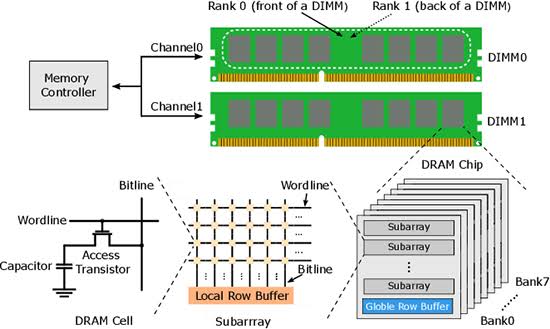
To understand read disturbance, we need a quick primer on DRAM. Think of DRAM as a massive grid of tiny buckets (capacitors) that hold a charge representing a 1 or a 0. Each bucket is paired with a switch (transistor) that controls access. The grid is organized into rows and columns. When you want to read a specific piece of data, the memory controller ‘activates’ the entire row containing that data. This raises a wire called a wordline, which opens all the switches in that row, allowing the charges to be sensed and read.
After reading, the row is ‘precharged’—the wordline is lowered, and the row is deactivated. This process happens millions of times per second. But here’s the catch: the capacitors leak charge over time, so DRAM must be refreshed every 64 milliseconds (the refresh interval) to maintain data integrity. This refresh is like a janitor coming by to top up the buckets before they get too empty.
The Problem: Read Disturbance
Now, imagine you activate a row repeatedly—say, you’re reading the same data over and over in a tight loop. Each activation causes the wordline to swing in voltage, creating a tiny electromagnetic disturbance. This disturbance can couple into neighboring rows, causing their capacitors to leak a bit more charge than usual. Over time, this leakage can become so significant that a ‘0’ flips to a ‘1’ or vice versa. This is a read disturbance: data corruption in rows you never intended to access.
This isn’t just a minor annoyance. Because the corruption happens silently, the system doesn’t know the data has changed. This can lead to crashes, incorrect calculations, or, in the worst case, security breaches where an attacker intentionally triggers these flips to gain unauthorized access.
RowHammer: The Original Discovery
In 2014, researchers at Carnegie Mellon University published a landmark paper titled “Flipping Bits in Memory Without Accessing Them.” They demonstrated that by rapidly activating the same row hundreds of thousands of times within a refresh window, they could cause bit flips in adjacent rows. This became known as RowHammer.
The threshold for RowHammer is roughly 100,000 to 200,000 activations per refresh interval (64ms). That might sound like a lot, but modern CPUs can easily achieve that rate. The attack was quickly weaponized: in 2015, a JavaScript-based exploit called Rowhammer.js showed that a malicious website could trigger bit flips remotely, potentially compromising the entire system.
RowPress: A New Twist
Fast forward to 2023. Researchers at ETH Zurich discovered a new variant called RowPress. Instead of rapidly activating a row, RowPress involves holding a row open for a long duration. Think of it as pressing and holding a button rather than tapping it repeatedly. This prolonged activation causes charge leakage to neighboring cells, leading to bit flips with just a single activation—if the row is held open for tens of microseconds.
This is a game-changer because existing defenses against RowHammer, like Target Row Refresh (TRR), which tracks and refreshes rows that are frequently accessed, are ineffective against RowPress. You can’t track a row that’s only activated once, even if it’s held open for a long time.
Why Should You Care?
You might think, “I’m not a hacker or a data center operator, so why does this matter?” Here’s the thing: these vulnerabilities are present in virtually all DRAM chips manufactured since the mid-2000s. That means your laptop, smartphone, and even your smart TV are potentially vulnerable. The implications are twofold:
- Security: Attackers can exploit bit flips to corrupt security-critical data, like page tables that control memory permissions, or cryptographic keys. This can lead to privilege escalation, where a normal user gains admin access.
- Reliability: In data centers, silent data corruption can cause system crashes or incorrect results in financial or scientific computations. The cost of such failures can be enormous.
Current Mitigations and Their Limitations
To combat these issues, several mitigation strategies have been developed:
- ECC (Error-Correcting Code): This adds extra bits to detect and correct single-bit errors. However, it’s not foolproof—it can’t handle multiple bit flips, and it adds overhead.
- Increased Refresh Rate: Refreshing more often reduces the time for charge leakage, but it consumes more power and reduces performance.
- Target Row Refresh (TRR): This hardware feature tracks frequently accessed rows and refreshes their neighbors. But as RowPress shows, it can be bypassed.
Despite these efforts, no perfect solution exists. Researchers continue to explore new attack variants, like combining RowHammer and RowPress, and developing more robust defenses.
The Road Ahead
As DRAM chips become denser and smaller, the problem is likely to worsen. The physical distance between cells shrinks, making them more susceptible to disturbance. This is a pressing concern for the industry, and it’s driving research into new memory technologies, like MRAM or RRAM, which are less prone to such issues.
In the meantime, understanding these phenomena is crucial for developers, security professionals, and even end-users who want to protect their data. Awareness is the first step toward mitigation.
RowHammer and RowPress are not just academic curiosities—they are real, exploitable vulnerabilities that affect the memory in virtually every computer. By understanding how they work, we can better appreciate the importance of robust memory design and the ongoing efforts to secure our digital infrastructure. As technology evolves, so too will the threats, but with continued research and vigilance, we can stay one step ahead.
Summary
- Read disturbance is a physical phenomenon where accessing one DRAM row causes bit flips in adjacent rows, leading to silent data corruption.
- RowHammer (discovered 2014) requires rapid repeated activation of a row, while RowPress (discovered 2023) requires a single prolonged activation.
- Both are hardware-level vulnerabilities present in most DRAM chips since the mid-2000s, with serious security and reliability implications.
- Existing mitigations like ECC and TRR are imperfect and can be bypassed, especially by RowPress.
- As DRAM gets denser, the risk increases, making ongoing research into new defenses and memory technologies essential.
FAQ
Q: What is DRAM read disturbance?
A: It’s a physical phenomenon where repeatedly accessing one memory row causes bit flips in adjacent rows, corrupting data without any explicit write operation.
Q: How does RowHammer differ from RowPress?
A: RowHammer requires rapidly activating the same row many times (hundreds of thousands) within a refresh window, while RowPress requires holding a row open for a long duration, even with a single activation.
Q: Can my computer be affected by these vulnerabilities?
A: Yes, virtually all DRAM chips made since the mid-2000s are potentially vulnerable. However, exploiting them requires specific conditions and often local access, though remote attacks have been demonstrated.
Q: What are the main defenses against RowHammer and RowPress?
A: Common defenses include Error-Correcting Code (ECC), increasing refresh rates, and Target Row Refresh (TRR). However, these are not foolproof and can be bypassed by advanced attacks.
Q: Why are these vulnerabilities important for security?
A: Bit flips can be used to corrupt security-critical data like page tables or cryptographic keys, potentially allowing attackers to gain unauthorized access or cause system crashes.