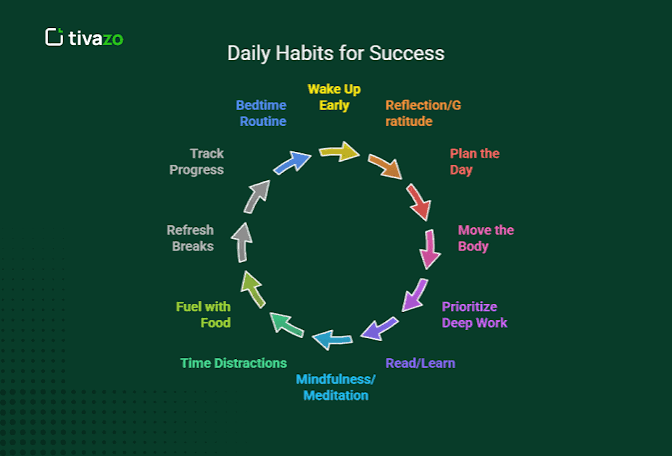
Success rarely comes from one dramatic breakthrough. More often, it’s the quiet accumulation of small, daily actions that compound over time. Think of the CEO who reads 20 pages every night, or the athlete who visualizes success for ten minutes each morning. These micro-routines—each taking less than half an hour—are the building blocks of high achievement.
But do these habits actually work, or are they just survivor stories? While many lists rely on celebrity anecdotes, the core behaviors are backed by psychology and productivity research. This article breaks down 12 of the most common small habits, explains why they matter, and offers practical ways to adopt them—without needing a 4 AM wake-up call.
1. Wake Up Early (But Not Necessarily at 3:45 AM)
Apple CEO Tim Cook rises at 3:45 AM. That’s extreme, but many high achievers are early risers. The key isn’t the specific hour—it’s carving out quiet, distraction-free time before the world demands your attention. A 2010 study in the Journal of Applied Social Psychology found that early risers are more proactive and better at anticipating problems.
Try it: Move your wake-up time 15 minutes earlier each week until you find a sustainable window. Use that time for something meaningful, not just checking email.
2. Move Your Body for 10–20 Minutes
Richard Branson says his daily exercise doubles his productivity. The science agrees: even short bursts of physical activity boost cognitive function, memory, and mood by increasing blood flow to the brain. A 2019 study in Frontiers in Psychology found that just 10 minutes of moderate exercise improves focus.
Try it: Don’t aim for a 2-hour gym session. A brisk walk, a few yoga sun salutations, or a quick bodyweight circuit before your morning shower is enough.
3. Read 20 Pages a Day
Warren Buffett reads 5–6 hours a day—but the average person can’t replicate that. The “small” version is 20 pages. That’s roughly 15–20 minutes of reading. A 2014 study from the Journal of Applied Psychology showed that reading for pleasure reduces stress by 68%, and a 2013 study in Brain Connectivity found it improves brain connectivity in regions related to empathy and attention.
Try it: Keep a book on your nightstand and commit to 20 pages before bed. If you prefer e-books, set a goal of 30 minutes of reading instead of scrolling.
4. Write Down Your Top 3 Tasks for the Day
Planning isn’t just about organization—it reduces decision fatigue. Psychologist Roy Baumeister’s research shows that making too many decisions depletes willpower. By choosing your top 3 priorities each morning, you start the day with intention, not reactivity.
Try it: Every morning, before checking your phone, write down the three tasks that will have the most impact. Do the hardest one first (eat the frog).
5. Journal for 5 Minutes
Gratitude journaling has been shown to increase happiness and resilience. A 2003 study by Emmons and McCullough found that participants who wrote about gratitude for 10 minutes a week felt more optimistic and exercised more. Reflection journaling—reviewing what went well and what you learned—also boosts self-awareness.
Try it: Each night, jot down one thing you’re grateful for and one thing you’d do differently. Keep it short—no pressure to write an essay.
6. Meditate for 10 Minutes
Salesforce CEO Marc Benioff credits meditation for his success. A 2011 study from Harvard found that mindfulness meditation can change brain structure in 8 weeks, increasing gray matter in regions linked to memory and emotion regulation. Even 10 minutes a day can lower stress and improve focus.
Try it: Use an app like Headspace or Calm, or simply sit quietly and focus on your breath. If 10 minutes feels long, start with 5.
7. Drink Water Before Coffee
This habit is more about hydration than magic. After 7–8 hours of sleep, you’re mildly dehydrated, which can cause fatigue and brain fog. A 2012 study in the Journal of Nutrition found that even mild dehydration impairs mood and concentration.
Try it: Keep a glass or bottle of water on your nightstand and drink it before you brew your morning coffee.
8. Make Your Bed
Admiral William McRaven’s 2014 commencement speech made this famous: “If you make your bed every morning, you will have accomplished the first task of the day.” It’s a small win that sets a tone of discipline. A 2017 study from the University of California, Davis, linked making your bed to better sleep quality.
Try it: It takes 2 minutes. Do it right after you get up—no snooze button.
9. Single-Task (Time-Block) for 25-Minute Chunks
Multitasking is a myth. Stanford researcher Clifford Nass found that heavy multitaskers are worse at filtering out irrelevant information. Instead, high achievers time-block—focusing on one task for a set period. The Pomodoro Technique (25 minutes of work, 5-minute break) is a simple way to build this habit.
Try it: Pick one task, set a timer for 25 minutes, and turn off notifications. You’ll be amazed at what you can accomplish.
10. Learn Something New During Your Commute
Successful people are lifelong learners. Instead of scrolling social media on the train, they listen to a podcast, an audiobook, or a language app. A 2015 study in the Journal of Applied Psychology found that continuous learning increases job performance and career satisfaction.
Try it: Download a podcast or audiobook that interests you. Even 15 minutes a day adds up to over 90 hours a year.
11. Make One Small Connection Per Day
Networking doesn’t have to mean schmoozing at events. A simple “touch base”—a quick email, a LinkedIn message, or a comment on someone’s post—keeps your network warm. A 2019 study in the Academy of Management Journal found that maintaining weak ties (acquaintances) leads to more job opportunities and innovation.
Try it: Each day, reach out to one person you haven’t spoken to in a while. Ask how they’re doing, not for a favor.
12. Unplug for the First and Last Hour of the Day
Digital detox is a buzzword, but it has real benefits. A 2018 study in the Journal of Experimental Psychology found that taking a break from screens reduces stress and improves sleep. Checking your phone first thing triggers a cortisol spike, putting you in a reactive state.
Try it: Leave your phone outside the bedroom or use a physical alarm clock. For the first hour after waking, avoid email and social media. Do the same for the hour before bed.
But Wait—Do These Really Work?
It’s easy to fall into the “successful people do X” trap. The truth is, these habits are not magic bullets. They work because they align with basic psychology: they reduce friction, build momentum, and create a sense of control. However, correlation is not causation. Successful people may also develop these habits because they have more autonomy and resources.
That’s why the “small” qualifier is so important. You don’t need to adopt all 12. Pick one or two that resonate and stack them onto existing routines. For example, drink water right after you make your bed (habit stacking). Research suggests it takes an average of 66 days for a habit to become automatic, but smaller behaviors are more likely to stick.
And if a habit doesn’t work for you, that’s okay. Not everyone thrives on a rigid 5 AM routine. Some people are night owls; some neurodivergent brains need novelty. The goal isn’t to copy Tim Cook—it’s to find small actions that improve your day.
The habits of highly successful people are not about grand gestures. They’re about the small, daily choices that compound into extraordinary results. Whether it’s making your bed, reading 20 pages, or taking a 10-minute walk, the key is consistency. Start with one habit, be patient, and remember: success is not a single decision—it’s a thousand small ones repeated daily.
Summary
- Small habits compound: 5–30 minute daily actions lead to significant long-term results.
- Science supports many habits: Exercise, planning, gratitude journaling, and reading have measurable cognitive and emotional benefits.
- You don’t need all 12: Pick 1–3 habits that fit your lifestyle and stack them onto existing routines.
- Beware of survivorship bias: Celebrity examples are anecdotal; focus on the behavioral psychology, not the famous names.
- Adapt to your needs: Not every habit works for everyone—sleep, neurodiversity, and personal preferences matter.
FAQ
Q: How long does it take to form a habit?
A: Research by Lally et al. (2010) found it takes an average of 66 days for a behavior to become automatic, but the range is 18 to 254 days. Smaller, simpler habits tend to stick faster.
Q: Can I really become successful just by making my bed?
A: No single habit guarantees success. But making your bed builds a sense of order and accomplishment that can trigger a chain of positive behaviors. It’s a starting point, not a magic wand.
Q: I’m not a morning person. Can I still be successful?
A: Absolutely. The habit is about finding a quiet, focused time—not necessarily morning. Some people are more productive at night. Adjust the routines to your chronotype.
Q: How do I avoid feeling overwhelmed by these habits?
A: Start small. Choose one habit you’re excited about and practice it for a week. Then add another. Use habit stacking: link a new habit to an existing one (e.g., “After I brush my teeth, I will journal for 5 minutes”).
Q: Are these habits supported by science or just anecdotes?
A: Many are supported by psychology research (e.g., exercise, planning, meditation). However, the specific claim that “successful people do X” is largely anecdotal. Use the science as a guide, not a prescription.