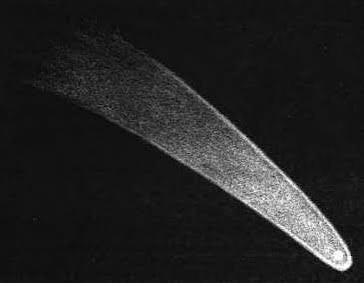
In the autumn of 1811, a brilliant comet stretched across the night sky, its tail curving like a cosmic fan over a world already in turmoil. For nearly nine months from March 1811 to January 1812 it remained visible to the naked eye, a record that still stands. This was no fleeting visitor; it was a celestial spectacle that captured the imagination of millions, from peasants to emperors.
But the Great Comet of 1811 was more than just a pretty sight. It arrived at a pivotal moment in history, when Napoleon was amassing his forces for the invasion of Russia, and the Romantic movement was reshaping European art and thought. Its appearance sparked a cultural and intellectual ferment that influenced everything from poetry to military strategy. This article explores how one comet left an indelible mark on art, literature, and even the course of war.
The Comet’s Splendor: A Cosmic Spectacle
Honoré Flaugergues, a French astronomer, first spotted the comet on March 25, 1811, from his observatory in Viviers. It was a faint smudge, but as weeks passed, it grew brighter and more dramatic. By September 12, when it made its closest approach to the Sun (perihelion), it had become a dazzling object with a magnitude of 0 as bright as the brightest stars. Its tail, composed of dust and gas, stretched an astonishing 25 to 30 degrees across the sky. Under dark rural skies, some observers claimed it reached up to 60 degrees a third of the way across the heavens.
What made this comet so remarkable was not just its brightness, but its longevity. Most bright comets fade within weeks, but this one remained visible for about 260 days. That’s roughly nine months of nightly reminders that humanity was not alone in the cosmos. William Herschel, the renowned British astronomer, measured the comet’s nucleus and estimated it to be about 645 kilometers in diameter a figure that turned out to be an overestimate, but it was clear the nucleus was genuinely large. Johann Elert Bode in Germany and Vincenzo Chiminello in Italy also tracked it meticulously, contributing to a growing body of scientific knowledge about these mysterious wanderers.
The Napoleonic Omen: A Comet of Destiny or Doom?
Napoleon Bonaparte was preparing for his invasion of Russia when the comet appeared. For him, it was a sign of personal destiny. He reportedly told his aides that the comet was a celestial endorsement of his ambitions. Some soldiers in his Grand Army saw it as a harbinger of victory, a cosmic reassurance that their emperor was favored by the heavens.
But not everyone shared that optimism. Across Europe, many saw the comet as a warning. In Russia, where the comet was still visible as Napoleon’s forces marched east in June 1812, peasants and soldiers alike interpreted it as an omen of the invader’s downfall. And indeed, the campaign ended in catastrophic defeat for Napoleon, with the Grand Army decimated by the Russian winter and guerrilla warfare.
Was the “Napoleon comet” interpretation a later invention, or did contemporaries genuinely believe it? The evidence suggests both. Some contemporary letters and diaries show that people actively debated the comet’s meaning. Some saw it as a sign of victory; others as a portent of disaster. When Napoleon fell, the comet was retrospectively cast as a harbinger of his doom—a classic example of hindsight bias. But at the time, it was a blank canvas onto which people projected their hopes and fears.
A Muse in the Sky: Romantic Art and Literature
The comet arrived during the Romantic era, a period that celebrated the sublime and the awe-inspiring power of nature. It was a perfect muse for poets and artists who sought to capture the ineffable.
Tolstoy’s War and Peace
The most famous literary reference comes from Leo Tolstoy’s War and Peace. In the novel, Pierre Bezukhov, a central character, sees the comet in 1812 (Tolstoy slightly compresses the timeline). For Pierre, who has been through a spiritual crisis, the comet is a symbol of hope and renewal. Tolstoy writes:
“This comet was like a flower… that had blossomed in the heavens.”
Pierre interprets the comet as a personal sign of rebirth, a moment of clarity amid the chaos of war. The comet becomes a metaphor for the possibility of change and redemption.
Romantic Poetry and Music
The comet also inspired a wave of poetry across Europe. British poets like Samuel Taylor Coleridge and Lord Byron mentioned it in their correspondence, and numerous odes and sonnets were published in its honor. In the United States, the young nation saw the comet as a sign of progress and manifest destiny. Musical tributes included the “Comet Waltz,” which was performed in dance halls.
Visual Art
Painters and printmakers produced countless images of the comet. Some were crude broadsides sold on the streets, while others were more refined works of art. These images often depicted the comet over city skylines, with crowds pointing upward in wonder. They served as both scientific records and cultural artifacts, capturing the public’s fascination.
Scientific Breakthroughs: Understanding Comets
The 1811 comet also contributed to the advancement of astronomy. At the time, comets were still poorly understood. Many believed they were atmospheric phenomena or supernatural omens. The detailed observations of the 1811 comet helped scientists refine their understanding of:
- Comet tails: The curved, fan-shaped tail was meticulously documented, leading to debates about its composition. Scientists later distinguished between dust tails (which are curved by solar radiation pressure) and ion tails (which are straight and affected by solar wind). The 1811 comet’s prominent dust tail provided valuable data.
- Nucleus size: Herschel’s measurements, despite being an overestimate, were a pioneering attempt to determine the physical size of a comet’s nucleus.
- Orbital mechanics: Improved calculations of the comet’s orbit, estimated at 3,000 to 3,400 years, helped astronomers understand long-period comets. This comet will not return until around the 5th millennium CE.
This period was also a golden age of discovery. Uranus had been found in 1781, and the first asteroids—Ceres, Pallas, Juno, and Vesta—were discovered between 1801 and 1807. The 1811 comet was part of a broader revolution in humanity’s understanding of the solar system.
A Shared Human Experience
What made the Great Comet of 1811 truly great was its universality. It was seen by people across Europe, Asia, and the Americas. In an era before artificial light pollution, the night sky was a constant companion. For months, everyone who looked up saw the same celestial visitor. It was a shared experience that transcended borders, languages, and cultures.
In America, observers saw it as a sign of national destiny. In Europe, it was a subject of both scientific study and superstitious dread. In Russia, it became intertwined with the fate of Napoleon’s invasion. The comet was a mirror, reflecting the hopes and fears of a world in transition.
Today, we know that comets are icy remnants from the solar system’s formation, but in 1811, they were mysteries that inspired awe and wonder. The Great Comet of 1811 reminds us that our place in the cosmos is both humbling and inspiring. It was a reminder that, even in the midst of human conflict, there are moments of beauty and unity.
The Great Comet of 1811 was more than just a celestial event; it was a cultural phenomenon that left its mark on history. From Napoleon’s war room to Tolstoy’s pages, it shaped how people thought about destiny, nature, and their place in the universe. As it fades into the distant past, its legacy endures, a reminder that the sky above us has always been a canvas for our deepest emotions and grandest ideas.
Summary
- The Great Comet of 1811 (C/1811 F1) was visible to the naked eye for 260 days, one of the longest such periods in history.
- Its appearance coincided with Napoleon’s invasion of Russia, leading many to interpret it as an omen of his destiny or downfall.
- The comet inspired art and literature, including a famous scene in Tolstoy’s War and Peace.
- It contributed to astronomical knowledge about comet tails, nuclei, and orbital mechanics.
- The comet was a global phenomenon, observed and interpreted across Europe, America, and Russia.
FAQ
Q: How long was the Great Comet of 1811 visible?
A: It was visible to the naked eye for approximately 260 days, from March 1811 to January 1812, making it one of the longest-visible comets in recorded history.
Q: What was the comet’s official name?
A: It is officially designated C/1811 F1, also known as Comet Flaugergues after its discoverer Honoré Flaugergues.
Q: How did Napoleon interpret the comet?
A: Napoleon reportedly saw the comet as a personal omen of triumph, telling his aides it was a sign of his destiny. After his defeat, it was retrospectively seen as a harbinger of his downfall.
Q: What literary work features the Great Comet?
A: Leo Tolstoy’s War and Peace includes a scene where the character Pierre Bezukhov sees the comet and interprets it as a symbol of spiritual rebirth.
Q: Will the comet return?
A: Yes, but not for a very long time. Its orbital period is estimated at 3,000–3,400 years, so it will not return until around the 5th millennium CE.