
Tag: Roman Empire

  • The Imperial Internet: How Rome’s Relay Riders Kept an Empire Connected

    The Imperial Internet: How Rome’s Relay Riders Kept an Empire Connected

    When Emperor Nero died in 68 CE, the news rippled outward from Rome like a stone dropped in a pond. Within weeks, provincial governors from Britain to Syria knew that the Julio-Claudian dynasty had ended and that a chaotic year of civil war was beginning. That speed — remarkable for a world without electricity, steam, or even a reliable postal stamp — was no accident. It was the product of a sophisticated state messaging system called the cursus publicus, built by Augustus and refined over centuries.

    This network of relay stations, fresh horses, and hardened couriers could move a dispatch at up to 150 miles per day. To put that in perspective, a message from Rome to the Rhine frontier — about 1,000 miles — arrived in roughly a week. That’s faster than a letter sent by Pony Express in the American West, which took about 10 days to cover a similar distance in the 1860s. The Romans didn’t invent the relay system — the Persians had it centuries earlier — but they perfected it, scaled it, and wired it into the very fabric of imperial control.

    The Real Cost of Communication

    The cursus publicus didn’t come cheap. Maintaining stations, feeding horses, and providing lodging for couriers was a heavy burden, and it fell on local communities. Officials could abuse the system, using their permits for personal errands or demanding more than the stations could provide. The historian Ammianus Marcellinus complained about such corruption in the 4th century, and emperors repeatedly issued edicts trying to curb it.

    Despite these problems, the system endured for over 400 years. It was one of the few institutions that survived the empire’s political upheavals, and it was still functioning when the Western Roman Empire collapsed in the 5th century. The cursus publicus was so effective that it became a model for later civilizations — the Persian relay system that inspired Herodotus’s famous praise (“Neither snow, nor rain, nor heat, nor gloom of night stays these couriers”) was similar, but Rome’s version was more extensive and more deeply integrated into state operations.

    In the end, the Roman messaging system wasn’t just a logistical achievement. It was a form of imperial glue. It allowed emperors to project authority, respond to crises, and maintain the fiction of a single, unified rule over a vast and diverse empire. And it did so with nothing more than horses, roads, and human endurance.

    The next time you send a text message that arrives in seconds, consider what it took to send a similar message 2,000 years ago. The Romans built a network of relay stations, paved roads, and disciplined couriers that could move a dispatch across an empire at 150 miles per day. It was expensive, it was exclusive, and it was prone to abuse — but it was also one of the most impressive administrative achievements of the ancient world. The cursus publicus was the imperial internet, and it kept Rome connected for centuries.

    Summary

    • The cursus publicus was a state-run relay system established by Augustus, with stations every 6–10 miles for changing horses and larger way stations every 20–30 miles for lodging.
    • Couriers could travel 100–150 miles per day on urgent missions, allowing a message from Rome to the Rhine (1,000 miles) to arrive in 7–10 days.
    • The system was reserved for official use and required a permit (diploma); private citizens used slaves, friends, or hired messengers.
    • Signal fires and flags provided fast, simple military alerts, but written dispatches were needed for complex communication.
    • The system was a tool of imperial control but also a burden on local communities, with frequent complaints about corruption and abuse.

    FAQ

    Q: How fast could Roman messengers travel?
    A: On an urgent mission with fresh horses at every relay station, couriers could cover 100–150 miles per day. A routine message from Rome to the Rhine frontier (about 1,000 miles) took 7–10 days, and to Egypt about 3–4 weeks.

    Q: Who was allowed to use the cursus publicus?
    A: Only official government business. Couriers needed a special permit called a diploma, issued by the emperor or his representatives. Private citizens had to use other means like friends, slaves, or hired messengers.

    Q: Did the Romans use any communication faster than couriers?
    A: For short-range military alerts, they used signal fires (beacons) and flags, which could transmit simple pre-arranged messages like “enemy sighted” almost instantly across a chain of watchtowers. But these couldn’t convey complex information.

    Q: How did the Roman system compare to the Persian relay?
    A: The Persians had a similar relay system centuries earlier, which Herodotus praised. Rome’s version was larger, more centralized, and more integrated into imperial administration, with a denser network of roads and stations.

    Q: Why did the cursus publicus matter for the empire?
    A: It enabled emperors to command distant armies, manage provincial governors, collect taxes, and project authority. Without it, the empire would have been nearly impossible to govern as a single unit.
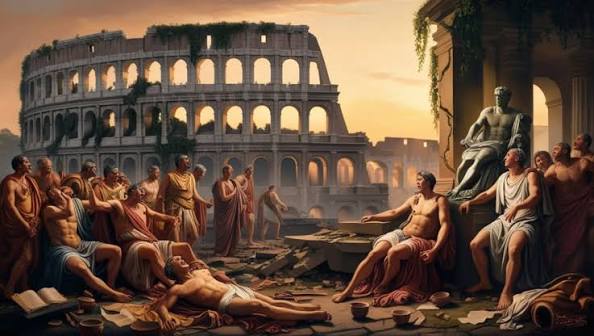
  • What Rome’s Rise and Fall Teaches Modern Superpowers

    What Rome’s Rise and Fall Teaches Modern Superpowers

    The Roman Empire’s trajectory—from a small city-state to the ancient world’s superpower, then to a fragmented relic—has fascinated historians and leaders for centuries. Its story is often invoked as a cautionary tale for modern nations, especially the United States. But is the comparison valid? This article explores the factors behind Rome’s rise and fall, and what—if anything—today’s superpowers can learn from its example.

    The Rise: What Made Rome Exceptional

    Rome’s ascent was not inevitable. It began as a modest settlement on the Italian peninsula, but a combination of geography, institutions, and strategy propelled it to dominate the Mediterranean.

    Geographic advantage played a crucial role. Italy’s central location in the Mediterranean, fertile lands, and natural barriers like the Alps and seas provided a secure base. But geography alone doesn’t explain empire. Rome’s institutional innovation—the Republic’s mixed constitution, balancing monarchical (consuls), aristocratic (Senate), and democratic (assemblies) elements—created a stable and adaptable governance system that Polybius praised.

    Military adaptability was another key. The legion system, professionalization, and a willingness to integrate conquered peoples into the military turned former enemies into loyal soldiers. Rome’s citizenship strategy—gradually extending legal rights to allies and conquered peoples—fostered loyalty and integration, unlike many empires that maintained rigid distinctions.

    Infrastructure—roads, aqueducts, ports—enabled rapid troop movement and economic integration. At its peak under Trajan (c. 117 CE), Rome controlled ~5 million square kilometers and 60–70 million people, roughly 20–25% of the world’s population. Its army numbered 300,000–400,000, and its road network spanned 400,000 km, with the denarius as the ancient world’s reserve currency.

    The Fall: A Complex Interplay of Factors

    The traditional narrative of Rome’s fall—moral decay, barbarian invasions, and overexpansion—has been refined by modern scholarship. No single cause explains the collapse; instead, a web of interconnected factors emerged over centuries.

    Economic strain was significant. Rome relied heavily on slave labor, which stifled technological innovation and created a fragile economic base. Currency debasement led to inflation, heavy taxation shrank the tax base, and the cost of maintaining a vast empire strained the treasury.

    Political instability reached a crisis in the third century CE, when 26 emperors ruled in 50 years, most dying by assassination or in battle. This instability weakened central authority and diverted resources to internal power struggles.

    Military overextension was another factor. Rome’s borders stretched over 10,000 km, and defending them with ancient communication and logistics was costly. Increasingly, Rome relied on barbarian mercenaries whose loyalty was questionable.

    Barbarian pressure—driven by Hunnic migrations—pushed Germanic tribes like the Visigoths and Vandals into Roman territory. The sacking of Rome in 410 CE by the Visigoths was a psychological blow, and the deposition of Romulus Augustulus in 476 CE marks the conventional end of the Western Empire.

    Internal decay—corruption, loss of civic virtue, and a widening wealth gap—eroded the social fabric. The division of the empire into East and West by Diocletian in 284 CE left the West economically weaker and more exposed.

    Modern historians add nuance. Climate and disease—the Antonine Plague (165–180 CE), Cyprian Plague (249–262 CE), and the Late Antique Little Ice Age—stressed the empire. The ‘late antiquity’ school argues that Rome transformed rather than collapsed, with cultural and religious continuity. The Eastern Roman (Byzantine) Empire survived until 1453, suggesting the fall was specific to the West.

    Lessons for Modern Superpowers

    Drawing parallels between Rome and the U.S. is common, but such comparisons require caution. Still, several lessons emerge.

    First, overstretch is a real risk. Paul Kennedy’s ‘imperial overstretch’ thesis—military commitments exceeding economic capacity—applies to Rome. The U.S. has allies, technology, and forward bases that reduce costs, but the principle remains: a superpower must balance its global commitments with its economic resources.

    Second, economic health is foundational. Rome’s economic decline—currency debasement, heavy taxation, and reliance on slave labor—undermined its power. Modern superpowers must maintain fiscal responsibility and avoid over-reliance on unsustainable practices.

    Third, political stability matters. Rome’s crisis of the third century shows how internal strife can cripple a state. Polarization and institutional decay are warning signs.

    Fourth, integration and citizenship are strengths. Rome’s extension of citizenship created loyalty. Modern nations that embrace diversity and provide a path to belonging may be more resilient.

    Fifth, adaptability is key. Rome’s military and institutional flexibility aided its rise, but its later rigidity contributed to its fall. Superpowers must innovate and adapt to changing circumstances.

    However, critics argue that direct parallels are selective. The U.S. has nuclear weapons, a globalized economy, and democratic institutions that Rome lacked. The ‘fall’ of Rome was not inevitable, and modern superpowers are not destined to repeat it.

    Conclusion

    Rome’s rise and fall offer a rich tapestry of lessons, but they are not a simple blueprint. The empire’s success stemmed from geography, institutions, and adaptability; its decline resulted from a complex interplay of economic, political, and external pressures. Modern superpowers can learn from Rome’s mistakes—overstretch, economic mismanagement, political instability—but must also recognize the profound differences in their contexts. The Roman story is a reminder that power is fleeting, but it is also a testament to human resilience and transformation.

    The Roman Empire’s story is not a prophecy but a mirror. It reflects the challenges that all great powers face: balancing ambition with resources, unity with diversity, and tradition with change. By studying Rome’s rise and fall, modern superpowers can gain perspective on their own trajectories—not to predict doom, but to make wiser choices.

    Summary

    • Rome’s rise was driven by geography, institutional innovation, military adaptability, and a citizenship strategy that integrated conquered peoples.
    • The fall was not caused by a single factor but by a complex interplay of economic strain, political instability, military overextension, barbarian pressure, and internal decay.
    • Modern scholarship emphasizes climate, disease, and the ‘transformation’ rather than ‘fall’ narrative, noting the Byzantine Empire’s survival.
    • Lessons for modern superpowers include avoiding overstretch, maintaining economic health, ensuring political stability, and embracing integration.
    • Direct parallels are selective; structural differences like nuclear weapons and democratic institutions make Rome’s fate not inevitable.

    FAQ

    Q: What was the main reason for Rome’s fall?
    A: There is no single cause. Modern historians point to a combination of economic strain, political instability, military overextension, barbarian invasions, and internal decay, exacerbated by climate and disease.

    Q: How long did the Roman Empire last?
    A: The Western Empire lasted from 27 BCE to 476 CE, but the Eastern (Byzantine) Empire continued until 1453 CE, making the total span nearly 1,500 years.

    Q: Is the U.S. like Rome?
    A: Some draw parallels in terms of military overstretch and fiscal issues, but critics note structural differences like nuclear weapons, a globalized economy, and democratic institutions that make the comparison imperfect.

    Q: What was the ‘Crisis of the Third Century’?
    A: A period from 235–284 CE when Rome experienced extreme political instability, with 26 emperors in 50 years, economic decline, and external threats, nearly leading to collapse.

    Q: Did Rome really ‘fall’ or transform?
    A: The ‘late antiquity’ school argues that Rome transformed rather than collapsed, with cultural and religious continuity, especially in the East. The Western Empire’s political structure ended, but Roman influence persisted.