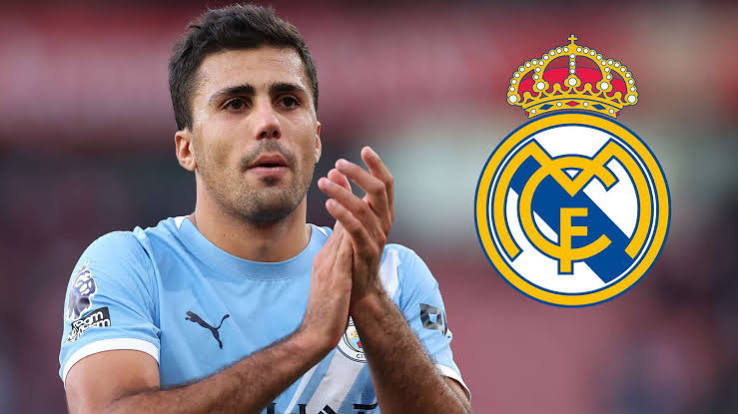
When the reigning Ballon d’Or winner, a defensive midfielder who redefined the position, becomes the subject of a transfer tug-of-war between Europe’s giants, it’s more than a rumor—it’s a seismic event. Rodri’s name has been whispered in the corridors of the Santiago Bernabéu, and Barcelona’s president has publicly swooned, but Manchester City’s stance is as unyielding as a Guardiola press conference. This is the story of a player who holds the keys to three of football’s most powerful institutions, and the intricate dance of ambition, finances, and loyalty that surrounds him.
At 30, with an ACL injury behind him and a contract running until 2027, Rodri stands at a crossroads. Real Madrid sees him as the missing piece to replace the legendary Toni Kroos and the aging Luka Modrić. Barcelona dreams of a homecoming, but their financial reality is a cold shower. Meanwhile, City, the club that made him the world’s best, refuses to even entertain the idea. The stakes are immense: a potential transfer fee exceeding €100 million, the balance of power in La Liga and the Premier League, and the legacy of a player who has already achieved everything.
The Context: A Midfield Maestro’s Journey
Rodri’s rise from Villarreal’s youth academy to the summit of world football is a testament to his unique talent. After a brief but impactful stint at Atlético Madrid, he joined Manchester City in 2019 for a €70 million release clause—a fee that now looks like a bargain. Under Pep Guardiola, he evolved into the quintessential modern defensive midfielder: a metronome who dictates tempo, a shield who snuffs out attacks, and a goal threat from distance. His crowning moment came in 2024 when he won the Ballon d’Or, the first defensive midfielder to do so since Fabio Cannavaro in 2006. He was also the Player of the Tournament in Spain’s Euro 2024 triumph, cementing his status as the best in the world at his position.
But football is a cruel mistress. In September 2024, Rodri suffered an ACL injury that sidelined him for most of the 2024–25 season. His absence exposed City’s fragility—they struggled without their anchor, proving his irreplaceable value. He returned to action in the 2025 Club World Cup, but the question lingers: is he the same player post-injury? And at 30, how many peak years remain?
Real Madrid’s Midfield Puzzle
Real Madrid’s interest in Rodri is not a fleeting whim; it’s a calculated solution to a looming crisis. Toni Kroos retired in 2024, leaving a void in midfield creativity and control. Luka Modrić, at 39, is a living legend but a diminishing asset. The current options—Aurélien Tchouaméni, Eduardo Camavinga, Federico Valverde, and Jude Bellingham—are talented but lack the metronomic consistency Rodri offers. Tchouaméni, in particular, has been inconsistent, and Camavinga is more of a dynamic box-to-box presence than a deep-lying playmaker.
Real Madrid’s transfer policy under Florentino Pérez has been to acquire elite players in their prime or young stars with immense potential. Rodri fits the ‘Galáctico’ mold: a proven world-class talent who could immediately anchor the midfield for the next three to four years. The club has reportedly made him a priority target for 2026, but the financial and practical hurdles are formidable. Would they pay over €100 million for a 30-year-old with a recent ACL injury? It’s a gamble that even the most ambitious clubs might hesitate to take.
Manchester City’s Unshakeable Stance
Manchester City’s position is unequivocal: Rodri is not for sale at any price. He is the tactical cornerstone of Guardiola’s system, the player who makes everything tick. City’s struggles during his injury absence were a stark reminder of his value. The club has no financial need to sell—City Football Group’s resources are vast—and they have historically resisted selling key starters, especially to European rivals. While they’ve sold players like Gabriel Jesus, Raheem Sterling, and Riyad Mahrez, those were not core starters at the time of their departures. Rodri is different; he’s the fulcrum.
City’s counter-move could be a new contract with improved terms, removing any doubt about his future. Rodri’s current deal runs until 2027, and he has repeatedly expressed happiness at City. He has not publicly requested a transfer, and there’s no indication he’s agitating for a move. But in football, loyalty is often a bargaining chip, and the allure of a return to his native Madrid could be potent.
The Player’s Perspective: A Madrid Boy’s Dilemma
Rodri was born in Madrid and reportedly grew up supporting Real Madrid. The prospect of playing for the club he idolized as a child is a powerful emotional draw. At 30, this could be his last major contract, and a move to Real Madrid would offer a new challenge and the chance to play in La Liga, where he hasn’t competed since leaving Atlético in 2019. However, leaving City means leaving a system where he is the undisputed starter, a guaranteed trophy contender, and adored by fans. The grass isn’t always greener, especially when you’re already on the best pitch in the world.
Rodri’s camp is reportedly aware of the interest from both Spanish giants, and some speculate they might use this as leverage in contract negotiations with City. But Rodri himself has been diplomatic, focusing on his recovery and his performances. He’s a professional’s professional, unlikely to rock the boat publicly.
Barcelona’s Interest: Realistic or Rhetorical?
Barcelona’s interest in Rodri is more about aspiration than actuality. President Joan Laporta has expressed admiration, but the club’s financial fair play issues and La Liga’s salary cap restrictions make a transfer nearly impossible. Barcelona’s midfield is already crowded with young talents like Pedri, Gavi, Frenkie de Jong, and Marc Casadó. Adding Rodri would be a luxury they can’t afford, both financially and in terms of squad balance.
Some reports suggest Barcelona’s interest is being used by Rodri’s camp as leverage in negotiations with City—a classic football tactic. Laporta has a history of making public overtures to marquee players that never materialize, often for political reasons or to appease the fanbase. In this case, it’s likely more rhetoric than reality.
The Injury Factor: A Wildcard
Rodri’s ACL injury is the elephant in the room. At 30, a major knee injury can be career-altering. While he’s returned to training and made a comeback appearance, the question of whether he can regain his pre-injury form remains. Real Madrid, known for their meticulous medical assessments, would be taking a significant risk. City, on the other hand, have the advantage of knowing his recovery process firsthand and might be more confident in his long-term fitness.
The injury also affects his transfer value. A club would be paying a premium for a player who might not be the same force he was. This could be a bargaining chip for City—they can argue that any offer should reflect the risk, or they can simply refuse to sell, citing his importance regardless of injury.
The Broader Implications
This transfer saga is more than just a player moving between clubs; it’s a reflection of modern football’s power dynamics. Real Madrid’s pursuit of Rodri signals their intent to maintain dominance in Europe, while City’s refusal underscores their financial muscle and ambition. Barcelona’s interest, however unrealistic, highlights the gap between their historical prestige and current financial reality.
For Rodri, the decision is about legacy, loyalty, and the next chapter of his career. He’s already won everything at City—Premier League titles, a Champions League, a Ballon d’Or. A move to Real Madrid could be the ultimate validation, but it comes with risks. At 30, he might have only a few peak years left, and he must choose the environment that best suits his style and ambitions.
As the 2026 transfer window approaches, the speculation will only intensify. But one thing is certain: Rodri’s future will be one of the most closely watched stories in football, with implications that extend far beyond the pitch.
Rodri’s potential move to Real Madrid is a story of ambition, loyalty, and the unyielding nature of modern football’s elite. While City’s stance is firm and Barcelona’s interest is fleeting, the saga is far from over. For Rodri, the choice is personal and professional—a decision that will shape his legacy and the balance of power in European football for years to come. Whether he stays in Manchester or returns to Madrid, his impact on the game is already indelible.
Summary
- Real Madrid sees Rodri as the ideal replacement for Kroos and Modrić, but his age and injury history make a €100M+ transfer risky.
- Manchester City considers Rodri unsellable, viewing him as the tactical anchor of Guardiola’s system and vital to their success.
- Rodri, a Madrid native, faces a personal dilemma between loyalty to City and the allure of a return to his childhood club.
- Barcelona’s interest is largely rhetorical, given their financial constraints and crowded midfield.
- The ACL injury adds uncertainty, affecting both his transfer value and long-term performance potential.
FAQ
Q: Is Rodri actually leaving Manchester City?
A: As of now, no. Manchester City has stated he is not for sale, and Rodri has not requested a transfer. The links to Real Madrid are speculative, though they persist due to his profile and Real’s need.
Q: How much would Rodri cost?
A: Reports suggest a fee in excess of €100 million, but City’s refusal to sell makes any valuation moot. His contract runs until 2027, giving City significant leverage.
Q: Why is Real Madrid interested in Rodri?
A: Real Madrid needs a world-class defensive midfielder to replace Toni Kroos and eventually Luka Modrić. Rodri is the best in the world at that position, making him an ideal target.
Q: Can Barcelona afford Rodri?
A: No. Barcelona’s financial fair play issues and La Liga salary cap restrictions make a transfer nearly impossible. Their interest is likely aspirational or political.
Q: How has Rodri’s injury affected his transfer prospects?
A: The ACL injury adds risk, potentially lowering his transfer value and making clubs hesitant. However, his return to form could mitigate those concerns.