Tag: robotics

  • Why Robotics Is So Hard: 14 Challenges That Make It Different From Software

    Why Robotics Is So Hard: 14 Challenges That Make It Different From Software

    Robotics is often compared to software development, but that comparison misses a crucial point: software runs in a controlled digital world, while robots operate in the messy, unpredictable physical world. This difference creates a set of unique challenges that make robotics fundamentally harder than writing an app or a website.

    In this article, we’ll break down 14 specific reasons why robotics is so difficult, from the embodiment problem to the long-tail of edge cases. Whether you’re a software engineer curious about the field or a robotics enthusiast looking for a clear overview, this guide will give you a concrete understanding of what makes robots so tricky to build and deploy.

    The Embodiment Problem: You Can’t Ctrl+Z the Real World

    When you write software, you can run it, test it, and fix bugs in milliseconds. If something goes wrong, you can hit ‘undo.’ Robots don’t have that luxury. They exist in physical space, subject to friction, inertia, and material deformation. You can’t perfectly model every physical interaction, and even if you could, the model would be too complex to compute in real time.

    Consider a simple task: grasping a cup. The cup’s shape, weight, and surface friction affect how your robot’s gripper should approach it. But the cup might be slightly different from what your sensor data shows, or the gripper might slip. These are not abstract problems—they’re physical ones that can’t be solved by writing more code alone.

    Sensor Noise: The World Is a Messy Place

    Robots rely on sensors like cameras, LiDAR, and inertial measurement units (IMUs). These sensors give noisy, incomplete, or even conflicting data. A camera might be blinded by sunlight, LiDAR might miss a transparent object, and an IMU might drift over time. Perception is never ‘clean’ in the real world.

    Software engineers often assume that you can just ‘read’ the environment, but in robotics, every piece of sensor data is uncertain. This uncertainty is a core problem in robotics, requiring sophisticated algorithms to filter and fuse data from multiple sources just to get a rough idea of what’s happening.

    The Moravec Paradox: Easy for Humans, Hard for Robots

    Hans Moravec observed that tasks that are easy for humans—like walking, grasping, or recognizing a face—are computationally hard for robots, while tasks that are hard for humans, like chess or calculus, are relatively easy for computers. This paradox highlights that our intuition about what’s ‘difficult’ is often wrong when it comes to robotics.

    Walking seems effortless, but it involves constant balance adjustments, coordination of dozens of muscles, and real-time feedback. Robots struggle with this because they lack the millions of years of evolution that perfected human locomotion. This paradox is why we have robots that can play chess but still can’t fold laundry.

    Actuation Limitations: Motors Can’t Do Everything

    Even if a robot knows exactly what to do, it still needs to physically do it. Motors and actuators have finite torque, speed, and precision. They wear out, break, and respond with delays. A motor might not be powerful enough to lift a heavy object, or it might be too imprecise to perform delicate surgery.

    These limitations are not just engineering inconveniences—they fundamentally constrain what tasks a robot can perform. You can’t code around a motor that can’t move fast enough. You have to design the hardware to match the task, and that’s a whole other engineering discipline.

    Real-Time Constraints: No Pause Button in the Physical World

    In software, you can take as long as you need to compute a solution. In robotics, decisions must be made in milliseconds. A self-driving car has to react to a pedestrian in a fraction of a second; a factory robot must adjust its grip before an object slips. There’s no ‘pause’ button in the physical world.

    This real-time constraint means that robots can’t use slow but accurate algorithms. They have to use fast approximations that might be less reliable. This trade-off between speed and accuracy is a constant battle in robotics.

    The Sim-to-Real Gap: Simulations Lie

    To train robots, researchers often use simulations because they’re cheaper and safer than real-world testing. But simulations never perfectly capture reality. There are always differences in physics, lighting, and material properties. This is known as the ‘sim-to-real gap,’ and it’s a major hurdle.

    A robot trained in simulation might learn to walk on a flat surface, but when deployed in the real world, it might fail on a slightly uneven floor. The gap means that even the best simulations can’t fully prepare a robot for the real world.

    Non-Stationary Environments: The World Is Always Changing

    Even if a robot perfectly models its environment at one moment, that model becomes outdated quickly. Lighting changes as the sun moves, people walk into the room, objects get shifted. The world is non-stationary, meaning it’s always in flux.

    Robots must constantly update their models of the world, but they can only sense a limited area and with limited accuracy. This means they always have an outdated or incomplete view of their surroundings. It’s like trying to navigate a city with a map that’s always one street behind.

    Safety and Robustness: Bugs Can Injure People

    A bug in a web app is an inconvenience; a bug in a robot can injure a person or destroy property. This makes safety a critical concern in robotics. Robots must be designed to fail gracefully, with multiple layers of safety checks. You can’t just ship a robot and hope it works—you have to prove it won’t hurt anyone.

    This requirement adds a huge overhead to development. Every feature has to be tested extensively, and even then, you can’t guarantee safety in all possible situations. The stakes are much higher than in software.

    The Long-Tail Problem: Infinite Edge Cases

    No matter how many scenarios you test, there will always be more edge cases. The real world is infinitely varied, and you can’t enumerate every possible situation. This is the ‘long-tail’ problem. A robot might handle 99% of cases perfectly, but the remaining 1% can be unpredictable and dangerous.

    For example, a robot vacuum might navigate around a chair, but what if the chair has a leg covered in a rope? What if the lighting is weird? What if there’s a puddle of water? These edge cases are impossible to fully anticipate, making robotic systems inherently fragile.

    Mechanical Complexity: Building the Body Is Half the Battle

    A robot’s physical body is as important as its brain. Building a robotic hand that can manipulate objects, for example, is a major engineering challenge. It requires precision actuators, flexible joints, and tactile sensors—all in a small, lightweight package.

    This mechanical complexity means that robotics is not just a software problem. It requires expertise in mechanical engineering, materials science, and electrical engineering. Each discipline adds its own set of challenges and constraints.

    Power and Thermal Constraints: Batteries Limit Everything

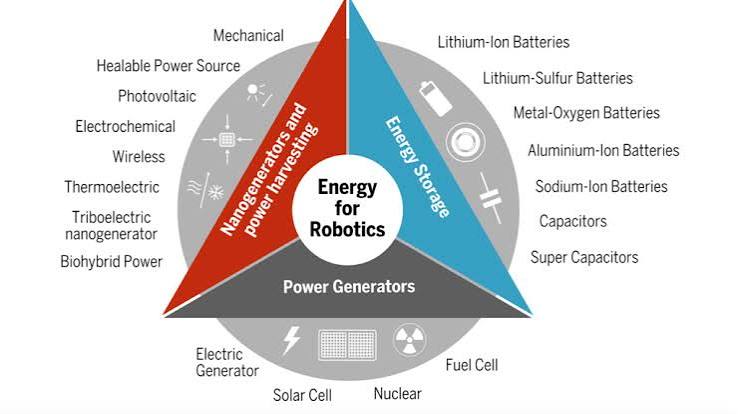
    Robots need power to move, sense, and compute. Batteries are heavy and have limited capacity, and motors and processors generate heat that must be dissipated. These power and thermal constraints limit how long a robot can operate and how much it can do.

    A robot might have a great algorithm, but if it requires too much power, it can’t run for long. Thermal issues can cause components to fail. These physical limitations are often overlooked by software-focused engineers.

    Cost of Iteration: Every Test Costs Money and Time

    In software, you can iterate millions of times for free. In robotics, every physical experiment costs time, money, and materials. If a robot breaks, you have to repair it. If a test fails, you have to set up again. This makes iteration slow and expensive.

    This cost of iteration means that roboticists can’t afford to try as many approaches as software developers. They have to be more careful and rely on simulations, which have their own limitations.

    Integration Complexity: Everything Must Work Together

    A robot is a system of systems: perception, planning, control, and hardware. Each component can work independently, but they must all work together in real time. A failure in any one subsystem can break the whole robot.

    Integration is a huge challenge because components are often developed by different teams or even different companies. They need to communicate flawlessly, handle errors, and coordinate complex actions. This is much harder than integrating software modules, because physical components have their own quirks and failures.

    Testing and Verification: Proving Safety Is Hard

    How do you prove that a robot will behave safely in all possible situations? This is a fundamental challenge in robotics. You can’t test every scenario, so you need formal methods, simulations, and rigorous analysis. But even then, you can’t guarantee absolute safety.

    This lack of verifiability makes it difficult to deploy robots in critical applications like healthcare or autonomous driving. Regulators and the public demand high levels of safety, but achieving that is an open research problem.

    The Bottom Line: Robotics Is a Full-Stack Problem

    Robotics is hard because it requires solving problems across multiple disciplines simultaneously. It’s not just about writing clever code; it’s about building a physical system that can interact with an unpredictable world. This complexity is why many impressive demos don’t translate to commercial success.

    But the challenges are also what make robotics exciting. Every breakthrough—whether in perception, control, or hardware—pushes the boundaries of what machines can do. Understanding these 14 challenges helps set realistic expectations and appreciate the hard work that roboticists do every day.

    Robotics is not just ‘hard software’—it’s a fundamentally different kind of challenge that blends hardware, physics, and real-time decision-making under uncertainty. The 14 reasons above show why robots still struggle with tasks humans find trivial. Yet, these challenges also drive innovation. As we continue to advance in AI, materials, and control theory, some of these hurdles will fall, but new ones will emerge. For now, the difficulty is what makes robotics a fascinating field: it’s a constant test of human ingenuity against the stubbornness of the physical world.

    Summary

    • Robotics is hard because robots must operate in the physical world, which is messy and unpredictable.
    • Key challenges include sensor noise, the Moravec paradox, and real-time constraints.
    • The sim-to-real gap means that training in simulation often doesn’t transfer to the real world.
    • Safety and verification are major concerns, as failures can cause physical harm.
    • The long-tail problem means robots will always encounter unexpected edge cases.

    FAQ

    Q: Why is walking so hard for robots if it’s easy for humans?
    A: This is the Moravec paradox. Tasks like walking require constant real-time adjustments and coordination of many muscles, which is computationally complex. Humans have evolved over millions of years to do this effortlessly, but robots lack that biological hardware.

    Q: Can’t we just use better simulations to train robots?
    A: Simulations are helpful but never perfect. The sim-to-real gap means that differences in physics, lighting, and materials cause robots to fail in the real world even if they succeed in simulation. Closing this gap is an active area of research.

    Q: Why can’t robots just use more sensors to get better data?
    A: More sensors can help, but they also add noise and complexity. Fusing data from many sensors is itself a hard problem, and even the best sensors have limitations. There’s no way to get perfect information about the world.

    Q: Is robotics harder than software engineering?
    A: Yes, in many ways. Robotics requires solving software problems plus hardware constraints, real-time demands, and physical uncertainty. A bug in software is an inconvenience; a bug in a robot can be dangerous.

    Q: Why aren’t robots more common in everyday life?
    A: The challenges listed in this article, like the long-tail problem and integration complexity, make it hard to build reliable, safe robots for unstructured environments. Most robots today work in controlled settings like factories, where the environment is predictable.
  • Embodied AI: When Intelligence Gets a Body

    Embodied AI: When Intelligence Gets a Body

    You’ve probably chatted with an AI like ChatGPT. It’s smart, but it lives in a server, with no arms to pick up a cup or legs to walk across a room. Embodied AI changes that. It’s artificial intelligence that isn’t just thinking it’s sensing, moving, and acting in the physical world. Think of a warehouse robot that grabs boxes, a humanoid that helps with chores, or a self-driving car navigating traffic. This is the frontier where AI meets reality.

    This article unpacks what embodied AI is, why it’s booming now, and what’s real versus hype. We’ll look at the key players, the tech breakthroughs, and the hard problems that remain. Whether you’re a tech enthusiast or just curious about the robot future, here’s a clear guide to the machines that are learning to live in our world.

    What Makes AI ‘Embodied’?

    Most AI you’ve encountered like voice assistants or chatbots is disembodied. It processes text and images but has no physical presence. Embodied AI, on the other hand, is anchored in a body. That body has sensors (cameras, microphones, touch sensors) and actuators (motors, joints) that let it move and interact with the world.

    But embodiment isn’t just about having a robot shell. The deep idea is that the AI’s intelligence is grounded in physical experience. A robot learns object permanence by touching objects and seeing them disappear behind others. It learns balance by falling, just like a toddler. This grounding makes its reasoning about the world more robust. For example, a robot that has physically manipulated a cup understands its weight and fragility in ways a text-only AI never could.

    There are several subfields, each tackling a different challenge:

    • Manipulation: Getting robots to grasp, assemble, and use tools. This is crucial for warehouses and factories.
    • Locomotion: Teaching robots to walk, run, fly, or swim. Quadrupeds (like Spot) and humanoids are the showpieces here.
    • Navigation & SLAM: Helping robots map unknown environments and know where they are within them. This is what lets a robot vacuum clean a room without getting lost.
    • Human-Robot Interaction (HRI): Making robots socially aware understanding gestures, following gaze, and responding to speech. This is key for robots that work alongside people.

    The Journey from Stiff Machines to Learning Robots

    Robotics isn’t new. But today’s embodied AI is a world away from the clunky machines of the past.

    The Rule-Based Era (1960s–1980s): Early robots like Shakey followed strict ‘sense-plan-act’ rules. They’d sense the world, build a plan, then act slowly and rigidly. Any unexpected change threw them off.

    The Reactive Turn (1990s–2000s): Rodney Brooks and others flipped the script. Instead of central planning, they built robots with simple reactive behaviors. Each behavior responded directly to sensors, creating complex actions without a big brain. This approach powered the Mars rovers Sojourner, Spirit, and Opportunity, which navigated the Martian surface with limited computing power.

    The Deep Learning Revolution (2010s): Deep neural networks transformed perception. Robots could finally recognize objects, people, and places with stunning accuracy. Reinforcement learning let them learn control policies through trial and error. But the DARPA Robotics Challenge in 2015 showed a gap: robots could see well but still struggled to act robustly in the real world.

    The Foundation Model Era (2020s): Large language models (LLMs) like GPT-4 and Google’s PaLM-E became the ‘brains’ of robots. Now you can give a robot a natural language command like ‘pick up the red mug’ and it can parse that, plan a sequence of actions, and execute them. In 2024, Figure 01, a humanoid powered by OpenAI, demonstrated conversational interaction—you could talk to it, and it would respond and perform tasks. That was a taste of the ‘ChatGPT moment’ for robotics, though we’re not fully there yet.

    Why Now? The Perfect Storm of Tech and Need

    Embodied AI has been brewing for decades. So why is it exploding now?

    Compute: Modern GPUs and TPUs can run complex neural networks in real time. A robot can process camera feeds, make decisions, and control motors within milliseconds.

    Data: Massive datasets like Open X-Embodiment and Google’s RT-1/RT-2 allow robots to learn from each other’s experiences. Instead of starting from scratch, a new robot can build on the collective knowledge of thousands of robots.

    Cheaper Hardware: Sensors like LiDAR and depth cameras have plummeted in price. Electric actuators are now powerful, precise, and affordable, replacing bulky hydraulic systems. Boston Dynamics’ Atlas, for example, switched to electric actuation, making it cleaner and quieter.

    Economic Pressure: Countries like Japan, Germany, and China face aging populations and labor shortages. Automating tasks isn’t just convenient—it’s necessary. The global industrial robotics market is already over $50 billion and growing at about 10% annually. Humanoid robots alone could reach a market of $13.8 billion by 2030, according to Goldman Sachs. Venture capital is pouring in—over $1 billion into humanoid startups between 2023 and 2024.

    The Stars of Embodied AI: From Factories to Living Rooms

    Let’s meet the major players across different sectors.

    Industrial Robots: The classic arms from ABB, KUKA, and FANUC have been building cars and electronics for decades. They’re fast, precise, and tireless. But they’re also fixed in one spot, so they’re being joined by newer, more mobile robots.

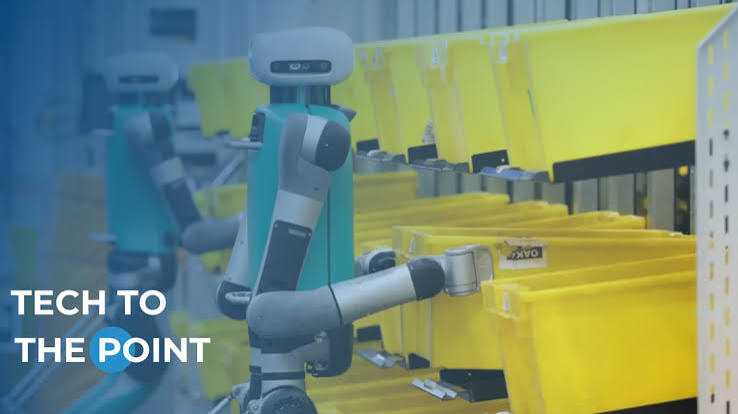
    Logistics Robots: Amazon Robotics (formerly Kiva) uses thousands of wheeled robots to move shelves around its warehouses. Companies like GreyOrange and Locus Robotics make autonomous mobile robots that work alongside humans to pick and pack orders. These are among the most successful commercial embodiments of AI.

    Humanoids: This is the flashy end. Figure AI, Tesla’s Optimus, and Boston Dynamics’ Atlas are all vying to become the general-purpose humanoid helper. In 2025, Tesla showed Optimus performing factory tasks like sorting battery cells. Boston Dynamics unveiled an all-electric Atlas that can do backflips and lift heavy objects. But these machines are still in the prototype stage, and their dexterity is limited compared to a human’s.

    Service Robots: The Roomba is the most famous domestic robot—it’s essentially a low-level embodied AI that navigates and cleans. Samsung’s Ballie and Amazon’s Astro are trying to become household companions or assistants, though they’re still more gimmick than essential.

    The Hard Problems That Remain

    Despite the progress, embodied AI has a long way to go. The skeptics have a point.

    Bipedal Locomotion: Walking on two legs is incredibly inefficient. Wheels are cheaper and more reliable. For most tasks, a wheeled robot makes more sense. Humanoids are cool, but they may be solving a problem that doesn’t exist.

    Dexterity: The ‘last mile’ of manipulation is brutal. Folding laundry, handling cables, or using tools requires a level of fine motor control that robots still lack. A robot can assemble a car door, but it struggles to tie a shoelace.

    Sim-to-Real Transfer: Training robots in simulation (like NVIDIA Isaac Sim) is efficient, but moving those skills to the real world often fails. The real world is messy—lighting changes, objects are unpredictable, and physics is unforgiving.

    Safety and Liability: If a robot harms a person, who’s responsible? The owner, the manufacturer, or the AI’s programmer? The EU AI Act classifies robots as ‘high-risk’ systems, but the US has no federal robotics law, leaving a patchwork of state rules.

    Bias and Ethics: Robots can inherit the biases of their training data. In caregiving or policing, that’s dangerous. And there’s the broader question of wealth concentration—who owns the robots that replace workers? The benefits might accrue to a few, while the job losses hit many.

    The Road Ahead

    Embodied AI is at an inflection point. The technology is advancing fast, but it’s not yet reliable or affordable enough for mass adoption. The next few years will be critical.

    We’ll likely see more specialized robots in warehouses and factories, where environments are controlled and tasks are repetitive. Humanoids will gradually move from labs to niche roles, like performing dangerous jobs in bomb disposal or disaster response. And as the hardware gets cheaper and the AI gets smarter, we may finally see robots in our homes—folders of laundry, washers of dishes, and companions for the elderly.

    But don’t expect a robot butler anytime soon. The journey from ‘impressive demo’ to ‘everyday helper’ is long, and the remaining challenges are as much about software as they are about mechanical engineering. Still, the progress is undeniable. Embodied AI is learning to live in our world, one sensor and actuator at a time.

    Embodied AI is where the rubber meets the road—literally. It’s the field that takes AI out of the cloud and drops it into our messy, physical world. The progress is real, from warehouse robots that boost efficiency to humanoids that can converse and perform tasks. But the hype often outpaces reality. Dexterity, safety, and cost remain significant hurdles. As the technology matures, we’ll see a shift from flashy demos to practical applications that solve real problems. The robots are coming—but they’ll arrive task by task, not all at once.

    Summary

    • Embodied AI is AI that interacts with the physical world through a body, grounding its intelligence in real-world experience.
    • Key subfields include manipulation, locomotion, navigation, and human-robot interaction.
    • The field has evolved from rule-based systems to deep learning and now to foundation models that enable natural language control.
    • Major players include industrial giants (ABB, KUKA), logistics robots (Amazon Robotics), and humanoid startups (Figure, Tesla Optimus, Boston Dynamics).
    • Hard problems remain: bipedal locomotion, dexterity, sim-to-real transfer, safety, and ethics.

    FAQ

    Q: What is the difference between embodied AI and regular AI?
    A: Regular AI (like ChatGPT) processes information but has no physical presence. Embodied AI is embedded in a robot body, allowing it to sense, move, and act in the real world. Its intelligence is grounded in physical experience, like learning to grasp objects by actually holding them.

    Q: Why are humanoid robots so popular if they’re inefficient?
    A: Humanoids are popular because they can theoretically operate in environments designed for humans—our homes, offices, and factories. They’re a bet that a general-purpose robot that looks like us can adapt to our world. But bipedal locomotion is indeed inefficient, and many argue that specialized wheeled robots are more practical for most tasks.

    Q: What are the main challenges in embodied AI?
    A: The biggest challenges are dexterity (fine motor skills like folding laundry), robust locomotion (especially on two legs), and transferring skills learned in simulation to the real world. Safety and liability are also unresolved issues.

    Q: Will embodied AI take away jobs?
    A: It will change jobs. Some tasks will be automated, especially repetitive ones in warehouses and factories. But new jobs will emerge in robot maintenance, fleet management, and AI training. The bigger concern is wealth concentration—who owns the robots and profits from them.

    Q: When will we have robot helpers in our homes?
    A: You already have simple ones like robot vacuums. More capable helpers—like humanoids that do chores—are still years away. The technology is advancing, but it needs to become cheaper, more reliable, and safer before it’s practical for everyday homes.

  • World Models: Teaching AI to Dream Before It Acts

    World Models: Teaching AI to Dream Before It Acts

    World Models 101: Teaching AI to Imagine Before It Acts | by Parvez Mohammed @ Techlatest.net | Aug, 2026 | Medium

    Consider a chess player who mentally rehearses a sequence of moves before touching a piece, or a driver who visualizes a turn before entering it. Humans and animals constantly simulate possible futures in their heads, a skill that lets us plan and avoid costly mistakes. For decades, AI systems have lacked this ability, relying instead on trial-and-error in the real world. But a new class of models, aptly called ‘world models,’ is changing that. These systems build an internal simulation of their environment, allowing them to predict outcomes and plan actions without physical interaction. This article unpacks what world models are, how they work, and why they’re a cornerstone for advanced robotics and AI.

    What Exactly Is a World Model?

    A world model is an AI system’s internal representation of its environment. It’s not a static map but a dynamic, predictive model that learns how the world changes over time. When you show a world model a series of frames from a video, it learns the underlying rules: objects persist, gravity pulls things down, and actions have consequences. This knowledge lets the model simulate what might happen next, even for scenarios it has never seen.

    Think of it as the difference between a student who memorizes answers and one who understands the subject. A standard AI might learn to recognize a cat from millions of labeled images that’s input-output mapping. A world model, however, learns how a cat moves, how it reacts to a thrown ball, and what happens when it walks behind a sofa. It builds a predictive understanding, not just a pattern-matching one.

    This predictive power is what sets world models apart. They don’t just say, ‘This is a cat.’ They say, ‘If I toss this toy, the cat will likely pounce.’ That ability to forecast is the foundation of planning and reasoning.

    A Brief History: From Mental Models to Neural Networks

    The idea of mental models isn’t new. In 1943, psychologist Kenneth Craik proposed that humans carry small-scale models of reality in their heads, allowing us to try out alternatives before acting. Philip Johnson-Laird later expanded this in the 1980s. In AI, the concept of model-based reinforcement learning (MBRL) has existed for decades, where an agent learns a model of its environment to guide decisions. But early attempts were fragile, often breaking in anything but the simplest settings.

    A breakthrough came in 2018 when David Ha and Jürgen Schmidhuber published a paper simply titled ‘World Models.’ They trained a small neural network to play a car-racing game, but with a twist. The network didn’t just learn to map pixels to steering angles. It built a compressed, latent representation of the track and learned to predict future states based on its actions. This allowed the agent to ‘imagine’ the track ahead and plan its path, even in areas it hadn’t seen. The paper was a revelation, showing that a compact model could learn to simulate a visually rich environment with surprising accuracy.

    How Do World Models Work? Three Key Components

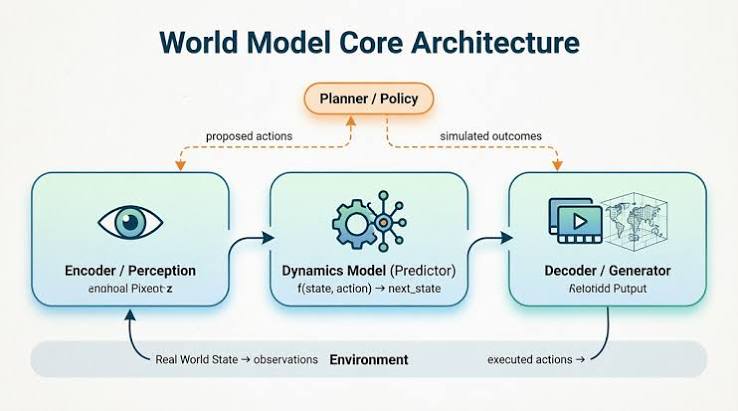
    Most world models follow a blueprint set by Ha and Schmidhuber. They consist of three parts, each with a specific role:

    1. Vision (V) Model: This compresses high-dimensional observations, like camera images, into a smaller, latent representation. It’s like converting a huge video file into a few key frames that capture the essential information.
    2. Memory (M) Model: Typically a recurrent neural network (like an LSTM), this predicts the next latent state based on the current one and an action. It learns the dynamics—how the world evolves. This is the ‘physics engine’ of the model, but learned from data rather than coded.
    3. Controller (C): This decides what action to take, based on the predicted future states. It’s the ‘brain’ that uses the world model to plan.

    The magic is that the controller can act entirely in the latent space, imagining many possible futures and choosing the best one, without ever seeing the raw pixels. This is incredibly efficient—the model runs in a compressed world, not the full complexity of reality.

    Modern Marvels: Dreamer, Genie, and Sora

    The 2018 paper sparked a wave of innovation. DeepMind’s Dreamer family took the idea further. DreamerV3 (2023) is a model-based agent that learns entirely from ‘imagined’ rollouts inside its own world model. It doesn’t need millions of real-world interactions. Instead, it trains in its head, simulating experiences and learning from them. This approach achieved state-of-the-art performance across diverse domains, from Atari games to Minecraft and robotic control tasks, all with a single set of hyperparameters. That’s a big deal—it means the same algorithm can adapt to very different environments without tweaking.

    Google DeepMind’s Genie (2024) took a different approach. It was trained on internet videos and can generate a playable, interactive world from a single image or text prompt. You give it a picture of a forest, and it creates a 2D game world where you can move around, with the environment responding consistently. This shows that world models can be trained on passive video data, not just interactive experiences.

    OpenAI’s Sora (2024) is a text-to-video model that exhibits emergent world-simulation abilities. When you prompt it with a sentence, it generates a video that often respects physical laws—objects stay solid, shadows move with light sources, and motions are consistent. Although Sora isn’t explicitly trained as a world model, its outputs suggest it has learned some implicit understanding of how the world works. That’s a tantalizing hint that large-scale generative models might be building world models as a byproduct.

    Why World Models Matter for Robotics

    Robotics is the field most poised to benefit. Training a robot to grasp a cup or navigate a room in the real world is slow, expensive, and risky. A robot might need millions of trials, and each mistake can be costly. World models offer a solution: train the robot’s ‘brain’ in a simulated world that the model has learned. The robot can imagine thousands of attempts in seconds, learning from failures that never physically happen.

    Companies like NVIDIA, Tesla, and Figure are investing heavily in this idea. NVIDIA’s Cosmos platform (2025) explicitly markets ‘world foundation models’ for physical AI, targeting robotics and autonomous vehicles. The vision is a robot that can ‘imagine’ the outcome of its actions before moving, much like a chess player visualizing a checkmate.

    But there are challenges. Current world models struggle with long-horizon predictions—they drift in accuracy over time. They also have trouble with stochasticity (random events) and generalizing to novel situations. And running these models in real-time on a robot’s onboard computer is computationally demanding.

    Open Challenges and Future Directions

    Researchers are tackling these hurdles in several ways. One approach is object-centric world models, which represent the world as discrete objects and their relations, rather than as raw pixels. This mirrors how humans perceive—we see a mug, not a mosaic of colors. This could lead to better generalization and reasoning.

    Another direction is uncertainty-aware world models. If a model knows what it doesn’t know, it can act cautiously or ask for help. This is critical for safety in real-world deployments.

    Finally, there’s the question of scaling. The success of large language models suggests that bigger models trained on more data might yield more accurate world models. But world models need diverse, dynamic data—videos, interactions—which is harder to collect than text. Still, the internet is full of videos, and robots are increasingly generating teleoperation data, so the fuel is there.

    A Word on Safety

    Like any powerful technology, world models come with risks. If a robot relies on a flawed world model, it might act on false predictions, causing accidents. In safety-critical domains like autonomous driving, an inaccurate world model could be dangerous. Researchers are therefore developing methods to validate and verify world models and to build in fail-safes. The goal is not to eliminate uncertainty but to manage it responsibly.

    The Road Ahead

    World models are not yet a commercial technology for robotics at scale, but they are a vibrant research frontier. The convergence of large-scale compute, internet-scale data, and generative AI has made it possible to learn world dynamics in ways that were unthinkable a decade ago. As these models improve, they could unlock robots that learn faster, adapt to new situations, and operate safely in the messy, unpredictable real world.

    The idea is simple: give AI the ability to dream, and it will wake up smarter.

    World models represent a shift from reactive AI to predictive AI. By learning to simulate their environment, these systems can plan, reason, and act with foresight. While challenges remain, the progress from Ha and Schmidhuber’s 2018 paper to today’s Dreamer and Genie is remarkable. The next decade may see robots that ‘imagine before they act,’ transforming industries and everyday life. The future of AI isn’t just about recognizing patterns—it’s about understanding the world.

    Summary

    • A world model is an AI’s internal simulation of its environment, enabling prediction and planning.
    • The concept was popularized by Ha and Schmidhuber’s 2018 paper, which used a latent space and recurrent network.
    • Modern examples include DeepMind’s Dreamer (learns from imagined rollouts) and Genie (generates interactive worlds from images).
    • World models are crucial for robotics, allowing training in imagination to reduce real-world trial-and-error.
    • Key challenges include long-term prediction stability, stochasticity, and computational cost.

    FAQ

    Q: How is a world model different from a generative model like GPT?
    A: GPT generates text based on patterns in language, but it doesn’t necessarily simulate a physical world. A world model predicts how an environment evolves over time, focusing on dynamics and cause-effect, which is more like understanding physics than language.

    Q: Can world models be used for autonomous driving?
    A: Yes, they are being explored for self-driving cars to predict other vehicles’ behavior and road conditions. Companies like NVIDIA and Tesla are investing in this, but it’s still in research stages.

    Q: Do world models require massive amounts of data?
    A: They can leverage large datasets, like internet videos, but some approaches are sample-efficient, learning from fewer interactions than traditional RL.

    Q: What are the biggest risks of using world models in robots?
    A: If the model’s predictions are wrong, the robot might make dangerous mistakes. Ensuring accuracy and uncertainty awareness is key to safe deployment.