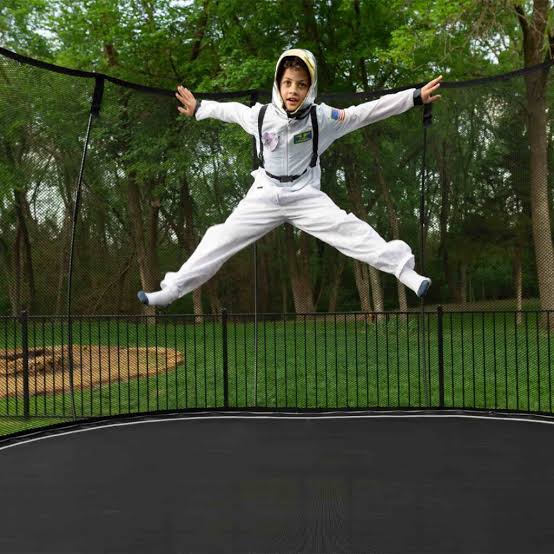
Imagine bouncing on a trampoline. You push down, the mat stretches, and you fly upward sometimes high enough to feel your stomach drop. But what’s really happening beneath your feet? A trampoline is not just a toy; it’s a finely tuned physics machine that converts energy, exploits resonance, and even mimics the sensation of weightlessness in space. In this article, we’ll peel back the mat to reveal the hidden physics that lets you soar.
The Elastic Engine: How a Trampoline Stores and Returns Energy
Every bounce on a trampoline is a dance between kinetic and elastic potential energy. When you land, your body’s kinetic energy—the energy of motion—is transferred to the mat and springs. The mat stretches, the coils compress and extend, and this energy is stored as elastic potential energy, much like winding a spring in a toy. Then, on the rebound, that stored energy is released, propelling you upward again.
The key players are the mat and the springs. A typical recreational trampoline has between 80 and 120 coiled steel springs, each with a spring constant (k) of about 200 to 500 Newtons per meter. The spring constant measures stiffness: a higher k means a stiffer spring that requires more force to stretch. The mat itself is usually woven from polypropylene or nylon, materials that can stretch significantly without tearing. Together, the mat and springs form one integrated elastic system.
But here’s a twist: the trampoline isn’t a perfect spring. According to Hooke’s Law, the force needed to stretch a spring is directly proportional to the distance it’s stretched (F = -kx). However, a trampoline mat behaves more complexly. As the mat depresses, the springs change angle, and the fabric itself stretches non-linearly. This means the effective spring constant actually changes as you bounce deeper. This non-linear behavior is part of what makes trampolines feel springy and responsive, but it also complicates the physics.
Resonance: The Secret to Bouncing Higher with Less Effort
Have you ever noticed that experienced jumpers seem to go higher without extra effort? They’ve mastered resonance. Every trampoline has a natural frequency—the rate at which it naturally oscillates when disturbed. For a typical trampoline, that’s about 1.5 to 3 Hertz, meaning 90 to 180 bounces per minute. This frequency depends on the combined stiffness of the springs and the mass of the jumper.
When you bounce at that natural frequency, you’re in sync with the trampoline. Each bounce adds energy efficiently, like pushing a child on a swing at just the right moment. But if you bounce off-beat, you fight the system, and energy is wasted. This is why novices often tire quickly and struggle to gain height, while experts make it look easy.
Expert jumpers also use their bodies to drive the oscillation. At the bottom of the depression, they extend their legs to push against the mat, adding energy. At the top, they tuck their limbs to reduce air resistance. This is a classic driven harmonic oscillator: your muscles provide the driving force, and matching the frequency amplifies the motion.
The Feeling of Weightlessness and the G-Force Rollercoaster
At the top of a high bounce, you feel weightless. That’s because for a brief moment, you’re in free fall, just like an astronaut in orbit. The only force acting on you is gravity, and you don’t feel the trampoline pushing against you. This sensation of zero g-force is why NASA uses trampolines in astronaut training. It helps astronauts get used to the feeling of weightlessness and also helps build bone density in simulated low-gravity conditions.
But the bottom of the bounce is a different story. When you land and the mat stretches, you experience a rapid deceleration, which produces g-forces several times your body weight. On a typical bounce, you might feel 3 to 5 g’s. That’s why your legs feel heavy and your stomach drops—your body is suddenly much heavier than normal.
The contrast between weightlessness at the top and high g-forces at the bottom is part of the thrill of trampolining. It’s also why the sport is physically demanding; your body has to withstand those forces repeatedly.
The Mat as a Wave: Why Location Matters
Next time you bounce, notice that the mat ripples like a drumhead. The trampoline mat is a tensioned membrane, and when you land off-center, waves travel across it. Skilled jumpers use this to their advantage. They can “ride” the wave, absorbing and redirecting energy to move across the mat or gain height.
Competitive trampolines have a “sweet spot” in the center. Land there, and the waves converge symmetrically, producing the highest and most predictable bounce. Land off-center, and the energy disperses unevenly, resulting in a lower, wobblier bounce. This is why gymnasts and trampolinists aim for the center every time—it’s not just for consistency; it’s physics.
The wave behavior also explains why trampolines feel different depending on where you land. The mat’s tension is crucial. Competition mats are tensioned to specific levels, often measured in Newtons per meter, to ensure uniform performance across the entire surface.
The Material Science: Why Springs Don’t Wear Out (Usually)
Trampoline springs are made of spring steel, chosen for its high yield strength and fatigue resistance. It can undergo millions of cycles—stretch and release—without permanently deforming. The mat fabric must also withstand repeated stress without stretching out over time. Competition mats use high-tensile-strength materials with low creep, meaning they don’t permanently elongate.
Temperature affects performance too. Cold springs are stiffer because the steel contracts, increasing the spring constant. This makes the trampoline feel harder—you don’t sink as deep, and the bounce is quicker. Warm springs are more compliant, giving a softer, deeper bounce. So if you’ve ever bounced on an outdoor trampoline in winter and in summer, they feel different for a reason. In competitive settings, athletes often adjust spring tension based on their weight and the ambient temperature to achieve the desired feel.
The Competitive Edge: How Athletes Use Physics
Trampolining became an Olympic sport in 2000, and elite athletes push the limits of what’s possible. Competitive trampolinists can reach heights of 8 to 9 meters—about three stories high. They achieve this by precisely tuning their bounces to the trampoline’s natural frequency and using their bodies to add energy at the right moments.
In competition, the trampoline’s spring tension is adjusted to match the athlete’s weight, ensuring optimal resonance. Athletes talk about “finding the rhythm” of the bed—a proprioceptive sense that tells them exactly when to push. This rhythm isn’t mystical; it’s a physical synchronization with the trampoline’s oscillation.
The pursuit of height has led to the development of competition-grade trampolines with higher tension and more responsive materials. These are different from backyard trampolines, which are designed for safety and leisure, not maximum bounce. The highest competitive bounces, around 9 meters, are achieved on these specialized apparatuses in controlled settings.
A Brief History: From Circus Stunt to Olympic Sport
The modern trampoline was invented in 1934 by George Nissen and Larry Griswold at the University of Iowa. Nissen, a gymnast and diver, thought of the idea while watching circus performers bounce in safety nets. He named it after the Spanish word trampolín, meaning diving board. Nissen later took his invention on tour, and in a famous 1945 publicity stunt, he bounced alongside a kangaroo in Central Park to demonstrate the trampoline’s capabilities.
What started as a novelty soon became a training tool for astronauts and athletes. Today, it’s a competitive sport with its own world championships and Olympic events. The physics that makes trampolining fun is the same physics that makes it a serious athletic endeavor.
The trampoline is a perfect example of physics in action. From the storage of elastic potential energy to the timing of resonance, every bounce is governed by fundamental principles. Whether you’re a casual jumper or an aspiring Olympian, understanding these principles can help you bounce higher, land safer, and appreciate the science behind the fun.
Summary
- A trampoline stores kinetic energy as elastic potential energy in the springs and mat, then returns it on the rebound.
- Resonance occurs when you bounce at the trampoline’s natural frequency (1.5–3 Hz), maximizing energy transfer.
- The mat acts as a tensioned membrane, producing waves that skilled jumpers can use.
- G-forces range from near-zero at the top of the bounce to 3–5 g’s at the bottom.
- Spring steel and mat materials are chosen for their durability and elasticity, but temperature affects performance.
FAQ
Q: Why do I go higher if I bounce in rhythm with the trampoline?
A: Because you’re matching the trampoline’s natural frequency, which allows energy to be added efficiently each bounce, much like pushing a swing at the right moment.
Q: Is it true that astronauts train on trampolines?
A: Yes, NASA uses trampolines to help astronauts experience reduced-gravity sensations and to maintain bone density.
Q: Why does the trampoline feel different in winter?
A: Cold makes the springs stiffer, increasing the spring constant and creating a harder bounce, while warmer temperatures make them more compliant.
Q: What is the ‘sweet spot’ on a trampoline?
A: The center of the mat, where landing produces symmetrical wave convergence, resulting in the highest and most predictable bounce.
Q: How high can competitive trampolinists bounce?
A: They can reach heights of 8–9 meters (26–30 feet), which is about three stories high.