Tag: Renaissance

  • The Unlikely Origin of the Violin: How a Medieval Fiddle Became the King of Instruments

    The Unlikely Origin of the Violin: How a Medieval Fiddle Became the King of Instruments

    The violin is a masterpiece of design a wooden box with four strings that can mimic the human voice, weep with sorrow, or dance with joy. It is the undisputed king of the orchestra, the centerpiece of chamber music, and the instrument most likely to make a listener cry. But how did this iconic instrument come to be? Its story begins not in a grand concert hall, but in the hands of medieval minstrels and troubadours, and it takes a surprising detour through the Islamic world. The violin’s journey from a humble fiddle to the pinnacle of Western music is a tale of innovation, cultural exchange, and a few brilliant craftsmen in a small Italian town.

    From the Vielle to the Violin: A Medieval Starting Point

    In the 11th century, if you heard music at a European court, it was likely played on a vielle, a versatile bowed instrument that was the most popular of its time. The vielle was a workhorse: it could play melody and harmony (thanks to drone strings), accompany songs, and get people dancing. Troubadours and minstrels carried it across the continent. It had five strings and a flat bridge, and it was held against the chest or shoulder. But the vielle was not a standardized instrument—body shapes varied from oval to figure-eight, and it was often built for portability rather than power.

    Meanwhile, a different bowed instrument was making its way into Europe: the rebec. With a pear-shaped body carved from a single piece of wood, the rebec was a descendant of the Arab rabab, which had traveled through the Iberian Peninsula and Sicily during the medieval period. The rebec was known for its piercing, nasal tone, and it was played on the arm like the violin would later be. It was a folk instrument, but also found its way into art music. The very bow used to play it likely originated in Central Asia, where the horsehead fiddle (morin khuur) tradition still survives today. From there, the bow spread via the Silk Road to the Islamic world and then to Europe.

    The Missing Link: The Lira da Braccio

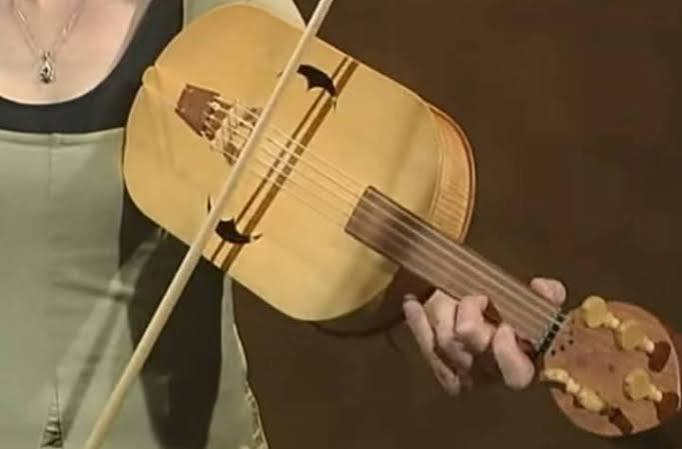
    By the 15th century, Renaissance Italy was buzzing with a rediscovery of classical culture. Poets and humanists wanted to emulate Orpheus, the mythical musician who could charm beasts with his lyre. They found their instrument in the lira da braccio—literally “arm lyre.” This instrument had seven strings (four melody strings over the fingerboard, plus two or three drone strings) and a body shape remarkably close to the modern violin. It was played on the shoulder, and its flat bridge allowed for chords, making it perfect for accompanying one’s own singing.

    The lira da braccio is considered the most direct ancestor of the violin in terms of playing position and body shape, but it still lacked the violin’s defining features: f-holes, a curved bridge, and four strings tuned in fifths. These innovations emerged in the early 16th century, as luthiers in northern Italy began experimenting with ways to make the instrument louder, more agile, and more expressive.

    The Violin Is Born: Brescia and Cremona

    The cities of Brescia and Cremona in northern Italy became the crucible of violin making. The earliest documented violins are attributed to Andrea Amati of Cremona, with surviving examples from the 1540s. The earliest known dated violin, the “Charles IX,” was made for the French court around 1560. Amati’s instruments set the standard: four strings tuned in fifths (G–D–A–E), f-holes (which allow the top plate to vibrate more freely than the C-holes of earlier instruments), a curved bridge for bowing individual strings, and no frets—a radical departure from the viol family.

    But why did the violin succeed where its relatives failed? The answer lies in its construction. Unlike the viola da gamba (the aristocrat’s instrument, with six strings, frets, and a flat back), the violin had a convex back, a shorter and thicker neck, and a sound post and bass bar inside the body. These internal components are critical to the violin’s powerful, focused tone. The sound post—a small wooden dowel—transfers vibrations from the top plate to the back, while the bass bar strengthens the top and distributes tension. These weren’t invented in Cremona, but they were refined there, and they gave the violin a volume and projection that could fill a hall.

    The Golden Age of Cremona: Amati, Stradivari, and Guarneri

    Andrea Amati’s sons and grandson continued the family tradition, but it was his grandson Nicolò Amati (1596–1684) who would shape the future of violin making. Nicolò taught two apprentices who would become legends: Antonio Stradivari (c. 1644–1737) and Andrea Guarneri (c. 1626–1698). Stradivari went on to produce around 1,100 instruments over his career, of which about 650 survive. His “Golden Period” (c. 1700–1725) is considered the apex of the craft. Stradivari’s violins are prized for their tonal balance, clarity, and projection—qualities that have never been fully replicated.

    The Guarneri family, meanwhile, produced Bartolomeo Giuseppe Guarneri (1698–1744), known as “del Gesù” for the cross he inscribed on his labels. His instruments have a darker, more powerful tone, and they were favored by the great virtuoso Niccolò Paganini, whose 1742 “Il Cannone” Guarneri remains one of the most famous violins in history.

    Why the Violin Won

    The violin family—violin, viola, cello, and double bass—eventually outcompeted the viol family for a simple reason: it was louder. As music moved from intimate courts to larger halls and orchestras, the violin’s ability to project was a decisive advantage. Its lack of frets allowed for expressive techniques like vibrato and glissando, which became essential to the Romantic style. And its agility made it a favorite of composers from Vivaldi to Beethoven to Paganini.

    The viola da gamba, with its sweet but quiet tone, retreated to the drawing rooms of aristocrats and eventually became a historical curiosity. The violin, meanwhile, became the king of instruments—not because it was the most complex or the most ancient, but because it was the most adaptable. It can whisper or shout, sing or speak, and it does so with a voice that feels almost human.

    A Legacy Carved in Wood

    Today, the violin remains a marvel of engineering and artistry. Each one is a unique creation, made from spruce and maple, shaped by hand, and tuned by ear. The instruments of Stradivari and Guarneri are still played by the world’s greatest musicians, and they command prices in the millions. But the violin’s true origin is humble: it descends from the vielle of medieval minstrels, the rebec of Arab traders, and the lira da braccio of Renaissance poets. It is a testament to how cultural exchange and a few clever innovations can transform a simple fiddle into an eternal masterpiece.

    The violin’s journey from a medieval fiddle to the king of instruments is a story of evolution—not just of wood and string, but of cultures and ideas. It was born in the workshops of northern Italy, but it owes its existence to a thousand years of musical experimentation across Europe, Asia, and the Middle East. Every time a violinist draws a bow across the strings, they are playing an instrument that carries the echoes of troubadours, court poets, and Arab musicians. The violin may be a product of its time, but its allure is timeless.

    Summary

    • The violin emerged in early 16th-century northern Italy, with the earliest documented instruments by Andrea Amati of Cremona.
    • Its ancestors include the medieval vielle, the Arab-derived rebec, and the Renaissance lira da braccio.
    • Key innovations—four strings tuned in fifths, f-holes, a curved bridge, and no frets—set it apart from the viol family.
    • The Amati, Stradivari, and Guarneri families in Cremona perfected the instrument during the 16th–18th centuries.
    • The violin won out over the viol due to its louder volume, greater agility, and expressive potential.

    FAQ

    Q: What is the earliest known violin?
    A: The earliest known dated violin is the “Charles IX,” made by Andrea Amati around 1560–1570 for the French court. Surviving instruments from the 1540s are also attributed to Amati.

    Q: How did the violin get its name?
    A: The word “violin” comes from the Italian violino, meaning “small viola.” The term viola itself traces back to the medieval Latin vitula, which possibly derives from vitulari, meaning “to rejoice” or “to sing.”

    Q: Why did the violin replace the viol?
    A: The violin family was louder and more agile than the viol family. The violin’s lack of frets allowed for expressive techniques like vibrato, and its construction gave it greater projection, making it better suited for larger halls and orchestras.

    Q: What is the sound post, and why is it important?
    A: The sound post is a small wooden dowel inside the violin’s body that transfers vibrations from the top plate to the back. It is crucial for the instrument’s tone and projection.

    Q: Are Stradivarius violins really better than modern ones?
    A: Many musicians and experts believe Stradivarius violins have superior tonal qualities, but scientific studies have been inconclusive. In blind tests, players often cannot distinguish between a Stradivarius and a high-quality modern violin, though the mystique remains.

  • Rome vs Florence: Where Did the Renaissance Really Happen?

    Rome vs Florence - Which is Right for You? | Italy4Real

    When you think of the Renaissance, you might picture Michelangelo’s David in Florence or the Sistine Chapel in Rome. But these two cities tell very different stories about the same era. Florence gave birth to the movement; Rome transformed it into something monumental. This article unpacks the rivalry, the art, and the legacy of two of Italy’s most iconic cities.

    The Two Renaissance Capitals

    Florence and Rome both claim the Renaissance, but they experienced it in distinct ways. Florence was the cradle—a city of bankers and merchants who funded a cultural explosion in the 1400s. Rome was the stage—a city of popes who used art to project power and piety in the 1500s. Understanding the difference between these two cities is key to understanding the Renaissance itself.

    Florence’s golden age ran from about 1400 to 1520. Rome’s revival peaked a bit later, from 1500 to 1650, overlapping with the Baroque era. The primary patrons differed: in Florence, it was the Medici family—private, merchant, and humanist. In Rome, it was the Papacy—institutional, religious, and ambitious. These differences shaped the art each city produced.

    Florence: Birthplace of the Renaissance

    Florence’s rise was economic. By the 13th and 14th centuries, banking and wool trade made it one of Europe’s wealthiest cities. The florin, its currency, was the standard across the continent. This wealth created a merchant class that valued education, civic pride, and patronage.

    The political structure was a republic, though the Medici family held outsized influence from 1434 onward. Cosimo de’ Medici and his grandson Lorenzo the Magnificent were the driving forces behind the city’s artistic output. They funded artists like Botticelli, Donatello, and Brunelleschi, and their support extended to thinkers as well.

    Humanism was the intellectual fuel. Florence was the epicenter of the revival of classical Greek and Roman texts, emphasizing human potential and secular learning. This directly shaped art: instead of only religious subjects, artists explored mythology, portraiture, and the human form with new naturalism.

    Artistic competition was built into the city’s culture. The famous 1401 competition for the Baptistery doors, won by Ghiberti over Brunelleschi, set a precedent. Public artistic rivalry became a engine for innovation. Brunelleschi went on to solve the engineering puzzle of the Duomo, the largest brick dome ever built, which remains a triumph of human ingenuity.

    Florence produced defining works like Michelangelo’s David (now in the Accademia), Botticelli’s Birth of Venus and Primavera (in the Uffizi), and Leonardo’s Annunciation. These pieces are celebrated for their perspective, chiaroscuro, and emotional depth. Florence also coined the term “Renaissance”—Giorgio Vasari, a Florentine artist-historian, used “rinascita” in his 1550 Lives of the Artists to describe the city’s rebirth.

    Rome: The Eternal City’s Second Life

    Rome’s story is layered. It was the center of the ancient empire, leaving monuments like the Pantheon and Colosseum. After the empire’s fall, the city declined dramatically—by the 14th century, its population had shrunk to around 20,000. The papacy even moved to Avignon between 1309 and 1377, further draining the city’s prestige.

    But the popes returned, and they had a plan. Starting with Pope Nicholas V in 1447, they embarked on a deliberate campaign to restore Rome’s grandeur. Sixtus IV built the Sistine Chapel and the Vatican Library in the 1470s–80s. Then came Julius II, the “Warrior Pope,” who aggressively commissioned the greatest artists of the age.

    Michelangelo was summoned to paint the Sistine Chapel ceiling (1508–1512) and later the Last Judgment. Raphael decorated the Vatican Stanze with frescoes like The School of Athens, a masterpiece of classical and Christian synthesis. Bramante designed the new St. Peter’s Basilica, which Michelangelo and later Bernini would continue. These works were monumental in scale and ambition, intended to assert papal authority over Christendom.

    Rome’s innovation was in integrating classical antiquity with Christian theology. The city’s ancient ruins served as both inspiration and competition. Artists and architects studied the arches, columns, and proportions of the Colosseum and Pantheon, applying them to new churches and piazzas.

    The Sack of Rome in 1527 was a turning point. Holy Roman Emperor Charles V’s troops sacked the city, scattering artists and ending Rome’s High Renaissance golden age. Yet the city’s artistic legacy endured, evolving into the Baroque under Bernini and Caravaggio.

    The Rivalry: Who Wins?

    Florence and Rome were not just different; they were rivals. Florence trained the artists; Rome attracted them with the grandest commissions. Michelangelo, Raphael, and Leonardo all moved between the two cities. Florence offered intellectual ferment and training; Rome offered scale and prestige.

    If you’re asking which city was more important, it depends on your lens. Florence was the birthplace—the place where the Renaissance began. Rome was the culmination—where it became a global statement. Florence gave us the David, a symbol of human potential; Rome gave us the Sistine Chapel, a vision of divine power.

    For the traveler, both cities are essential. In Florence, you walk the streets where Brunelleschi’s dome changed architecture. In Rome, you stand in the shadow of the Colosseum and then step into St. Peter’s, seeing centuries of history layered. The two cities together tell the complete story of the Renaissance—its origins and its triumph.

    Conclusion: A Tale of Two Cities

    Rome and Florence are not competitors; they are complementary chapters in one of history’s greatest cultural movements. Florence’s intimate masterpieces and Rome’s monumental frescoes represent different responses to the same humanist impulse. Whether you prefer the intimate galleries of the Uffizi or the awe of the Sistine Chapel, both cities offer a window into the rebirth of art and ideas that changed the world.

    TL;DR

    • Florence was the birthplace of the Renaissance (1400–1520), driven by the Medici family and humanist thought.
    • Rome was the stage for the High Renaissance and Baroque (1500–1650), driven by the Papacy’s monumental commissions.
    • Florence excelled in perspective, naturalism, and intimate masterpieces; Rome excelled in fresco cycles, classical revival, and urban scale.
    • Both cities produced unmatched art: Florence’s David and Duomo, Rome’s Sistine Chapel and St. Peter’s.
    • The Sack of Rome in 1527 ended Rome’s golden age, but its influence continued into the Baroque.

    FAQ

    Q: Which city is better for seeing Renaissance art?
    A: Both are essential. Florence has the Uffizi and Accademia (Michelangelo’s David), while Rome has the Vatican Museums and Sistine Chapel. If you must choose, Florence is more concentrated on early Renaissance, Rome on High Renaissance and Baroque.

    Q: Who were the main patrons of art in Florence and Rome?
    A: In Florence, it was the Medici family, particularly Cosimo and Lorenzo. In Rome, it was the popes, especially Julius II, Leo X, and Sixtus IV.

    Q: What is the difference between Renaissance and Baroque art?
    A: Renaissance (14th–16th century) focused on naturalism, perspective, and balance. Baroque (17th century) emphasized drama, emotion, and grandeur. Rome is known for both, but especially Baroque, with artists like Bernini and Caravaggio.

    Q: Why did the Renaissance start in Florence?
    A: Florence had the wealth (banking and wool trade), the political structure (a republic with merchant power), and the intellectual movement (humanism) that fueled artistic innovation. The 1401 Baptistery competition also created a culture of rivalry.

    Q: What is the Sack of Rome?
    A: In 1527, troops of Emperor Charles V sacked Rome, a brutal event that ended the High Renaissance in Rome and scattered artists across Europe. It marked a turning point in both political and artistic history.

    In the end, the Renaissance is not a single story but a dialogue between two cities. Florence provided the spark; Rome turned it into a blaze. To truly understand the era, look at both—the intimate and the monumental, the human and the divine.

    Summary

    • Florence was the birthplace of the Renaissance, driven by the Medici family and humanist thought.
    • Rome was the stage for the High Renaissance and Baroque, driven by the Papacy’s monumental commissions.
    • Florence excelled in perspective, naturalism, and intimate masterpieces; Rome excelled in fresco cycles, classical revival, and urban scale.
    • Both cities produced unmatched art: Florence’s David and Duomo, Rome’s Sistine Chapel and St. Peter’s.
    • The Sack of Rome in 1527 ended Rome’s golden age, but its influence continued into the Baroque.

    FAQ

    Q: Which city is better for seeing Renaissance art?
    A: Both are essential. Florence has the Uffizi and Accademia (Michelangelo’s David), while Rome has the Vatican Museums and Sistine Chapel. If you must choose, Florence is more concentrated on early Renaissance, Rome on High Renaissance and Baroque.

    Q: Who were the main patrons of art in Florence and Rome?
    A: In Florence, it was the Medici family, particularly Cosimo and Lorenzo. In Rome, it was the popes, especially Julius II, Leo X, and Sixtus IV.

    Q: What is the difference between Renaissance and Baroque art?
    A: Renaissance (14th–16th century) focused on naturalism, perspective, and balance. Baroque (17th century) emphasized drama, emotion, and grandeur. Rome is known for both, but especially Baroque, with artists like Bernini and Caravaggio.

    Q: Why did the Renaissance start in Florence?
    A: Florence had the wealth (banking and wool trade), the political structure (a republic with merchant power), and the intellectual movement (humanism) that fueled artistic innovation. The 1401 Baptistery competition also created a culture of rivalry.

    Q: What is the Sack of Rome?
    A: In 1527, troops of Emperor Charles V sacked Rome, a brutal event that ended the High Renaissance in Rome and scattered artists across Europe. It marked a turning point in both political and artistic history.