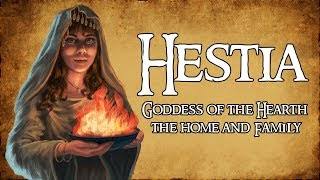
When you picture the Greek gods, you likely think of Zeus’s thunderbolts, Athena’s wisdom, or Poseidon’s trident. But there was one goddess who received the first and last offering at every sacrifice, whose fire burned at the center of every home and every city, and who had virtually no myths at all. Her name was Hestia, and her quiet power held Greek society together.
Hestia was the eldest Olympian, the first child of Cronus and Rhea, and yet she is often forgotten. She had no adventures, no love affairs, no battles just a flame. But that flame was the literal and symbolic heart of Greek life, bridging the private world of the household and the public world of the state.
The First and Last: Hestia’s Unique Birth and Status
Hestia’s story begins with a paradox. As the first-born of Cronus and Rhea, she was the first to be swallowed by her father, who feared his children would overthrow him. When Zeus eventually forced Cronus to disgorge his siblings, Hestia came out last. This made her both the eldest and the youngest a position that gave her a unique claim to honor. She was the alpha and the omega of the Olympian generation, and this duality was reflected in her role as the recipient of the first and last libations at every sacrifice.
Her virginity was another defining feature. According to the Homeric Hymn to Aphrodite, Hestia swore an oath by the head of Zeus to remain a virgin, rejecting marriage offers from Poseidon and Apollo. This was not a rejection of the world, but a choice to stay rooted. While other gods ventured out to conquer, seduce, or battle, Hestia stayed put. She was the hearth, and the hearth does not move.
The Hearth as the Center of the Home
In an ancient Greek home, the hearth was more than a place to cook. It was the ritual and emotional center of the household, or oikos. The word for the goddess and the word for the hearth were the same: hestia. This was no coincidence. The hearth was where the family gathered for warmth, food, and stories. It was also where the most important moments of life unfolded.
When a child was born, the family performed a ceremony called the amphidromia. The newborn was carried around the hearth, formally introducing the child to the household gods and the family. When a couple married, the bride was escorted from her father’s hearth to her husband’s, symbolizing her transition from one oikos to another. When someone died, the body was laid out near the hearth before burial, a final farewell in the presence of the sacred flame.
The hearth was also a place of sanctuary. Those seeking refuge would sit at the hearth, and harming them was a grave offense against the gods. This custom underscored the hearth’s role as a sacred space, protected by Hestia herself.
From Home to City: The Public Hearth
Hestia’s influence extended far beyond the individual home. Every Greek city-state, or polis, maintained a public hearth in a building called the Prytaneion. Here, the prytaneis (chief magistrates) met, and the fire was kept burning continuously. This was the koinē hestia, the “common hearth,” and it represented the unity of the citizen body.
The public hearth was not just a symbolic gesture. It was the literal center of civic life. Ambassadors and honored guests were entertained there, and it was considered the symbolic home of the city itself. When a colony was founded, settlers carried fire from the mother city’s hearth to the new settlement. This act transferred not just a flame, but the very identity of the city. The fire was a thread that connected the new colony to its origins, ensuring that the gods and the ancestors were present in the new land.
The connection between Hestia and civic life was so strong that even the Delphic oracle began its rituals with an offering to her. The Prytaneion at Delphi housed a perpetual flame, and no consultation of the oracle could begin without first honoring the goddess of the hearth.
The Silence of Myth: Stability Over Story
One of the most striking things about Hestia is her absence from myth. Unlike Zeus, who has countless adventures, or Athena, who plays a central role in epic poems, Hestia has no stories. But this silence is not a lack—it is a feature. Myth requires movement, conflict, and change. Hestia is the fixed point around which all that movement occurs. She is the hearth that stays lit while heroes journey, wars rage, and gods scheme.
Plato recognized this in his dialogue Phaedrus, where he places Hestia at the center of the cosmos as the unmoving hearth of the universe. This image of the axis mundi—the world axis—captures her essence. She is the still point in a turning world, the force that holds everything together.
Contrasting Powers: Hestia and Athena
To understand Hestia’s unique form of power, it helps to compare her to Athena. Both are virgin goddesses, but they embody very different kinds of authority. Athena is public, martial, and cerebral. She is the goddess of wisdom and strategy, always at the center of action, advising heroes and leading armies. Hestia, on the other hand, is private, pacific, and domestic. Her power is centripetal—she draws things inward and holds them together.
This contrast is not a criticism of Hestia. Rather, it reveals how Greek culture valued different kinds of female-coded power. Athena’s power was outward, projecting influence through the state and its institutions. Hestia’s power was inward, creating the stability that made those institutions possible. Without the hearth, there would be no home; without the home, there would be no city; without the city, there would be no civilization.
The Roman Echo: Vesta and the Vestal Virgins
Hestia’s Roman counterpart, Vesta, carried this legacy even further. The Vestal Virgins, a college of priestesses dedicated to Vesta, maintained the sacred fire of Rome with strict discipline. If the fire went out, it was seen as a dire omen. The Vestals held unique privileges, such as the power to free condemned prisoners they encountered, which demonstrated the high status of their office. This direct continuation of Hestia’s cult shows how deeply the Greeks’ reverence for the hearth had shaped the wider ancient world.
Why It Matters Today
Hestia’s story challenges our assumptions about power and significance. We tend to celebrate the loud, the visible, and the disruptive. But Hestia reminds us that quiet, steady forces are just as important. The flame that never goes out is the one that holds a community together, whether it is a family gathered around a kitchen table or a nation united by shared symbols.
In a world obsessed with motion and novelty, Hestia offers a counterpoint. She is the reminder that some things must remain constant—the home, the city, the sacred bond between them. Her flame may be forgotten in our textbooks, but it never went out in the ancient world, and its legacy still warms us today.
Hestia is often the last goddess we think of when we remember Greek mythology. But she was the first-born, the first honored, and the last to receive her due. Her flame was the thread that connected the private hearth to the public state, the individual to the community, and the mortal to the divine. In her silence, she spoke volumes about the importance of stability, continuity, and the quiet power that holds the world together.
Summary
- Hestia was the eldest Olympian, first-born of Cronus and Rhea, yet she has virtually no myths, reflecting her role as a stable, unmoving force.
- Her symbol was the hearth fire, which was central to both the home (oikos) and the city-state (polis), where a public hearth burned in the Prytaneion.
- Life-cycle rituals such as birth (amphidromia), marriage, and death all took place around the hearth, making Hestia the guardian of family transitions.
- Colonies carried fire from their mother city’s hearth to their new home, symbolically transferring civic identity and divine protection.
- Plato placed Hestia at the center of the cosmos, reinforcing her as the axis mundi, and her Roman counterpart Vesta continued her cult with the Vestal Virgins.
FAQ
Q: Why doesn’t Hestia appear in any myths?
A: Hestia’s absence from myth is intentional. Myth relies on narrative movement—adventures, conflicts, and changes. Hestia represents the opposite: stability and continuity. She is the fixed point that allows other stories to unfold, which is why she has no tales of her own.
Q: What was the role of the public hearth in Greek cities?
A: The public hearth, or koinē hestia, was housed in the Prytaneion, the civic hall where magistrates met. Its fire was kept burning continuously and symbolized the unity and continuity of the city. It was also a place of hospitality for ambassadors and honored guests.
Q: How did Hestia’s cult connect the home and the state?
A: The hearth was the center of both the private household and the public city. Rituals at the hearth marked key events in family life, while the public hearth represented the city’s identity. When colonies were founded, fire from the mother city’s hearth was carried to the new colony, linking the two through Hestia’s flame.
Q: What was the significance of Hestia receiving the first and last libations?
A: This practice honored Hestia as both the first-born and last-released of Cronus’s children. It acknowledged her as the beginning and end of all offerings, symbolizing her role as the foundational and enduring presence in Greek religious practice.
Q: How does Hestia compare to Athena?
A: Both are virgin goddesses, but Athena is public, martial, and intellectual, while Hestia is private, pacific, and domestic. Athena’s power projects outward, while Hestia’s draws inward and holds things together. Together, they show the different ways Greek culture valued female authority.