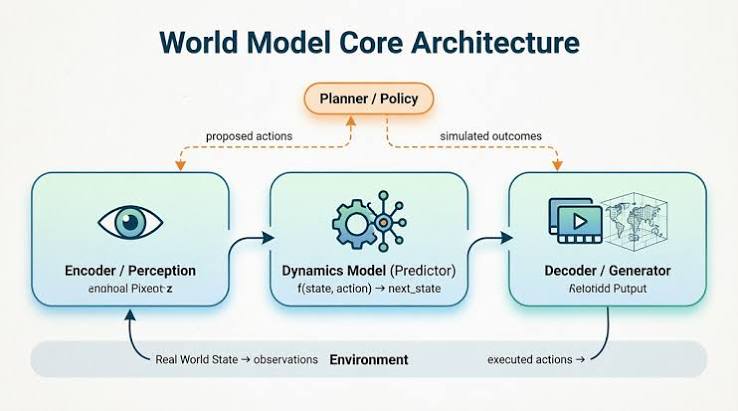
Consider a chess player who mentally rehearses a sequence of moves before touching a piece, or a driver who visualizes a turn before entering it. Humans and animals constantly simulate possible futures in their heads, a skill that lets us plan and avoid costly mistakes. For decades, AI systems have lacked this ability, relying instead on trial-and-error in the real world. But a new class of models, aptly called ‘world models,’ is changing that. These systems build an internal simulation of their environment, allowing them to predict outcomes and plan actions without physical interaction. This article unpacks what world models are, how they work, and why they’re a cornerstone for advanced robotics and AI.
What Exactly Is a World Model?
A world model is an AI system’s internal representation of its environment. It’s not a static map but a dynamic, predictive model that learns how the world changes over time. When you show a world model a series of frames from a video, it learns the underlying rules: objects persist, gravity pulls things down, and actions have consequences. This knowledge lets the model simulate what might happen next, even for scenarios it has never seen.
Think of it as the difference between a student who memorizes answers and one who understands the subject. A standard AI might learn to recognize a cat from millions of labeled images that’s input-output mapping. A world model, however, learns how a cat moves, how it reacts to a thrown ball, and what happens when it walks behind a sofa. It builds a predictive understanding, not just a pattern-matching one.
This predictive power is what sets world models apart. They don’t just say, ‘This is a cat.’ They say, ‘If I toss this toy, the cat will likely pounce.’ That ability to forecast is the foundation of planning and reasoning.
A Brief History: From Mental Models to Neural Networks
The idea of mental models isn’t new. In 1943, psychologist Kenneth Craik proposed that humans carry small-scale models of reality in their heads, allowing us to try out alternatives before acting. Philip Johnson-Laird later expanded this in the 1980s. In AI, the concept of model-based reinforcement learning (MBRL) has existed for decades, where an agent learns a model of its environment to guide decisions. But early attempts were fragile, often breaking in anything but the simplest settings.
A breakthrough came in 2018 when David Ha and Jürgen Schmidhuber published a paper simply titled ‘World Models.’ They trained a small neural network to play a car-racing game, but with a twist. The network didn’t just learn to map pixels to steering angles. It built a compressed, latent representation of the track and learned to predict future states based on its actions. This allowed the agent to ‘imagine’ the track ahead and plan its path, even in areas it hadn’t seen. The paper was a revelation, showing that a compact model could learn to simulate a visually rich environment with surprising accuracy.
How Do World Models Work? Three Key Components
Most world models follow a blueprint set by Ha and Schmidhuber. They consist of three parts, each with a specific role:
- Vision (V) Model: This compresses high-dimensional observations, like camera images, into a smaller, latent representation. It’s like converting a huge video file into a few key frames that capture the essential information.
- Memory (M) Model: Typically a recurrent neural network (like an LSTM), this predicts the next latent state based on the current one and an action. It learns the dynamics—how the world evolves. This is the ‘physics engine’ of the model, but learned from data rather than coded.
- Controller (C): This decides what action to take, based on the predicted future states. It’s the ‘brain’ that uses the world model to plan.
The magic is that the controller can act entirely in the latent space, imagining many possible futures and choosing the best one, without ever seeing the raw pixels. This is incredibly efficient—the model runs in a compressed world, not the full complexity of reality.
Modern Marvels: Dreamer, Genie, and Sora
The 2018 paper sparked a wave of innovation. DeepMind’s Dreamer family took the idea further. DreamerV3 (2023) is a model-based agent that learns entirely from ‘imagined’ rollouts inside its own world model. It doesn’t need millions of real-world interactions. Instead, it trains in its head, simulating experiences and learning from them. This approach achieved state-of-the-art performance across diverse domains, from Atari games to Minecraft and robotic control tasks, all with a single set of hyperparameters. That’s a big deal—it means the same algorithm can adapt to very different environments without tweaking.
Google DeepMind’s Genie (2024) took a different approach. It was trained on internet videos and can generate a playable, interactive world from a single image or text prompt. You give it a picture of a forest, and it creates a 2D game world where you can move around, with the environment responding consistently. This shows that world models can be trained on passive video data, not just interactive experiences.
OpenAI’s Sora (2024) is a text-to-video model that exhibits emergent world-simulation abilities. When you prompt it with a sentence, it generates a video that often respects physical laws—objects stay solid, shadows move with light sources, and motions are consistent. Although Sora isn’t explicitly trained as a world model, its outputs suggest it has learned some implicit understanding of how the world works. That’s a tantalizing hint that large-scale generative models might be building world models as a byproduct.
Why World Models Matter for Robotics
Robotics is the field most poised to benefit. Training a robot to grasp a cup or navigate a room in the real world is slow, expensive, and risky. A robot might need millions of trials, and each mistake can be costly. World models offer a solution: train the robot’s ‘brain’ in a simulated world that the model has learned. The robot can imagine thousands of attempts in seconds, learning from failures that never physically happen.
Companies like NVIDIA, Tesla, and Figure are investing heavily in this idea. NVIDIA’s Cosmos platform (2025) explicitly markets ‘world foundation models’ for physical AI, targeting robotics and autonomous vehicles. The vision is a robot that can ‘imagine’ the outcome of its actions before moving, much like a chess player visualizing a checkmate.
But there are challenges. Current world models struggle with long-horizon predictions—they drift in accuracy over time. They also have trouble with stochasticity (random events) and generalizing to novel situations. And running these models in real-time on a robot’s onboard computer is computationally demanding.
Open Challenges and Future Directions
Researchers are tackling these hurdles in several ways. One approach is object-centric world models, which represent the world as discrete objects and their relations, rather than as raw pixels. This mirrors how humans perceive—we see a mug, not a mosaic of colors. This could lead to better generalization and reasoning.
Another direction is uncertainty-aware world models. If a model knows what it doesn’t know, it can act cautiously or ask for help. This is critical for safety in real-world deployments.
Finally, there’s the question of scaling. The success of large language models suggests that bigger models trained on more data might yield more accurate world models. But world models need diverse, dynamic data—videos, interactions—which is harder to collect than text. Still, the internet is full of videos, and robots are increasingly generating teleoperation data, so the fuel is there.
A Word on Safety
Like any powerful technology, world models come with risks. If a robot relies on a flawed world model, it might act on false predictions, causing accidents. In safety-critical domains like autonomous driving, an inaccurate world model could be dangerous. Researchers are therefore developing methods to validate and verify world models and to build in fail-safes. The goal is not to eliminate uncertainty but to manage it responsibly.
The Road Ahead
World models are not yet a commercial technology for robotics at scale, but they are a vibrant research frontier. The convergence of large-scale compute, internet-scale data, and generative AI has made it possible to learn world dynamics in ways that were unthinkable a decade ago. As these models improve, they could unlock robots that learn faster, adapt to new situations, and operate safely in the messy, unpredictable real world.
The idea is simple: give AI the ability to dream, and it will wake up smarter.
World models represent a shift from reactive AI to predictive AI. By learning to simulate their environment, these systems can plan, reason, and act with foresight. While challenges remain, the progress from Ha and Schmidhuber’s 2018 paper to today’s Dreamer and Genie is remarkable. The next decade may see robots that ‘imagine before they act,’ transforming industries and everyday life. The future of AI isn’t just about recognizing patterns—it’s about understanding the world.
Summary
- A world model is an AI’s internal simulation of its environment, enabling prediction and planning.
- The concept was popularized by Ha and Schmidhuber’s 2018 paper, which used a latent space and recurrent network.
- Modern examples include DeepMind’s Dreamer (learns from imagined rollouts) and Genie (generates interactive worlds from images).
- World models are crucial for robotics, allowing training in imagination to reduce real-world trial-and-error.
- Key challenges include long-term prediction stability, stochasticity, and computational cost.
FAQ
Q: How is a world model different from a generative model like GPT?
A: GPT generates text based on patterns in language, but it doesn’t necessarily simulate a physical world. A world model predicts how an environment evolves over time, focusing on dynamics and cause-effect, which is more like understanding physics than language.
Q: Can world models be used for autonomous driving?
A: Yes, they are being explored for self-driving cars to predict other vehicles’ behavior and road conditions. Companies like NVIDIA and Tesla are investing in this, but it’s still in research stages.
Q: Do world models require massive amounts of data?
A: They can leverage large datasets, like internet videos, but some approaches are sample-efficient, learning from fewer interactions than traditional RL.
Q: What are the biggest risks of using world models in robots?
A: If the model’s predictions are wrong, the robot might make dangerous mistakes. Ensuring accuracy and uncertainty awareness is key to safe deployment.