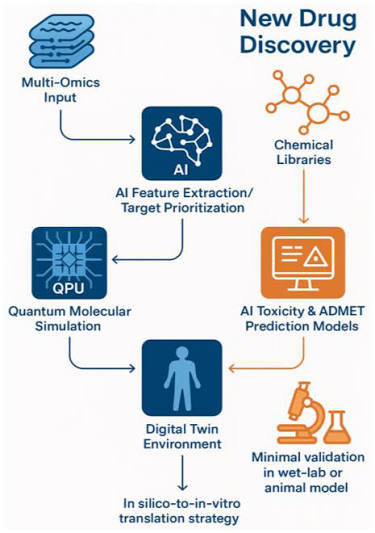
The idea of using quantum computers to simulate molecules has been around since 1982, when physicist Richard Feynman first suggested it. Today, that idea is moving from theory into practice, with pharmaceutical companies and startups testing quantum algorithms on real hardware. The goal is to model molecular interactions — like how a drug binds to a protein — with a precision that classical computers can’t match. But despite the hype, quantum advantage in drug discovery hasn’t been achieved yet. This article explains what quantum simulation actually is, where it stands now, and what it might realistically deliver in the coming years.
The Quantum Problem in Drug Discovery
Drug discovery hinges on understanding how small molecules interact with protein targets. The most critical calculation is the binding free energy — the amount of energy released when a drug attaches to its target. This depends on quantum effects like van der Waals forces, hydrogen bonding, charge transfer, and polarization. Classical computers approximate these effects, often with significant error.
For example, density functional theory (DFT), a widely used method, struggles with transition metal complexes — like the iron in hemoglobin or the zinc in metalloproteases. Enzymatic reaction mechanisms, which involve bond breaking and forming, are also poorly modeled. Quantum computers, by contrast, natively represent electrons and their interactions. In principle, they could solve the Schrödinger equation exactly for molecules with dozens of electrons, something classical computers cannot do.
How Quantum Simulation Works
Quantum simulation uses qubits — the quantum equivalent of bits — to represent the state of a molecule. Unlike classical bits, qubits can exist in superposition, meaning they can be 0 and 1 simultaneously. They can also be entangled, allowing the quantum computer to explore many molecular configurations at once.
Several algorithms have been developed to turn this capability into useful chemistry. The Variational Quantum Eigensolver (VQE) is the most common for near-term hardware. It uses a hybrid approach: a classical optimizer adjusts parameters in a quantum circuit to minimize the energy of a molecular state. Quantum Phase Estimation (QPE) is more powerful but requires fault-tolerant hardware, which is still years away. The Quantum Approximate Optimization Algorithm (QAOA) is also being explored, though it’s more often applied to combinatorial problems than to chemistry.
In practice, current quantum computers are ‘noisy intermediate-scale quantum’ (NISQ) devices — they have enough qubits to run small experiments but suffer from high error rates. To work around this, most practical approaches use a hybrid classical–quantum workflow: classical computers handle pre- and post-processing, while quantum subroutines focus on the hardest part of the calculation.
Current State of the Field
As of 2024–2025, quantum hardware has reached 100–1,000+ qubits, but error rates remain a major obstacle. Fault-tolerant quantum computing is estimated to be 5–15 years away. Despite these limitations, researchers have successfully simulated small molecules on quantum hardware, including hydrogen, lithium hydride, beryllium hydride, and water. These are proof-of-concept demonstrations, not yet drug-relevant molecules.
Pharmaceutical companies are paying attention. Pfizer, Roche, Merck, and Novartis have all launched quantum computing initiatives. Biotech startups like ProteinQure, Qubit Pharmaceuticals, and Menten AI are exploring quantum simulation for drug design. But no one has yet demonstrated a quantum advantage — a case where a quantum computer solves a problem faster or more accurately than a classical computer in a way that matters for drug discovery.
Classical methods remain the workhorses. Molecular docking (e.g., AutoDock, Glide) is fast but approximate. Molecular dynamics (e.g., GROMACS, AMBER) handles conformational changes well but relies on classical force fields. DFT (e.g., Gaussian, ORCA) is accurate for many systems but scales poorly and fails for correlated electrons. Machine learning potentials are fast but require large training datasets.
Where Quantum Could Make a Difference
Quantum simulation is most promising for problems where classical methods are notoriously inaccurate. These include:
- Metalloproteins: Enzymes like cytochrome P450, which metabolize drugs, contain transition metals. Classical methods have difficulty modeling their electronic structure.
- Reaction mechanisms: Understanding how a drug is metabolized or how an enzyme catalyzes a reaction requires modeling bond breaking and forming, which is quantum in nature.
- Binding affinity calculations: Accurate prediction of how tightly a drug binds to its target would allow better lead optimization and reduce the risk of late-stage failure.
Even small improvements in early-stage screening could have huge financial impact. The drug discovery process typically takes 10–15 years and costs $1–2 billion per drug. A quantum simulation that reduces a single drug–target interaction calculation from weeks to hours could save hundreds of millions of dollars in development costs.
The Road Ahead
The path to practical quantum simulation is clear but long. In the next 5–10 years, we can expect larger, more reliable NISQ devices and better error mitigation techniques. These will enable simulations of slightly larger molecules — perhaps small drug-like fragments — but still not full proteins. Fault-tolerant quantum computers, which would allow exact simulations of drug-relevant systems, are likely 10–15 years away.
In the meantime, hybrid classical–quantum approaches are the most likely to yield practical benefits. For example, a quantum computer could be used to refine the electronic structure of a specific active site in a protein, while classical methods handle the rest of the protein’s dynamics. This kind of integration is already being explored in academic and industrial labs.
Conclusion
Quantum simulation for drug discovery is a promising but still immature field. The potential is enormous — exact simulation of molecular interactions could transform how we find and optimize drugs. But the hardware and algorithms aren’t there yet. For now, the realistic expectation is incremental progress: better quantum hardware, better error mitigation, and eventual demonstrations of quantum advantage on specific problems. The pharmaceutical industry is watching closely, and the next decade will be critical in determining whether quantum simulation lives up to its promise.
Quantum simulation holds genuine promise for drug discovery, but it’s not a near-term solution. The science is sound, the progress is real, but the gap between current NISQ devices and the fault-tolerant machines needed for drug-relevant simulations is still wide. For researchers and clinicians, the takeaway is cautious optimism: quantum simulation may one day accelerate drug discovery, but for now, classical methods remain essential.
Summary
- Quantum simulation uses quantum computers to model molecular interactions at the quantum level, potentially offering exact solutions to the Schrödinger equation.
- Classical methods like DFT and molecular dynamics are accurate for many systems but fail for transition metals, reaction mechanisms, and strongly correlated electrons.
- Current quantum hardware (NISQ) can simulate only small molecules, and fault-tolerant quantum computing is still 5–15 years away.
- No quantum advantage has been demonstrated for a real drug discovery problem, but companies like Pfizer and Roche are investing in the technology.
- The most promising early applications are in metalloproteins, enzyme mechanisms, and binding affinity calculations, where classical methods are least accurate.
FAQ
Q: What is quantum simulation?
A: Quantum simulation uses quantum computers to model the behavior of molecules and chemical reactions at the quantum level, representing electrons and nuclei as qubits in superposition and entanglement.
Q: How could quantum simulation speed up drug discovery?
A: By providing more accurate calculations of molecular interactions, such as binding affinities, which could reduce the time and cost of early-stage drug screening and lead optimization. Current classical methods are often inaccurate for complex systems, leading to trial-and-error in the lab.
Q: What are the main challenges?
A: Quantum hardware is noisy and error-prone, and fault-tolerant machines are not yet available. Also, current algorithms can only handle small molecules, and scaling to drug-relevant sizes remains a major hurdle.
Q: When will quantum simulation be useful for drug discovery?
A: Estimates vary, but fault-tolerant quantum computers are likely 10–15 years away. In the near term, hybrid classical–quantum approaches may offer incremental improvements, but significant impact on drug discovery is probably a decade or more away.
Q: Are there any real-world examples of quantum simulation in drug discovery?
A: As of now, only proof-of-concept simulations of small molecules have been done on quantum hardware. Pharmaceutical companies are exploring partnerships, but no drug has been discovered or optimized using quantum simulation yet.