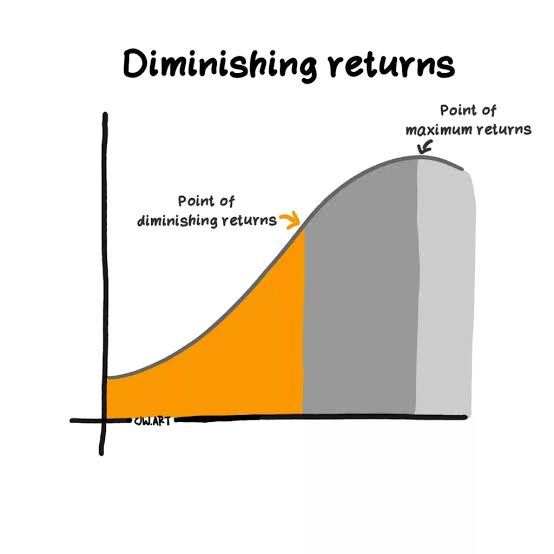
Imagine a farmer with a fixed plot of land. The first bag of fertilizer makes the crops leap skyward. The second helps a bit more. But by the tenth bag, the plants are wilting, and the yield actually drops. This isn’t a gardening quirk—it’s the law of diminishing returns, a principle that shapes everything from factory floors to your study habits.
First formalized by economists like Thomas Malthus and David Ricardo in the 19th century, this law states that as you add more of one input—while holding everything else constant—there comes a point where each extra unit gives you less and less extra output. It’s why your third cup of coffee doesn’t taste as good as the first, and why doubling your marketing budget rarely doubles your sales.
Understanding this law isn’t just academic. It’s a practical tool for making smarter decisions about where to put your time, money, and energy—and knowing when to stop.
The Core Idea: Marginal Product and the Turning Point
At the heart of the law is the concept of marginal product—the extra output you get from adding one more unit of an input. Think of a small bakery with one oven (the fixed input). As you hire more bakers (the variable input), the first few bakers work efficiently, each adding significantly to the daily bread output. But as the kitchen gets crowded, each additional baker has less oven space, gets in the way, and adds less to the total. The point where the marginal product starts to fall is the “turning point.”
Crucially, diminishing marginal returns don’t mean total output falls immediately. Total output can still rise, just at a slower rate. Only when you push well past the turning point—into what economists call Stage III—does total output actually decline. In the bakery, that’s when you have so many bakers that they’re tripping over each other, and production dips below what a smaller team could achieve.
Three Stages of Production: Where to Operate
Economists divide production into three stages:
- Stage I: Increasing Returns—Each new baker adds more output than the previous one, often due to specialization and better use of the fixed input.
- Stage II: Diminishing Returns—Each new baker still adds positive output, but less than the previous one. This is where rational firms operate, balancing marginal gains against costs.
- Stage III: Negative Returns—Adding more bakers actually reduces total output. No sensible business operates here.
The sweet spot is somewhere in Stage II, where you’re getting the most out of your fixed input without wasting resources. Finding that exact point is the challenge every manager faces.
Why It Happens: The Mechanics Behind the Law
Why does this pattern appear so consistently? The underlying cause is the presence of a fixed input. When one factor—like land, machinery, or a factory—cannot change, variable inputs eventually compete for limited capacity. Overcrowding, bottlenecks, and diminishing synergies kick in. In agriculture, plants have a biological limit on how much nutrient they can absorb. In manufacturing, a single assembly line can only process so many workers before they slow each other down.
This is a physical, technical relationship, not just a monetary one. It holds even if prices and wages are constant. The fixed input acts as a constraint, and no amount of extra variable input can fully overcome it.
Beyond the Farm: Modern Applications
The law wasn’t just relevant for 19th-century farmers. It shows up everywhere:
- Software Development: Fred Brooks famously observed in The Mythical Man-Month that adding more programmers to a late project makes it later. Communication overhead grows exponentially, while productivity gains shrink—a textbook case of diminishing returns.
- Marketing: Spending more on the same ad channel eventually yields fewer new customers per dollar. The first $10,000 might bring in 100 leads, but the next $10,000 might bring only 60.
- Education: Cramming for an exam hits a wall—after a certain number of hours, each additional study session yields smaller improvements in recall, and sleep deprivation can make it worse.
- Healthcare: More medical interventions don’t always mean better health. Beyond a certain point, treatments can have side effects that outweigh benefits.
- Personal Fitness: Training more than your body can recover from doesn’t build muscle faster—it leads to overtraining, injury, and stalled progress.
The Managerial Angle: Finding the Optimal Point
For businesses, the key question is: Where is the point of diminishing returns, and should we operate before or after it? The answer depends on costs and revenues. If an extra unit of input costs less than the value of the output it generates, you should keep adding it—even if returns are diminishing. The optimal point is where marginal cost equals marginal revenue.
Modern firms use data analytics to find this inflection point empirically. For example, an e-commerce company might test different levels of ad spend to see where customer acquisition cost starts climbing unsustainably. By identifying that threshold, they can allocate budgets more efficiently across channels.
The Behavioral Trap: Why We Keep Pushing
Psychology explains why we often ignore this law. We systematically overestimate the returns on additional effort, especially when we’re invested in a project. The sunk cost fallacy makes us keep pouring resources into something that’s clearly past its peak—just because we’ve already invested so much. Similarly, hedonic adaptation means that additional income or pleasure brings declining happiness gains, yet we still chase more.
Recognizing these biases is the first step to countering them. Sometimes, the best decision is to stop adding inputs and instead reallocate them elsewhere—or simply enjoy the plateau.
The law of diminishing returns is a reminder that more isn’t always better. Whether you’re managing a farm, a team, or your own time, there’s a point where extra effort stops paying off. The trick is to identify that turning point, respect it, and shift your resources to where they can make a real difference. In a world that glorifies hustle, sometimes the smartest move is to know when to ease off.
Summary
- The law of diminishing returns states that adding more of one input, while others are fixed, eventually yields smaller increases in output.
- It operates in three stages: increasing returns, diminishing returns, and negative returns—rational operation happens in the middle stage.
- The law applies beyond agriculture to software, marketing, education, healthcare, and fitness.
- Managers use data to find the optimal point where marginal cost equals marginal revenue.
- Behavioral biases like sunk cost fallacy lead us to ignore the law and over-invest past the optimal point.
FAQ
Q: What is the law of diminishing returns?
A: It’s an economic principle where adding more of one input (keeping others fixed) eventually yields smaller increases in output. For example, adding more workers to a fixed factory floor will eventually produce less additional output per worker.
Q: Does diminishing returns mean total output decreases?
A: Not immediately. Diminishing marginal returns mean each extra unit adds less than the previous one, but total output can still rise. Only in the final stage (negative returns) does total output actually decline.
Q: Why does the law happen?
A: Because of fixed inputs. When one factor is limited, variable inputs compete for it, causing overcrowding, bottlenecks, and reduced efficiency. It’s a physical relationship, not just a financial one.
Q: How can I apply this law in my life?
A: Identify where you’re putting in effort and whether the returns are declining. For example, if studying more hours stops improving grades, take a break or change tactics. Apply the same logic to work, exercise, and spending.
Q: Is the law always true?
A: In the short run, with at least one fixed input, yes. In the long run, when all inputs can be varied, the law still applies to individual production processes, but firms can adjust capacity to shift the curve.