The rise of artificial intelligence has brought us chatbots, image generators, and self-driving car research. But there’s a hidden cost to this digital revolution: your electricity bill. As AI data centers spring up across the country, they’re consuming massive amounts of power, and utilities are passing those costs on to everyday consumers. This article explores the geographic hotspots where this is happening and why it matters to you.
The Invisible Energy Hungry Beast
Imagine a single building that uses as much electricity as a small town. That’s a data center. These facilities house thousands of servers that process and store the data powering everything from your email to AI models. But AI is different from traditional computing. Training a large AI model like GPT-3 can consume as much energy as hundreds of homes use in a year. And once the model is trained, running it (called inference) also requires significant power. This is why AI data centers are so energy-intensive.
The Map: Where the Power Goes
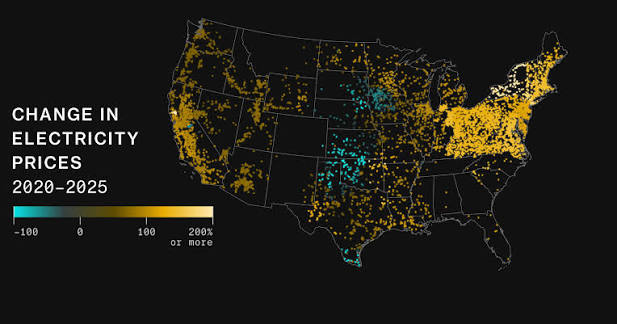
The map in question highlights regions where data center demand is highest and where rate increases are most pronounced. The most notable hotspot is Northern Virginia, often called “Data Center Alley” because it hosts the largest concentration of data centers in the world. Other key areas include Texas (around Dallas and Austin), California’s Silicon Valley, and increasingly the Midwest (Ohio, Illinois) and Mountain West (Utah, Arizona). Internationally, Ireland, the Netherlands, and Singapore are also feeling the strain.
Why Your Bill Goes Up
Utilities are regulated monopolies. They’re required to provide electricity to everyone, and they earn a profit on the investments they make in infrastructure. When data centers need more power, utilities must build new power plants, upgrade transmission lines, and ensure grid stability. These costs are passed on to all ratepayers through higher base rates or special charges. For example, Dominion Energy in Virginia has filed for rate increases citing data center load growth. Similarly, AEP in Ohio and PacifiCorp in the Mountain West have done the same.
The Bigger Picture: A Grid Under Pressure
For decades, U.S. electricity demand was flat. But now, data centers, electric vehicles, and manufacturing are driving the first sustained load growth in a generation. This is a structural shift, not a temporary blip. The grid is aging and wasn’t designed for this load. Interconnection queues are backlogged, with some data centers waiting 3–5 years to connect. This has led to a surge in natural gas plant proposals and renewed interest in nuclear power, including small modular reactors.
Who’s Paying? The Consumer’s Burden
The core issue is fairness. When a data center moves in, it brings jobs and tax revenue, but it also brings higher electricity costs. Utilities argue that these investments benefit everyone by modernizing the grid and ensuring reliability. But critics say that ordinary households are subsidizing corporate AI profits. Many data centers receive tax breaks and pay industrial rates, which are often lower than residential rates. Yet the cost of new infrastructure is spread across all customers.
Different Perspectives
- Utilities emphasize the economic benefits and the need for investment to avoid blackouts.
- Data center companies point to their investments in renewable energy and efficiency, and note they often pay higher industrial rates.
- Environmentalists worry about the surge in natural gas plants and the water used for cooling, which conflicts with climate goals.
- Regulators are caught between approving rate hikes and protecting consumers. Some states are considering “data center-specific tariffs” or requiring data centers to pay for their own grid upgrades.
- Local communities often court data centers for jobs, but these facilities create few permanent jobs, mostly in security and maintenance.
Common Misunderstandings
It’s important to note that data centers aren’t the only cause of rate increases. Inflation, grid upgrades for renewable energy, and other factors also play a role. However, in regions with heavy data center concentration, they are a significant driver. Also, not all data centers are the same; some are more efficient than others, and some use renewable energy directly.
What Can Be Done?
Policymakers have options. They can require data centers to pay for their own grid connections, rather than spreading the cost to all ratepayers. They can also encourage efficiency and the use of renewable energy. Some utilities are exploring innovative solutions like using data center waste heat for district heating. But ultimately, the demand for AI is only going to grow, so the pressure on the grid will continue.
Conclusion
The map showing AI data center hotspots is a wake-up call. It makes the abstract issue of rising electricity bills tangible. As AI becomes more integrated into our lives, we must have a conversation about who pays for the infrastructure that powers it. It’s not just a tech issue; it’s a consumer issue that affects every household.
Summary
- AI data centers are causing electricity prices to rise in specific regions, as utilities pass on the costs of new infrastructure.
- The map highlights hotspots like Northern Virginia, Texas, and California, where data center demand is highest.
- Rate increases are driven by the need for new power plants and grid upgrades, which are funded by all ratepayers.
- This is part of a broader trend of load growth from data centers, EVs, and manufacturing.
- Policymakers are considering ways to make data centers pay their fair share, such as special tariffs.
FAQ
Q: Why do AI data centers use so much electricity?nA: AI models require massive computational power for training and running, which consumes far more energy than traditional cloud computing. A single training run can use as much electricity as hundreds of homes in a year.nnQ: How are data center costs passed on to consumers?nA: Utilities build new power plants and upgrade grids to meet demand, then recover these costs through rate increases or special charges on all customers’ bills.nnQ: Are data centers the only reason for rising power bills?nA: No, other factors like inflation and renewable energy integration also contribute. However, in data center-heavy regions, they are a major driver.nnQ: What can be done to protect consumers?nA: Regulators can require data centers to pay for their own grid upgrades, implement data center-specific tariffs, and encourage efficiency and renewable energy use.nnQ: Do data centers bring any benefits?nA: Yes, they bring jobs, tax revenue, and economic development, though the number of permanent jobs is relatively small.