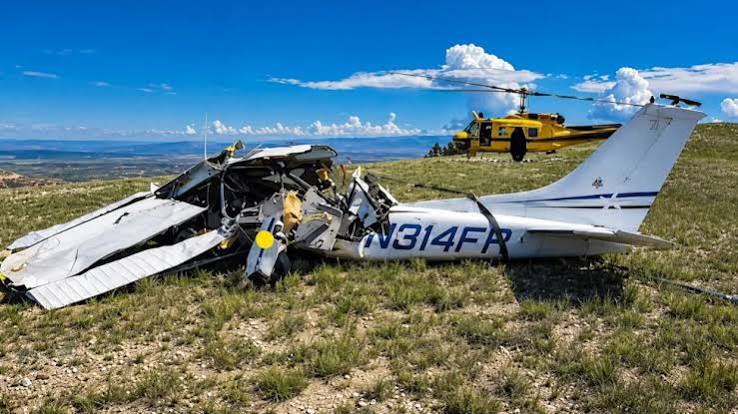
In a remote corner of New Mexico, a civilian aircraft fell from the sky. Investigators are now looking at whether the U.S. military’s GPS jamming exercises—designed to protect troops—may have inadvertently knocked that plane off course. The incident highlights a dangerous collision between national security and civilian safety.
GPS signals are incredibly weak, arriving at Earth’s surface with the power of a 25-watt lightbulb seen from 10,000 miles away. That makes them easy to disrupt. Military tests that jam or spoof these signals can create invisible hazards for pilots who rely on GPS for navigation, especially in small planes.
The Crash and the Suspected Cause
On [date if known, else ‘recently’], a civilian aircraft crashed in New Mexico under circumstances that point to GPS interference from military operations. While the official investigation is ongoing, the core claim is that the military’s jamming or spoofing of GPS signals in the region may have degraded or completely disabled the plane’s navigation systems.
For smaller general aviation aircraft, GPS is not just a convenience; it’s often the primary tool for navigation, terrain awareness, and landing approaches. Lose GPS, and a pilot can become spatially disoriented—especially in poor visibility or over unfamiliar terrain. In New Mexico’s rugged landscape, that can be fatal.
GPS: A Signal You Can’t See, But Can Easily Disrupt
To understand how this happens, you have to appreciate how fragile GPS really is. The signals from satellites travel thousands of miles through space and the atmosphere, arriving at your receiver with power levels around -125 dBm. That’s an incredibly faint signal—roughly equivalent to seeing a 25-watt lightbulb from 10,000 miles away. Any transmitter broadcasting on the same frequency with even modest power can drown it out completely.
Military forces exploit this weakness during training. They use jammers to block GPS signals (causing a loss of navigation) or spoofers to send false signals (tricking a receiver into thinking it’s somewhere it’s not). Spoofing is far more dangerous because a pilot might not realize anything is wrong until the plane is flying into a mountain.
The Military’s Testing Grounds in New Mexico
New Mexico is a hub for military aviation and electronic warfare testing. Installations like White Sands Missile Range, Kirtland Air Force Base, and Cannon Air Force Base regularly conduct exercises that involve GPS interference. These tests are meant to simulate electronic warfare environments and ensure that military systems can operate when GPS is unavailable.
In theory, these tests are coordinated with the Federal Aviation Administration (FAA) through Notices to Air Missions (NOTAMs). Pilots are supposed to check NOTAMs before every flight, and the military is supposed to keep jamming within designated areas. But in practice, things go wrong. There have been documented instances where jamming ‘leaked’ beyond test boundaries, and pilots have reported GPS anomalies over New Mexico and Texas during military exercises as recently as 2022.
Past Warnings and Near Misses
The current crash isn’t an isolated event. In 2022, pilots flying over the American Southwest reported GPS outages and anomalies during military exercises, prompting the FAA to issue warnings. These incidents are often described as ‘gray zone’ events—where jamming occurs without prior notice or extends beyond what was announced. For a pilot in a small plane, a sudden GPS loss can be disorienting, especially if they’ve come to rely on it for navigation.
The Pushback: Safety vs. Security
The military defends these tests as essential for national security. They argue that they follow protocols, issue NOTAMs, and that pilots should be prepared for GPS outages. But aviation safety advocates counter that the current system is insufficient. Small aircraft pilots may not check NOTAMs before every flight, and even if they do, the loss of GPS can be sudden and catastrophic. They advocate for stricter limits on jamming power, better real-time alerts, and mandatory backup navigation systems.
There’s also a legal dimension. If the military’s GPS jamming is found to be a contributing factor in the crash, questions of government liability arise under the Federal Tort Claims Act. However, the military often claims ‘discretionary function’ immunity, arguing that the decision to conduct tests is a policy judgment protected from lawsuits.
The Bigger Picture: GPS as a Single Point of Failure
This crash underscores a growing concern: the aviation industry has become overly reliant on GPS. While GPS is incredibly accurate and convenient, it’s also a single point of failure. As GPS interference—both from military tests and foreign adversaries—becomes more common, the need for redundant systems is pressing. Inertial navigation systems, VOR (very high frequency omnidirectional range) beacons, and ground-based radio beacons can provide backups, but many smaller aircraft lack them.
For pilots, the message is clear: don’t put all your eggs in the GPS basket. For regulators and the military, the challenge is to balance the need for realistic training with the safety of civilian airspace. The New Mexico crash may be the wake-up call that leads to change.
The New Mexico crash is a tragic reminder that GPS is both a marvel and a vulnerability. As military forces continue to test electronic warfare capabilities, they must ensure that civilian pilots aren’t caught in the crossfire. For now, the investigation will determine what exactly went wrong, but the broader lesson is already clear: we need to rethink how we protect and back up the systems that guide us through the skies.
Summary
- A civilian aircraft crash in New Mexico is being investigated as possibly caused by military GPS jamming or spoofing.
- GPS signals are extremely weak and easily disrupted by military jammers or spoofers.
- New Mexico hosts several military installations that conduct electronic warfare tests, with known instances of GPS interference.
- The military defends the tests as essential, but safety advocates argue for stricter limits and better alerts.
- The crash highlights the over-reliance on GPS and the need for backup navigation systems.
FAQ
Q: What is the difference between GPS jamming and spoofing?
A: Jamming blocks GPS signals entirely, causing a loss of navigation. Spoofing sends false GPS signals, tricking the receiver into thinking it’s somewhere it’s not. Spoofing is more dangerous because the pilot may not realize anything is wrong.
Q: How does military GPS testing work?
A: The military uses jammers or spoofers during training exercises to simulate electronic warfare environments. These tests are supposed to be coordinated with the FAA via NOTAMs and limited to specific areas.
Q: Why is GPS so vulnerable to interference?
A: GPS signals reach Earth with very low power, around -125 dBm. This makes them susceptible to disruption by relatively low-power transmitters.
Q: What can pilots do to protect against GPS interference?
A: Pilots should check NOTAMs before flights, be prepared for GPS outages, and maintain proficiency with backup navigation methods like VOR or dead reckoning.
Q: Can the military be held liable for damages from GPS interference?
A: Potentially, under the Federal Tort Claims Act, but the military often claims ‘discretionary function’ immunity, arguing that testing decisions are protected policy judgments.