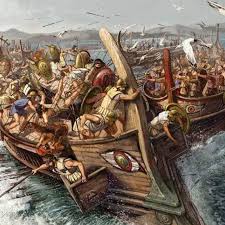
Around 800 BCE, a simple innovation changed the course of human communication: a script of just 22 characters that could record any word in a language. It wasn’t invented by a scholar in a library or a priest in a temple, but by a seafaring people whose ships crisscrossed the Mediterranean, carrying not just goods, but a revolutionary way of writing. This is the story of the Phoenicians and the alphabet they spread from Lebanon to the shores of Europe and Africa.
Before the alphabet, writing was an elite craft. Cuneiform in Mesopotamia and hieroglyphs in Egypt required years of training, with hundreds of signs and complex rules. Literacy was a rare skill, confined to a tiny class of scribes who served kings and temples. The alphabet changed that. With a small set of symbols representing individual sounds, it made writing accessible to merchants, sailors, and ordinary people. It was a democratization of knowledge, and it began with a sea trade.
The Ancient World’s Writing Problem
Writing was invented around 3200 BCE in Sumer (modern Iraq) with cuneiform—wedge-shaped marks pressed into clay tablets. Egypt developed hieroglyphs around the same time. Both systems were powerful but complex. Cuneiform used hundreds of signs for syllables and whole words. Hieroglyphs mixed logograms (symbols for entire words) with phonograms (symbols for sounds), requiring mastery of over 700 signs. A scribe had to train for years, and most people never learned to read or write. In a world where writing was the tool of state bureaucracy and religious ritual, literacy rates likely stayed below 5%.
This complexity was a feature, not a bug, for the powerful. Writing was a source of control. But it was also a practical problem for anyone who needed to record information quickly and cheaply—especially traders and travelers. The alphabet emerged as a simpler alternative, but where did it come from?
The Sinai Clue: Proto-Sinaitic Script
The earliest known alphabetic writing was discovered in the Sinai Peninsula, at sites like Serabit el-Khadim, a turquoise mining area controlled by Egypt. Inscriptions dating to around 1900–1800 BCE were found there, carved into stone and rock. This script, called Proto-Sinaitic, is the missing link between Egyptian hieroglyphs and the later alphabet.
How did it work? The script used a principle called acrophony: each symbol represented the first sound of a Semitic word. For example, the picture of an ox (‘aleph) stood for the sound ‘a’, becoming the letter A. A house (beth) became B. Water (mem) became M. These were not arbitrary signs but simplified pictures borrowed from Egyptian hieroglyphs, repurposed to represent sounds. It was a brilliant shortcut: instead of learning hundreds of signs, you only needed a few dozen.
The people who created this script were likely Semitic-speaking laborers or mercenaries working in the Egyptian mines. They were not Phoenicians, but their innovation set the stage for the alphabet’s later spread. It was a practical tool for recording names and transactions, not a sacred or official script. And because it was simple, it could be adapted by anyone.
The Phoenicians: Merchants and Mariners
The Phoenicians were a Semitic civilization that flourished from about 1500 to 300 BCE along the coast of modern Lebanon, in city-states like Tyre, Sidon, and Byblos. They were renowned as the greatest sailors and traders of the ancient Mediterranean. Their ships carried cedar wood, purple dye, glass, and other goods to ports across the region. They established colonies, most famously Carthage in North Africa, and their trade networks stretched from Cyprus to Spain.
Around 1050 BCE, the Phoenicians standardized the Proto-Sinaitic script into a 22-character consonantal alphabet. It was purely consonantal—no vowels. This was a crucial feature. In Semitic languages like Phoenician, vowels are often predictable from context, so a script without vowels was efficient. The Phoenician alphabet was simple enough to learn quickly, and it was not controlled by any state or religion. That made it highly adaptable.
Phoenician inscriptions have been found along their trade routes, on Cyprus, Sardinia, and in North Africa. They used the script for commercial records, ship logs, and contracts—practical needs of a merchant class. The alphabet was a tool of trade, not of empire. And because it was tied to commerce, it spread wherever Phoenician ships sailed.
The Greek Adaptation: Adding Vowels
The most consequential adaptation of the Phoenician alphabet came around 800 BCE, when the Greeks adopted it. The Greeks were in contact with Phoenician traders, and they saw the value of a simple script. But there was a problem: Greek, an Indo-European language, had vowel sounds that were not predictable without written vowels. The Phoenician script, which had no vowels, would have been ambiguous.
The Greeks solved this with a stroke of genius. They took Phoenician consonants that had no Greek equivalent and repurposed them as vowels. For example, ‘aleph became A, he became E, yod became I, and ‘ayin became O. This created the first true alphabet, with both consonants and vowels. Now any spoken word could be written with full fidelity. This was a revolutionary step—it meant that Greek could be written precisely, which was essential for recording poetry, philosophy, and law.
The Greek alphabet then gave rise to the Latin alphabet, via the Etruscans of Italy, and eventually the script used by most of the world today. The Romans adapted the Greek alphabet, and as the Roman Empire expanded, so did its script. Latin became the alphabet of Western Europe, and later, through colonization and globalization, of the Americas, Africa, and Asia.
The Aramaic Branch: A Sister Tradition
The Phoenician alphabet also had a sister branch: the Aramaic script, which developed in the Near East. Aramaic became the lingua franca of the Persian Empire and later spread across the Middle East. From Aramaic came Hebrew, Arabic, and the scripts of South and Central Asia, including Brahmi and Devanagari, which are used to write Hindi and Sanskrit. So the Phoenician alphabet is not just the ancestor of Latin and Greek—it is the ancestor of writing systems used by billions of people today.
The Real Revolution: Democratizing Literacy
The alphabet’s simplicity was its greatest power. While cuneiform and hieroglyphs required years of study, the alphabet could be learned in weeks. This meant that writing was no longer the exclusive domain of a priestly or scribal elite. Merchants could keep their own records. Sailors could write letters home. Ordinary people could learn to read and write, at least in principle.
This democratization had profound effects. In Greece, literacy spread beyond the palace and temple, enabling the rise of democratic institutions, public philosophy, and written law. The ability to read and write widely allowed ideas to circulate as never before. The alphabet did not cause democracy, but it made it possible for citizens to participate in governance by reading laws and decrees.
The Seafaring Debate: How Did the Alphabet Spread?
The story of the alphabet as a “gift of the sea” is compelling, but some scholars caution against overstating the Phoenicians’ role. The Proto-Sinaitic script was created by land-based miners, not sailors. The Phoenicians may have been transmitters, not inventors. And the alphabet may have spread via land routes—caravans and diplomatic exchanges—as much as by sea. Still, the Phoenicians’ maritime network was a key factor. Their colonies and trading posts provided a vast distribution network for the script. The alphabet was portable, practical, and profitable—perfect for a seafaring people.
The alphabet is one of humanity’s most transformative inventions, and its roots lie in a seafaring culture that spanned the Mediterranean. From the Proto-Sinaitic experiments of Egyptian miners to the Phoenician merchants who carried a 22-letter script across the sea, and finally to the Greeks who added vowels and created the first complete phonetic system, the alphabet’s journey is a story of adaptation and innovation. It democratized literacy, enabled the spread of ideas, and shaped the intellectual history of the world. The next time you write a message, remember: you are using a tool refined by sailors, traders, and scribes over thousands of years.
Summary
- The earliest alphabetic script, Proto-Sinaitic, dates to c. 1900–1800 BCE, found in Sinai, and was created by Semitic workers who simplified Egyptian hieroglyphs using acrophony.
- The Phoenicians standardized a 22-character consonantal alphabet around 1050 BCE and spread it across the Mediterranean through their trade networks.
- The Greeks adapted the Phoenician alphabet around 800 BCE, adding vowels to create the first true alphabet with both consonants and vowels.
- The Latin alphabet, derived from Greek via Etruscan, became the most widely used script, while Aramaic led to Hebrew, Arabic, and Indian scripts like Devanagari.
- The alphabet’s simplicity democratized literacy, breaking the monopoly of scribal elites and enabling broader participation in society and governance.
FAQ
Q: Who invented the alphabet?
A: The earliest known alphabetic script, Proto-Sinaitic, was likely created by Semitic-speaking laborers or mercenaries in Egypt’s Sinai mines around 1900–1800 BCE. They adapted Egyptian hieroglyphs into a sound-based system. The Phoenicians later standardized it, and the Greeks added vowels, creating the true alphabet.
Q: Why did the Greeks add vowels?
A: Greek, an Indo-European language, had vowel sounds that could not be predicted from context alone, unlike in Semitic languages. Without written vowels, Greek writing would be ambiguous. The Greeks repurposed Phoenician consonant signs that had no Greek equivalent to represent vowel sounds.
Q: How did the alphabet spread around the Mediterranean?
A: The Phoenicians, a seafaring trading civilization, spread their alphabet through their maritime networks, colonies, and trade routes. Ships carried goods and ideas, and the script was adopted by other cultures, including the Greeks, who further developed it.
Q: What is acrophony?
A: Acrophony is the principle where a symbol represents the first sound of the word for the object it depicts. For example, the picture of an ox (‘aleph) represents the sound ‘a’, which became the letter A. This made the alphabet easy to learn and remember.
Q: Is the alphabet a purely Phoenician invention?
A: No. The Phoenicians standardized and spread the alphabet, but the Proto-Sinaitic script came first. The alphabet evolved through multiple cultures, with each adapting it to their own language. The Phoenicians were key transmitters, but not the sole inventors.