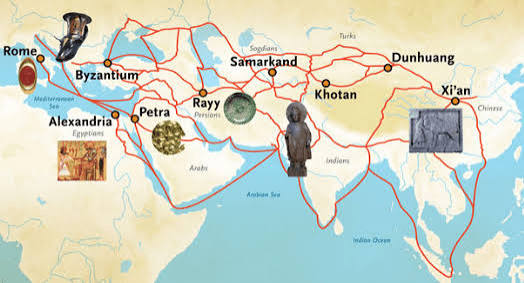
Before the Silk Road ever connected China to Rome, another trade network was already shaping the ancient world. The Incense Route a web of desert caravan tracks stretching from the southern coast of Arabia to the Mediterranean carried frankincense and myrrh that were worth more than gold. It built wealthy kingdoms, sparked cultural exchange, and even influenced the stories we tell today.
Yet this route is often overshadowed by its more famous eastern counterpart. While the Silk Road gets the documentaries and the museum exhibits, the Incense Route was just as transformative arguably more so for the Middle East. It funded grand engineering projects, created legendary cities like Petra, and made Arabian merchants so rich that they controlled the supply of luxury goods for centuries.
This is the story of that forgotten highway and the kingdoms it built.
The Scent of Power: What Was the Incense Route?
The Incense Route was a network of land and sea routes that connected the southern Arabian Peninsula modern-day Oman and Yemen to the Mediterranean world. It operated from roughly the 7th century BCE to the 2nd century CE, with some use continuing into the Islamic period. The primary commodities were frankincense (from the Boswellia sacra tree) and myrrh (from Commiphora myrrha), along with spices, gold, pearls, and textiles.
The overland route ran about 2,000 to 3,000 kilometers from Dhofar and Hadhramaut through the Hejaz, passing through Petra and ending at ports like Gaza and Alexandria. It wasn’t a single road but a network of seasonal tracks dictated by water sources and political alliances. Camels, domesticated around 1300-1000 BCE, could carry 200-300 kilograms and travel about 40 kilometers a day, making the one-way journey from Yemen to Gaza take 60 to 90 days.
The Kingdoms That Rose on Aromatics
The trade didn’t just move goods it built entire civilizations.
The Sabaeans: Sheba’s Wealth
The Sabaeans, based in modern Yemen with their capital at Marib, dominated the southern end of the route from around 1000 BCE. They are famous for the legendary Queen of Sheba and the Marib Dam, an engineering marvel that irrigated over 10,000 acres, supporting a population wealthy enough to field armies and build grand temples. Their wealth came from taxing caravans and controlling the source of frankincense.
The Nabataeans: Desert Masters
Further north, the Nabataeans a nomadic Arab people built Petra, the rock-carved city in modern Jordan. From the 4th century BCE to 106 CE, they controlled the northern terminus of the route. They mastered water conservation with cisterns and aqueducts, allowing them to thrive in the desert. As middlemen, they bought frankincense from South Arabian caravans and resold it to Greeks and Romans at a markup. Their unique script evolved into modern Arabic.
The Mineans and Hadramites
Lesser-known South Arabian kingdoms like the Mineans and Hadramites also controlled segments of the trade. The Hadramite capital at Shabwa was a key stop. These kingdoms, along with the Sabaeans, guarded the secret of frankincense’s source, spreading myths of winged serpents to deter competitors a strategy that kept prices high.
The Economic Engine: Frankincense Worth Its Weight in Gold
The scale of wealth generated was staggering. Pliny the Elder complained that Rome spent 100 million sesterces annually on Arabian luxuries, including spices and perfumes. Frankincense was sometimes valued as highly as gold by weight. This demand was driven by religious use: the resin was burned in temples across Egypt, Greece, and Rome, and later in Christian and Jewish rituals. The biblical Magi brought frankincense and myrrh to Jesus a nod to their immense value.
The trade supported entire industries: harvesting, processing, transport, taxation, and temple rituals. It created a web of economic interdependence that stretched from the Arabian Peninsula to the Mediterranean.
Cultural Exchange and the Spread of Ideas
The Incense Route was more than a commercial corridor—it was a conduit for culture. South Arabian polytheism influenced pre-Islamic Arabian religion. Nabataean art blended Greek, Egyptian, and Mesopotamian styles, visible in Petra’s tombs and temples. The route also facilitated the spread of Aramaic as a lingua franca, enabling communication across different peoples.
These exchanges were not one-way. The Greeks and Romans brought their own goods and ideas back, creating a multicultural milieu along the route. Palmyra, a later oasis city in Syria (1st–3rd century CE), profited from the northern extension, blending Roman and Persian influences.
Why the Route Declined
The Incense Route’s dominance didn’t last forever. By the 2nd century CE, the Romans began using Red Sea shipping, bypassing the overland caravans. The rise of the Aksumite kingdom in Ethiopia created competition from the south. And the South Arabian kingdoms, weakened by internal conflicts and the collapse of the Marib Dam, lost their grip on the trade.
By around 400 CE, the overland route had largely declined, though its legacy persisted. In the Islamic era, trade routes shifted, but the memory of the incense kingdoms lived on in stories and records. The “Year of the Elephant” (c. 570 CE) marked the end of South Arabian dominance, but the route’s impact on the region was permanent.
The Legacy: More Than a Road
The Incense Route built kingdoms, funded engineering marvels, and shaped cultural identities. Its decline was not a disappearance but a transformation. The skills in water management, trade, and diplomacy developed along the route were passed down. Petra remained a symbol of Nabataean ingenuity, and the Sabaean legacy echoed in Ethiopian and Arabian traditions.
Today, the route is a UNESCO World Heritage site, recognized for its role in human history. But it deserves more than a footnote—it was a highway of scent that carried more than perfume; it carried power, ideas, and the seeds of civilizations.
The Incense Route may lack the fame of the Silk Road, but its impact was no less profound. It turned desert tribes into empires, made a resin worth its weight in gold, and connected worlds that seemed impossibly far apart. As we remember the ancient trade networks that shaped our modern world, it’s time to give this forgotten sister her due.
Summary
- The Incense Route predated the Silk Road by centuries, connecting southern Arabia to the Mediterranean from the 7th century BCE.
- It was driven by demand for frankincense and myrrh, used in religious rituals across ancient civilizations.
- The Sabaeans and Nabataeans built wealthy kingdoms by controlling the trade and guarding its secrets.
- The route facilitated cultural exchange, spreading languages, art, and religious ideas.
- Its decline came from Roman shipping, Aksumite competition, and internal instability, but its legacy endured in the region’s culture and heritage.
FAQ
Q: What was the Incense Route?
A: The Incense Route was a network of land and sea trade routes connecting the southern Arabian Peninsula to the Mediterranean, active from roughly the 7th century BCE to the 2nd century CE. It primarily carried frankincense and myrrh, along with other luxury goods.
Q: Why was frankincense so valuable?
A: Frankincense was used in religious rituals across Egypt, Greece, Rome, and later Christian and Jewish traditions. Its supply was limited to specific regions in southern Arabia, and the source was kept secret, making it as valuable as gold by weight.
Q: What kingdoms were built on the Incense Route?
A: The Sabaeans (Sheba), Nabataeans (Petra), Mineans, Hadramites, and later Palmyra all rose to power by controlling segments of the route. Their wealth funded monumental architecture and engineering projects.
Q: How did the Incense Route decline?
A: The route declined due to Roman use of Red Sea shipping, competition from the Aksumite kingdom, and the weakening of South Arabian states. By the 4th–5th century CE, overland trade had largely shifted to other routes.
Q: Why is the Incense Route less famous than the Silk Road?
A: The Silk Road has received more attention in modern popular culture, but the Incense Route was equally important, predating it and shaping the Middle East. Its legacy is now recognized by UNESCO, but it remains less studied in mainstream narratives.