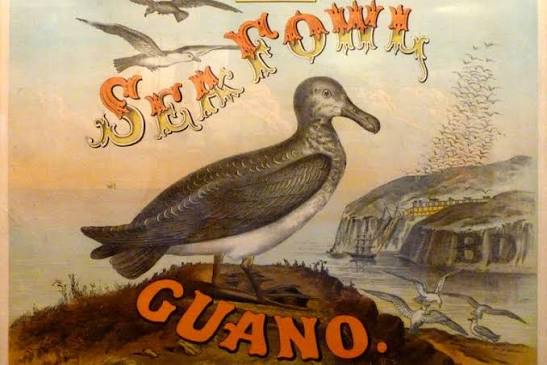
In the mid-1800s, the world’s most sought-after commodity wasn’t gold, oil, or spices it was bird excrement. Peruvian guano, a potent natural fertilizer, sparked a global rush that funded wars, toppled governments, and transformed farming. But the story of this ‘accidental empire’ is more than a tale of manure: it’s a lens through which to see how resource exploitation, geopolitics, and scientific discovery intersected in the 19th century.
Today, when we sprinkle synthetic fertilizer on our gardens, we rarely think about the fact that modern agriculture once depended on the accumulated droppings of seabirds on remote islands. The guano era shaped borders, economies, and labor practices in ways that still resonate. It’s a remarkable chapter in history—one that explains why the U.S. claims tiny Pacific islands, why Chile and Bolivia went to war, and why Peru’s economy boomed and busted.
The Stuff That Made the Desert Bloom
Guano is the accumulated excrement of seabirds, bats, and seals, but in the 19th century, the term meant one thing: the nitrogen-rich deposits on arid islands off the coasts of Peru, Chile, and Namibia. These islands had the perfect recipe for guano formation: a rainless climate that wouldn’t wash the nutrients away, massive seabird colonies (cormorants, boobies, and pelicans), and the cold, nutrient-rich Humboldt Current that supported enormous fish populations—which the birds ate and turned into fertilizer.
Peruvian guano was exceptionally potent, with nitrogen content often exceeding 12–15%, compared to modern synthetic fertilizers. That nitrogen, along with phosphorus and potassium, made it a superfood for crops. But it wasn’t just the chemistry that mattered; it was the scale. Over millennia, seabirds had deposited layers of guano dozens of feet thick on islands like the Chincha Islands, creating a seemingly endless supply.
The Agricultural Crisis That Created a Monster Demand
By the early 1800s, European agriculture was in trouble. Centuries of intensive farming had exhausted the soil, and traditional fertilizers—animal dung, night soil, bone meal—were nowhere near enough. The Industrial Revolution had also driven rapid urbanization, meaning more mouths to feed with fewer hands in the fields. It was a genuine crisis, often called the ‘manure crisis.’
Enter science. In 1840, German chemist Justus von Liebig published Organic Chemistry in Its Application to Agriculture and Physiology, proving that plants need specific mineral nutrients. This made guano’s value scientifically undeniable, not just folkloric. When Prussian naturalist Alexander von Humboldt brought guano samples back to Europe in 1802, they were a curiosity. By the 1840s, they were a strategic resource.
The demand was explosive. British farmers, in particular, were desperate, and guano became a household word. At its peak, a ton of guano sold for $50–$80 in Europe—equivalent to several thousand dollars today. It was literally worth its weight in gold, and the race was on.
Peru’s Boom and Bust
Peru was sitting on the world’s richest guano deposits, accumulated over millennia on its rainless islands. The government nationalized extraction and contracted foreign firms—mostly British—to mine and ship the stuff. Between 1848 and 1875, Peru exported an estimated 11–12 million tons of guano.
The revenue was staggering. At its peak, guano funded roughly 60% of Peru’s national budget. The money paid off foreign debt, built railroads, and financed a lavish state apparatus. It was a classic ‘resource curse’—a sudden influx of wealth that distorted the economy and created dependency.
But the boom had a dark side. The labor force was composed of convicts, Chinese indentured laborers (over 100,000 between 1849 and 1874), and conscripted indigenous workers. Conditions were brutal. Workers inhaled guano dust, which caused respiratory diseases, and they faced exhaustion, malnutrition, and high mortality. The guano islands were, in effect, a prison and a death sentence for many.
The U.S. Guano Islands Act: Claiming Islands for Bird Poop
American farmers also needed fertilizer, and U.S. merchants and whalers had already been scooping up guano from Caribbean and Pacific islands. In 1856, Congress passed the Guano Islands Act, which allowed any U.S. citizen to claim an unoccupied guano island for the United States. Once claimed, the island became U.S. territory.
This legislation was a foundational piece of U.S. overseas expansion, predating the more famous acquisitions of Alaska, Hawaii, and the Philippines. Under the Act, the U.S. claimed over 100 islands. Many of those claims are still U.S. territories today—Baker Island, Howland Island, and Jarvis Island, for instance, are almost entirely forgotten, but they remain part of the United States because of bird droppings. The Act is still on the books, vestigial but never repealed.
The War of the Pacific: When Fertilizer Caused a War
Guano wasn’t just an economic resource; it was a geopolitical flashpoint. The Atacama Desert, which stretched across the borders of Chile, Peru, and Bolivia, contained both guano deposits and sodium nitrate—another fertilizer and a key ingredient in gunpowder. In 1879, disputes over taxation and control of these resources erupted into the War of the Pacific.
Chile fought against Peru and Bolivia, and won decisively. Chile annexed Peru’s southern provinces and took Bolivia’s entire coastline, leaving Bolivia landlocked to this day. Peru’s guano economy collapsed, and the country was left bankrupt and politically destabilized. The war was, in many ways, a fight over who would control the literal excrement that kept global agriculture alive.
The Decline: Faster Than the Birds Could Poop
Guano deposits were mined faster than they could regenerate. Seabird guano accumulates at a rate of just 1–2 mm per year, so the islands’ reserves were finite. By the 1870s, the quality of Peruvian guano was visibly declining as miners reached lower-grade deposits.
The final blow came with the development of the Haber-Bosch process in the early 20th century. In 1909–1913, German chemists Fritz Haber and Carl Bosch figured out how to synthesize ammonia from atmospheric nitrogen, creating a virtually unlimited source of nitrogen fertilizer. This broke the link between food production and mined excrement.
Synthetic fertilizer didn’t just replace guano; it revolutionized agriculture. The world’s food supply no longer depended on the whims of seabird populations or political control of remote islands. But the guano era left its mark: it accelerated the expansion of synthetic fertilizers, which now feed billions of people. Ironically, the modern agricultural system that guano helped create is the very system that made guano obsolete.
The guano boom was a bizarre and brutal chapter in global history. It was a period when the world’s most powerful nations fought over bird droppings, when Peru’s economy soared and crashed, and when the U.S. quietly expanded its empire one island at a time. But it also laid bare the fragility of a world dependent on a single, non-renewable resource. The lessons from the guano era—about resource exploitation, labor practices, and the environmental costs of agriculture—are still relevant today. Next time you fertilize your garden, remember: it wasn’t always as simple as a bag from the hardware store.
Summary
- Guano is the accumulated excrement of seabirds, rich in nitrogen, phosphorus, and potassium, and was a vital fertilizer in the 19th century.
- Peruvian guano exports funded ~60% of the national budget during the boom years (1848–1875), but extraction relied on brutal labor.
- The U.S. Guano Islands Act of 1856 led to the claim of over 100 islands, many of which remain U.S. territories today.
- The War of the Pacific (1879–1884) was fought over guano and nitrate-rich territories, leaving Bolivia landlocked and bankrupting Peru.
- The Haber-Bosch process (1909–1913) made synthetic nitrogen fertilizer, displacing guano and transforming global agriculture.
FAQ
Q: What exactly is guano?
A: Guano is the accumulated excrement of seabirds, bats, or seals. In the 19th-century trade, it referred specifically to seabird guano from arid islands, prized for its high nitrogen content.
Q: Why was Peruvian guano so valuable?
A: Peruvian guano had an exceptionally high nitrogen content (often 12–15%), making it an extremely effective fertilizer for nitrogen-hungry crops. It also contained phosphorus and potassium, essential plant nutrients.
Q: How did the Guano Islands Act affect U.S. territory?
A: The Act allowed U.S. citizens to claim unoccupied guano islands for the U.S., leading to the acquisition of over 100 islands. Many remain U.S. territories today, such as Baker Island and Howland Island.
Q: What caused the War of the Pacific?
A: The war was fought over control of the Atacama Desert, which contained valuable guano and sodium nitrate deposits. Chile defeated Peru and Bolivia, annexing territory and leaving Bolivia landlocked.
Q: Why did guano stop being used?
A: Guano deposits were depleted faster than they could regenerate, and the Haber-Bosch process (developed 1909–1913) allowed synthetic production of ammonia fertilizer, which was cheaper and unlimited in supply.