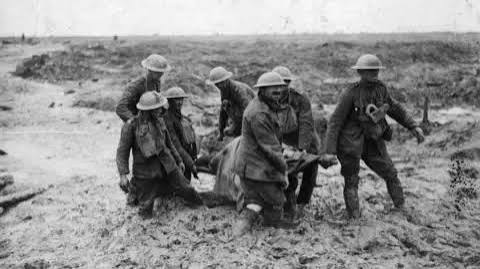
The Third Battle of Ypres, known to history as Passchendaele, lasted 103 days and produced one of the most haunting images of the First World War: soldiers, horses, and even entire guns sinking into a sea of mud. The battle was fought over a few kilometers of Belgian farmland that became a swamp, and its name is now synonymous with the brutality and futility of trench warfare.
But Passchendaele was not just a meaningless slaughter—it was a calculated, if flawed, strategic gamble. The British commander, Sir Douglas Haig, believed he could break the German line and relieve pressure on the exhausted French army. Instead, the offensive became a brutal war of attrition, costing hundreds of thousands of casualties for a strip of ground that would be abandoned in the German spring offensives of 1918.
This article explores the facts, the mud, and the human cost of Passchendaele, and asks why the battle remains a symbol of the Great War’s tragedy.
A Salient That Became a Trap
The battle was fought around the Ypres Salient, a bulge in the Allied line that had been held since 1914. The town of Ypres was a symbol of Belgian resistance, but it was surrounded on three sides by German-held ridges. The most important of these was Passchendaele Ridge, a low rise that gave the Germans perfect observation over the British positions.
For two years, the Allies had tried to break out of the salient, but every attack was met with devastating German fire. Haig’s plan in 1917 was to capture the ridge and then push on to the Belgian coast, where German submarine bases at Zeebrugge and Ostend were strangling Britain’s supply lines. He also needed to keep the Germans busy while the French recovered from a series of mutinies that had left their army in disarray.
The Artillery That Destroyed the Ground
The offensive began with a massive artillery bombardment. Over 4.25 million shells were fired in ten days, more than in any previous battle. The idea was to destroy German barbed wire, trenches, and gun positions, and to allow the infantry to advance with minimal opposition.
But the bombardment had a devastating side effect. The area around Ypres was reclaimed marshland, drained by a network of ditches and pumps. The shells tore up the drainage system and churned the clay soil into a waterlogged moonscape. Every shell hole became a potential death trap, filling with water and mud. When the infantry attacked on 31 July 1917, they found the ground already turning to sludge.
The weather made things worse. August 1917 was the wettest in thirty years. Rain began on the first day of the battle and continued almost without letup. The mud became so deep that men and animals drowned in shell holes. Rifles jammed, artillery pieces sank, and wounded soldiers were lost in the mire.
The Phases of the Battle
The battle was not one continuous push but a series of separate engagements, each with its own name and its own tragedy.
Pilckem Ridge and Langemarck: The Hopes and the Rain
The opening attack, the Battle of Pilckem Ridge (31 July – 2 August), made some initial gains. British, French, and Belgian troops advanced up to 1.8 kilometers in places, capturing German positions and taking thousands of prisoners. But German counterattacks, combined with the rain, halted the advance.
The Battle of Langemarck (16–18 August) was a follow-up attempt. It achieved little, and the mud was already slowing movement and making artillery support unreliable. The infantry struggled to keep up with the creeping barrage, and many attacks failed in the morass.
Plumer’s ‘Bite and Hold’: A Brief Success
In September, Haig handed command of the main effort to General Herbert Plumer, who adopted a different tactic: ‘bite and hold.’ Instead of trying to break through, the Allies would advance in small, well-supported steps, each one capturing a limited objective and then digging in to repel counterattacks.
This approach worked. At the Battle of Menin Road (20–25 September) and Polygon Wood (26 September – 3 October), the Allies gained ground with relatively low casualties. The Battle of Broodseinde (4 October) was the most successful day of the entire offensive: Australian and New Zealand troops overran German positions and captured the ridge’s crest.
But then the rain returned with a vengeance. The low ground turned into a quagmire, and the next attacks bogged down.
The Mud at Poelcappelle and Passchendaele
The Battle of Poelcappelle (9 October) was a disaster. The infantry could barely move, and many men fell into shell holes and drowned. The First Battle of Passchendaele (12 October) was fought by the ANZACs, who suffered heavy casualties for no gain. The mud was so deep that the wounded could not be evacuated, and many died where they lay.
The Canadian Corps, under Lieutenant-General Arthur Currie, was brought in for the final push. Currie had initially opposed the attack, calling it ‘not a matter of military skill but of pure endurance.’ But he obeyed orders. The Second Battle of Passchendaele (26 October – 10 November) was a series of bloody, step-by-step advances. On 6 November, Canadian troops finally captured the ruined village of Passchendaele. The ridge was in Allied hands.
The Cost of the Ridge
By the time the battle ended on 10 November, the Allies had gained about eight kilometers of ground. The cost was staggering: between 275,000 and 325,000 Allied casualties (killed, wounded, or missing). German casualties are harder to estimate, but they were likely between 220,000 and 260,000, with some sources suggesting as many as 400,000.
In some sectors, the ground gained was measured in yards. The official British history calculated that the offensive cost about one man per square yard of ground taken. The village of Passchendaele, which had been the objective, was a pile of rubble. The ridge was captured, but it was a hollow prize: the Germans simply withdrew to a new defensive line, and the ground was abandoned in 1918.
The Generals and the Men
The battle raised questions that are still debated today. Haig argued that it was necessary to wear down the German army and prevent a collapse of the Allied war effort. He believed the Germans were near exhaustion. But his critics, including Prime Minister David Lloyd George, called it a reckless gamble. Lloyd George later wrote that the battle was ‘a reckless gamble’ that could have been avoided.
The German perspective was different. They adopted a defense-in-depth strategy, using concrete pillboxes and counterattack divisions to inflict maximum casualties on the Allies. They, too, suffered heavily, but they could afford it less. Ludendorff later wrote that the battle ‘placed the German army under a strain from which it never recovered.’
For the men who fought, the mud was the enemy. One soldier wrote: ‘The mud is not just mud—it is a living thing that grips you, pulls you down, and swallows you.’ The battle became a byword for the horror of the Western Front.
The Legacy of Passchendaele
Passchendaele did not win the war. It did not break the German line, and it did not capture the submarine bases. It was a tactical success, in that the Allies held the ground they had gained, but it was a strategic failure. The German army was damaged, but it was not destroyed, and the war would drag on for another year.
Yet the battle had a profound effect on the course of the war. It forced the Germans to commit reserves that they could not replace. It also demonstrated the limits of attrition as a strategy. And it gave the world a new symbol of the futility of war: the image of a soldier sinking into the mud, unable to move, waiting for death.
The battle is remembered today through the Menin Gate Memorial in Ypres, which bears the names of 54,000 missing British and Commonwealth soldiers. Every night at 8 p.m., the Last Post is sounded under the arch, a ceremony that has taken place almost without interruption since 1928. The names on the gate are a reminder of the cost of the battle, and of the folly of war.
In the end, the ground gained at Passchendaele was given back in 1918. But the men who died there are not forgotten. Their sacrifice, like the mud, remains a part of the landscape.
Passchendaele is a lesson in the limits of military power. It shows what happens when ambition outruns the terrain, the weather, and the endurance of soldiers. The battle was not just a defeat or a victory—it was a tragedy that consumed hundreds of thousands of lives for a few kilometers of mud. And yet, it was also a testament to the courage of the men who fought, and to the resilience of the human spirit in the face of unimaginable horror. The memory of Passchendaele should serve as a warning, not just about war, but about the dangers of pursuing an objective at any cost.
Summary
- Dates and Duration: The Third Battle of Ypres lasted from 31 July to 10 November 1917, a total of 103 days.
- Casualties: Allied casualties were between 275,000 and 325,000; German casualties were between 220,000 and 260,000.
- Terrain: The battle was fought over reclaimed marshland that was destroyed by artillery and rain, turning into a swamp.
- Key Tactics: The ‘bite and hold’ tactics under General Plumer were initially successful, but the rain and mud made later attacks impossible.
- Outcome: The Allies captured Passchendaele Ridge, but the gain was small and was abandoned in 1918. The battle is remembered as a symbol of the futility of trench warfare.
FAQ
Q: Why is the battle called ‘Passchendaele’?
A: The battle is named after the village of Passchendaele, which was the final objective. The village was on a ridge that gave the Allies a vantage point over the German lines. The name became synonymous with the battle and its horrors.
Q: How many people died at Passchendaele?
A: Estimates vary, but the total number of casualties (killed, wounded, and missing) for both sides is around 500,000 to 600,000. The exact number is difficult to determine due to the nature of the fighting and the mud.
Q: What was the ‘bite and hold’ tactic?
A: This was a tactic used by General Plumer in September 1917. Instead of a full breakthrough, the Allies would advance in small steps, capture a limited objective, and then dig in and defend it against German counterattacks. This was initially successful, but the rain and mud made it impossible to maintain.
Q: Did the battle have any strategic impact?
A: The battle did not achieve its main objectives of breaking the German line or capturing the submarine bases. It did, however, inflict heavy casualties on the German army and forced them to use reserves. Some historians argue that it contributed to the eventual Allied victory in 1918.
Q: What is the Menin Gate?
A: The Menin Gate is a memorial in Ypres, Belgium, that commemorates the missing British and Commonwealth soldiers who died in the Ypres Salient. It lists over 54,000 names. The Last Post is played there every evening as a tribute.