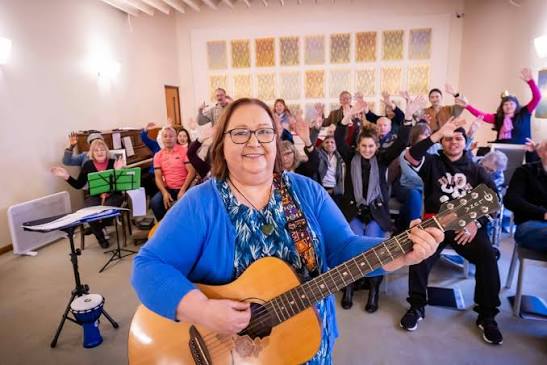
Imagine losing the ability to speak clearly, to find the right word, or to move with ease yet still being able to sing a familiar song from start to finish. For many people living with Parkinson’s disease, stroke-induced aphasia, or dementia, this is not a fantasy but a weekly reality in community choirs built around their needs. Over the past two decades, a growing body of research has shown that singing in a choir offers measurable therapeutic benefits, from improving speech and respiratory function to lifting mood and fostering social connection. The science behind this is as compelling as the sound: singing activates brain regions that speech cannot, creating new neural pathways around damaged areas. This article explores how something as simple as raising your voice in harmony can hit the right note for brain health.
The Brain on Choir Singing: More Than Just Music
When you speak, your brain relies heavily on the left hemisphere. But singing is different: it engages both hemispheres, tapping into right-brain regions that handle melody, rhythm, and emotion. This bilateral engagement is the key to why choir singing helps people with neurological damage. For someone with a left-hemisphere stroke that impairs speech, singing can “re-route” the message through intact right-hemisphere pathways. This is the same principle behind melodic intonation therapy (MIT), a clinical technique where patients sing phrases in a sing-song pattern to recover language. Choir singing is a community-based, joyful extension of that therapy.
Moreover, the rhythmic structure of singing activates the motor system, which is why people with Parkinson’s disease often find it easier to walk or move in time to music. This effect, known as rhythmic auditory stimulation, has been shown to improve gait and reduce freezing episodes. Singing also strengthens respiratory muscles, increasing breath control and voice volume—a common challenge for Parkinson’s patients who speak softly.
What the Research Shows: From Voice Volume to Mood
One of the most extensively studied programs is “Singing for Parkinson’s,” a UK initiative that has been the focus of research by the Royal College of Music and the University of London. Studies have found that participants improve in voice volume and swallowing function—both critical for daily living. In one study, after just a few months of weekly sessions, patients sang with more power and spoke more loudly, reducing the social isolation that comes from being hard to hear.
In dementia care, the “Sing to Remember” program at the University of Sydney has shown that choir participation improves cognition and quality of life scores. Depression scores drop, and participants often display more positive affect. A key finding is that even when dementia has eroded memory and language, familiar songs can unlock memories and emotions, allowing people to reconnect with their identities. This counters the “loss of self” that many patients report after diagnosis.
Aphasia choirs, which exist in the UK and US, demonstrate a remarkable phenomenon: people who cannot speak a single word can sing entire lyrics fluently. This is because singing relies on different neural circuits than speech, allowing expression to flow when conversation is impossible. For someone with severe aphasia, singing is a lifeline to communication and self-expression.
The Social Prescription: Choirs as a Safe Haven
Beyond the neurological benefits, choir singing addresses a profound psychological need: connection. A diagnosis of a brain condition often brings what researchers call “social death.” People withdraw because they can no longer keep up in conversations or move normally. They feel stigmatized and isolated. Choirs offer a structured, low-pressure environment where everyone sings together, and mistakes are absorbed by the group—a “safe failure” space.
In these choirs, there is no expectation to converse fluently; the music itself is the communication. This reduces anxiety and fosters a sense of belonging. Many programs also include caregivers, providing them with a shared positive activity and alleviating the burden of care. The result is a community where people are valued for their participation, not their deficits.
A Brief History and the Current Landscape
The idea of using community singing for health is not new, but clinical recognition has grown only in the last 15–20 years. The Alzheimer’s Society’s “Singing for the Brain” program began in the UK in 2003 and has since expanded globally. Parkinson’s-specific choirs, such as the Parkinson’s Voice Project in the US, have multiplied since 2010. Today, programs exist across the UK, US, Australia, Canada, and Europe, often led by music therapists or speech-language pathologists with neurological training. Some are integrated into hospital rehabilitation services, while others are community-based charities.
A notable development is the rise of online choirs during the COVID-19 pandemic. Telehealth choir sessions have made participation possible for housebound patients, and many have continued in hybrid form, expanding access to those who cannot travel. This has opened new doors for people in rural areas or with mobility issues.
Beyond Parkinson’s: Emerging Applications
While Parkinson’s disease has the most research, the benefits extend to other conditions. Studies are emerging for multiple sclerosis (MS), traumatic brain injury (TBI), and Huntington’s disease, with preliminary findings suggesting improvements in mood, respiratory function, and social connection. The underlying mechanisms—bilateral brain activation, rhythmic engagement, and emotional regulation—are likely universal across neurological conditions.
The broader “Music and Memory” movement has underscored how music can unlock memories in dementia, and choir singing is a social, active form of this. The evidence is clear: choir singing is not just a pleasant pastime; it is a therapeutic tool that can improve quality of life in measurable ways.
How to Get Involved or Start a Program
If you or a loved one lives with a neurological condition, joining a choir could be a transformative step. Search for local “Singing for Parkinson’s,” “Singing for the Brain,” or aphasia choirs. Many are free or low-cost, and they welcome people at all skill levels—no musical experience required. For healthcare professionals, consider referring patients to these groups as adjunctive therapy. And for community leaders, starting a choir requires a trained leader, a supportive venue, and a willingness to embrace the power of song. The research shows that the payoff is real: better speech, brighter mood, and a stronger sense of self.
Choir singing offers a unique blend of neurological, psychological, and social benefits that can significantly improve the lives of people with brain conditions. From enabling speech in aphasia to steadying gait in Parkinson’s, the act of singing together rewires the brain and reconnects the individual. As research continues to expand, these choirs are moving from the margins of therapy to the mainstream of care. The next time you hear a choir, remember: for some, it is not just music—it is medicine.
Summary
- Singing engages both brain hemispheres, enabling neuroplastic rerouting around damage.
- Choir singing improves speech, respiratory function, and voice volume in Parkinson’s and stroke patients.
- Group singing reduces depression and improves cognition in dementia patients.
- Aphasia patients can sing lyrics they cannot speak, offering a vital communication outlet.
- Choirs provide social connection and reduce isolation, countering the ‘social death’ of neurological diagnosis.
FAQ
Q: Is choir singing a replacement for speech therapy or medication?
A: No. Choir singing is considered an adjunctive therapy—it complements, but does not replace, standard treatments. It works alongside speech-language therapy and medication to enhance outcomes.
Q: Do I need to be a good singer to join a choir for neurological conditions?
A: Absolutely not. These choirs are designed for people with all levels of ability. The focus is on participation and enjoyment, not performance quality. No musical training is required.
Q: What conditions can benefit from choir singing?
A: The most research supports benefits for Parkinson’s disease, stroke (especially aphasia), and dementia. Emerging evidence also points to benefits for multiple sclerosis, traumatic brain injury, and Huntington’s disease.
Q: Can I join an online choir if I am housebound?
A: Yes. Many choirs now offer online or hybrid sessions, which became popular during the COVID-19 pandemic. This allows people with mobility issues or in remote areas to participate from home.
Q: How do I find a choir for someone with a neurological condition?
A: Start by searching for local programs like ‘Singing for Parkinson’s,’ ‘Singing for the Brain,’ or aphasia choirs. These are often run by music therapists or speech-language pathologists. Your healthcare provider may also have referrals.