At 00:16 on June 6, 1944, the first American paratroopers of the 82nd Airborne Division dropped into the darkness above Normandy. Their mission was to secure the town of Sainte-Mère-Église, a crossroads vital to the success of the largest seaborne invasion in history. Within hours, they would be followed by thousands more, and by dawn, the sea itself would churn with the largest armada ever assembled.
The D-Day landings were not a single battle but a sprawling, chaotic, and deadly operation that stretched across 50 miles of French coastline. It was the culmination of years of planning, a supreme gamble on weather, and a testament to the courage of ordinary soldiers facing an entrenched enemy. This is the story of how that day unfolded—from the tense decision-making in Allied headquarters to the blood-soaked sand of Omaha Beach.
The Decision to Go
In the spring of 1944, General Dwight D. Eisenhower faced a dilemma that would define the war. The invasion of Western Europe, code-named Operation Overlord, had been planned for months, but the weather was uncooperative. On June 3, a storm swept across the English Channel, whipping up waves and clouds that would make an amphibious landing nearly impossible. Eisenhower, the Supreme Commander of the Allied Expeditionary Force, had set June 5 as the launch date, but his chief meteorologist, James Stagg, warned of a break in the weather—a narrow window of improved conditions on June 6.
Eisenhower hesitated. The Germans, convinced that no invasion would come in such rough seas, had let their guard down. In a series of tense meetings, Eisenhower polled his commanders. Some agreed with the delay; others wanted to go. Finally, at 4:00 AM on June 5, Eisenhower made the call: “OK, we’ll go.” That decision, made in a damp English manor house, would send 156,000 troops into battle the next day.
The Atlantic Wall and the Deception
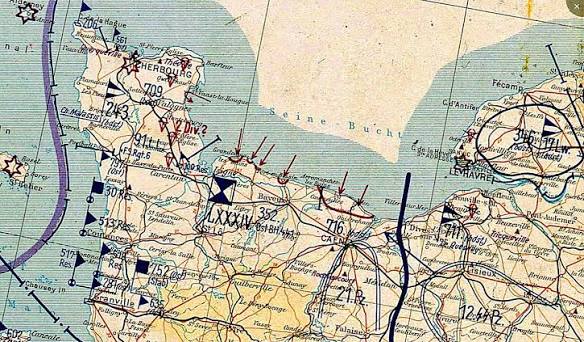
The Germans had spent years building the Atlantic Wall—a chain of fortifications stretching from Norway to the Spanish border. But the wall was not a single barrier; it was a patchwork of concrete bunkers, beach obstacles, and gun emplacements, some formidable, others incomplete. Field Marshal Erwin Rommel, assigned to defend the coast, believed the invasion must be stopped on the beaches. He had mined the shallows and strung barbed wire, but he could not be everywhere. The Allies, meanwhile, had launched Operation Bodyguard, a massive deception campaign designed to convince the Germans that the main attack would come at Pas-de-Calais, the closest point to England. They created a fictional army under George Patton, complete with inflatable tanks and fake radio traffic. The ruse worked: German reserves, including the powerful 15th Army, were held back from Normandy for weeks, waiting for an invasion that would never come.
The Airborne Assault
In the darkness before dawn, the skies over Normandy filled with aircraft. Around 13,000 paratroopers of the U.S. 82nd and 101st Airborne Divisions, along with the British 6th Airborne, jumped into the unknown. Their mission was to secure the flanks of the invasion beaches, capture key bridges, and disrupt German communications. But the drops were scattered by cloud cover and anti-aircraft fire. Men landed in flooded fields, on rooftops, and in the middle of German positions. At Sainte-Mère-Église, Private John Steele’s parachute caught on the church steeple, where he hung for two hours, playing dead to avoid capture. Despite the chaos, the paratroopers managed to achieve their objectives. By dawn, they had secured the village and were holding the line, their presence sowing confusion in the German ranks.
The Beaches
The seaborne assault began at 6:30 AM. The invasion force was divided into five sectors: Utah and Omaha for the Americans, Gold and Sword for the British, and Juno for the Canadians. At Utah, the landings were relatively easy—the troops came ashore on the wrong part of the beach, but the German defenses were light, and by noon, the 4th Infantry Division had pushed inland. At Gold and Sword, the British and Canadian forces faced stiff resistance but managed to secure their objectives, including the capture of the crucial Caen Canal bridge, later known as Pegasus Bridge, by glider-borne troops.
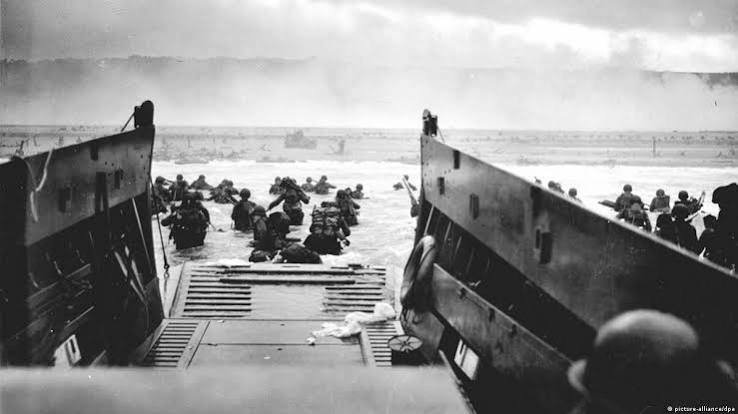
Omaha Beach was different. The Americans faced the 352nd Infantry Division, a crack German unit that had been moved there for training. The naval bombardment, meant to soften the defenses, had missed many of the bunkers. As the landing craft opened their ramps, the men were met with a murderous crossfire from the bluffs above. The first waves were decimated. Many soldiers were killed before they could even reach the water. For hours, the landing seemed to be a disaster. But slowly, small groups of men—many of them from the 1st and 29th Infantry Divisions—managed to climb the bluffs and knock out the German positions. By nightfall, they had carved out a beachhead, but at a cost of over 2,400 casualties, the highest of any sector.
The German Response
The Germans were caught off guard. Rommel was in Germany celebrating his wife’s birthday; many senior officers were away from their posts. The initial reaction was confusion. Hitler, who had been asleep, was not awakened until late morning. When he finally authorized the release of the Panzer divisions, it was already too late. The reserves, held back for the expected invasion at Pas-de-Calais, were slow to move, and Allied air superiority made their journey to the beaches a deadly gauntlet. By the end of the day, the Allies had landed over 156,000 troops and established a foothold. The Atlantic Wall had been breached, but the battle for Normandy was far from over.
The Human Cost
D-Day’s success came at a terrible price. Allied casualties on June 6 are estimated at around 10,000, with over 4,400 confirmed dead. The Americans suffered the most, particularly at Omaha. German casualties are estimated between 4,000 and 9,000, but the true numbers are unknown. French civilians also paid a heavy toll. In the weeks leading up to the invasion, Allied bombing raids targeted roads, bridges, and railways, killing thousands of civilians. The town of Caen, a key objective, was almost completely destroyed, and its liberation would not come until July. For the French, the war was not just a distant struggle; it was a brutal reality that shattered their homes and lives.
The Road to Victory
The D-Day landings were not the end of the war, but they were the beginning of the end. The lodgment area in Normandy, though initially shallow, grew over the following weeks as the Allies fought through the hedgerows. The German army, though defending fiercely, was slowly pushed back. The liberation of Paris came in August, and by September, the Allies were on the German border. But the road was long and bloody. The Battle of the Bulge in December would prove that the Germans were still capable of a deadly counterattack. Yet D-Day had irrevocably changed the course of the war. It established a second front in Western Europe, forcing Germany to fight a two-front war against the Soviets in the east and the Western Allies in the west. The eventual defeat of Nazi Germany was now a matter of time.
The Debate: Was D-Day Decisive?
Historians have long debated the significance of D-Day relative to the Eastern Front. Some argue that the Soviet Union bore the brunt of the German war machine and that the Red Army’s victories were more decisive. Others contend that the Western Allied invasion, with its massive logistical and industrial power, was essential to breaking Germany’s ability to fight. The truth is that both fronts were crucial. D-Day opened a new theater that forced Germany to disperse its forces, and the Allied strategic bombing campaign—which had been crippling German industry and transportation—could now be supported by ground forces advancing toward the heart of the Reich. The invasion also had a profound psychological impact, demonstrating to the world that the Allies were committed to the liberation of Europe.
The D-Day landings were a turning point, not just in military terms, but in the moral arc of the war. They were a demonstration of what free nations could achieve when they pooled their resources and their courage. The day’s heroism—from the paratroopers in the dark to the men struggling ashore on Omaha—has been immortalized in books, films, and memorials. But the true legacy of D-Day is not merely in the battle itself, but in the peace that followed. The invasion of Normandy was the first step toward the liberation of Western Europe and the eventual end of Nazi tyranny. It is a day that reminds us of the cost of freedom and the resolve required to defend it.
Summary
- Approximately 156,000 Allied troops landed on D-Day, supported by 11,000 aircraft and 7,000 naval vessels.
- The operation involved five beach sectors: Utah, Omaha (U.S.), Gold, Sword (British), and Juno (Canadian).
- A massive deception operation (Bodyguard) convinced the Germans that the invasion would come at Pas-de-Calais, not Normandy.
- The bloodiest fighting was at Omaha Beach, where American forces suffered over 2,400 casualties.
- Allied casualties on D-Day are estimated at 10,000, with 4,400 confirmed dead.
FAQ
Q: Why was Normandy chosen for the invasion instead of Pas-de-Calais?
A: Normandy was chosen because it was within range of Allied fighter aircraft, had suitable beaches, and was less heavily fortified than Pas-de-Calais. The shorter crossing to Pas-de-Calais made it an obvious target, so the Germans built stronger defenses there. Normandy also offered the advantage of surprise, as the Allies’ deception campaign led the Germans to expect the main attack elsewhere.
Q: What was the role of the French Resistance on D-Day?
A: The French Resistance played a crucial role in the days before and after D-Day. They carried out acts of sabotage, cutting telephone lines, disrupting rail lines, and ambushing German convoys. They also provided valuable intelligence to the Allies about German troop movements. The BBC broadcast coded messages to coordinate these actions, with phrases like “the dice are on the table” signaling the start of the invasion.
Q: How did the weather affect the invasion?
A: The invasion was originally scheduled for June 5, but poor weather forced a 24-hour delay. Eisenhower’s decision to go on June 6 was based on a narrow weather window—a break in the storms that would allow the landings to proceed. The Germans, believing the weather was too rough for an invasion, were caught off guard, which contributed to the initial success of the landings.
Q: What were the Mulberry harbors?
A: The Mulberry harbors were artificial portable harbors built by the Allies to supply the invasion forces. They were constructed in England and towed across the Channel, then assembled off the Normandy coast. Two were built, one at Omaha Beach and one at Gold Beach, but the one at Omaha was destroyed by a storm on June 19. The remaining harbor was used for months to bring in troops, vehicles, and supplies.
Q: How many casualties did the Allies suffer on D-Day?
A: Allied casualties on D-Day are estimated at around 10,000, with 4,400 confirmed dead. The Americans suffered the most, with about 2,400 casualties at Omaha Beach alone. German casualties are estimated between 4,000 and 9,000, but the exact numbers are uncertain. Civilian casualties in Normandy were also significant, with many French citizens killed in the bombing and fighting.