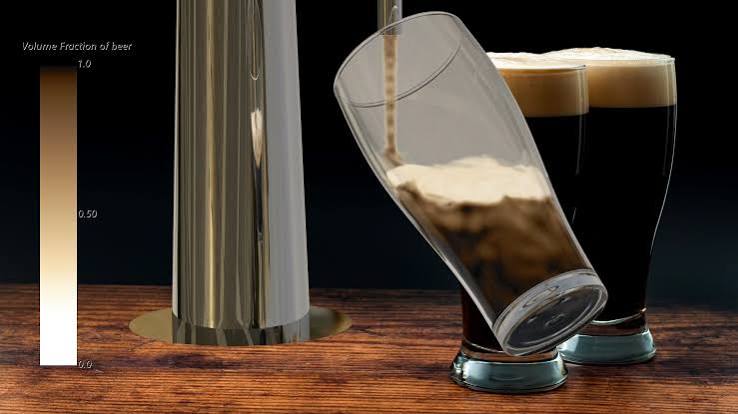
When you order a pint of Guinness, the bartender performs a ritual: tilt the glass at 45 degrees, fill it three-quarters full, let it settle, then top it off. The result is a mesmerizing cascade of bubbles that sink before they rise, and a creamy head that lasts. This isn’t just showmanship; it’s physics. The settling bubbles and the formation of the head are governed by fluid dynamics, the same principles that explain ocean currents and weather patterns. Understanding the math and science behind your stout reveals a hidden complexity in a simple pint.
Guinness is not your average beer. It’s a nitrogenated stout, which means it uses a blend of 75% nitrogen and 25% carbon dioxide, unlike most lagers that use pure CO₂. This difference changes everything about how the beer looks and feels. The nitrogen creates smaller, finer bubbles, and it’s these tiny bubbles that orchestrate the famous surge. The cascade isn’t just a pretty trick; it’s a carefully balanced physical phenomenon that has intrigued physicists and brewers alike.
The Surge: Why Bubbles Sink First
At first glance, bubbles should rise. They’re gas, less dense than liquid, so they should float. But in a freshly poured pint of Guinness, the bubbles initially sink. The reason lies in pressure. At the bottom of the glass, the hydrostatic pressure from the liquid above compresses the nitrogen and CO₂ inside the bubbles, making them denser than the surrounding beer. This negative buoyancy causes them to sink, dragging liquid downward with them.
This sinking motion sets up a convection current. As bubbles sink to the bottom, they eventually reach a depth where the pressure is lower, allowing them to expand. They become less dense than the liquid and begin to rise, creating a circular flow. This is similar to a Rayleigh–Bénard convection cell, but instead of being driven by temperature differences, it’s driven by bubble-induced density differences.
The cascade lasts for 60 to 120 seconds, a relatively long time. This is because the bubbles are so small. According to Stokes’ Law, the terminal velocity of a bubble is proportional to the square of its radius. Nitrogen bubbles in Guinness are about one-tenth the size of CO₂ bubbles in a lager, so they rise about 100 times slower. This slow rise prolongs the visual effect and allows the head to form gradually.
The Role of Nitrogen and the Widget
Why does Guinness use nitrogen in the first place? The answer is texture and stability. Nitrogen is less soluble in water than CO₂, which means it produces smaller, more stable bubbles. These fine bubbles create a dense, creamy head that sits on top of the beer like a cloud. The head is stabilized by proteins, specifically glycoproteins, and polysaccharides derived from barley. These molecules form a film around the bubbles, preventing them from coalescing into large, unstable foam.
The nitrogenation also affects the mouthfeel. With less CO₂, the beer is less carbonated, giving it a smoother, silkier texture. Guinness is typically served at about 6°C (43°F) and has about 1.5 to 2 volumes of CO₂, much lower than the 2.5 to 3 volumes found in a typical lager.
When you crack open a can of Guinness, you might notice a small plastic widget inside. This widget is a clever solution to the challenge of nitrogenating beer in a can. Nitrogen is difficult to dissolve in liquid under normal conditions, but the widget releases a burst of pressurized nitrogen when the can is opened, recreating the surge. The widget was introduced in 1989 and has become iconic in its own right.
The Two-Part Pour: Geometry and Timing
The perfect pint of Guinness is not poured in one go. The official method, standardized by Guinness in the 1990s, involves a two-part pour. First, you tilt the glass at a 45-degree angle and fill it to about three-quarters full. Then you let it settle for a minute or so. Finally, you top it off by holding the glass upright and filling it to the brim.
Why the 45-degree angle? The angle of the glass affects the flow patterns. When the glass is tilted, the beer flows gently down the side, reducing turbulence and allowing the bubbles to form more uniformly. The glass itself is tulip-shaped: wide at the top and narrower at the base. This shape is not arbitrary. The narrow base concentrates bubble nucleation, while the wide top gives the foam room to spread. The angle of the wall also influences the recirculation pattern of the cascade.
During the settling phase, the bubbles rise and coalesce, and the foam begins to stabilize. This resting period is crucial. If you skip it, the head won’t form properly, and the beer may become too foamy. The ideal head height is about 1 to 2 centimeters (three-quarters of an inch). The entire pour, from the first tilt to the final top-up, should take about 119.5 seconds—a precise number that has become part of Guinness lore.
The Physics of the Head: Foam Stability
The creamy head of a Guinness is a foam, a collection of gas bubbles separated by thin liquid films. The stability of this foam depends on the balance of forces at play. The proteins and polysaccharides in the beer act as surfactants, lowering the surface tension and preventing the bubbles from collapsing. The nitrogen gas inside the bubbles also plays a role. Because nitrogen is less soluble than CO₂, it doesn’t dissolve into the liquid as quickly, so the bubbles maintain their structure longer.
Foam drainage is another factor. As the foam sits, the liquid between the bubbles drains downward under gravity. The rate of drainage depends on the viscosity of the liquid and the size of the bubbles. In Guinness, the bubbles are so small that drainage is slow, helping the head persist. The iso-alpha acids from hops also interact with the proteins to enhance foam stability.
The Cascade in the Lab: What Scientists Have Learned
The Guinness surge is not just a barroom curiosity. It has been the subject of serious academic study. Researchers have used computational fluid dynamics (CFD) and particle image velocimetry (PIV) to model the flow patterns in a pint of stout. These studies have revealed that the cascade is a self-organizing pattern, a classic example of a dissipative structure. It’s a system far from equilibrium, where energy is dissipated through the flow, creating ordered patterns.
The Reynolds number in a pint of Guinness is around 1000 to 2000, indicating transitional flow—not quite laminar, not fully turbulent. This is an ideal regime for observing the convection patterns. The exact shape of the glass can significantly affect the cascade. Some studies have found that the cascade is more pronounced in a straight-sided glass than in the traditional tulip shape, but the tulip shape is preferred for head retention and the drinking experience.
The physics of the surge has implications beyond beer. It serves as a model for understanding bubbly flows in industrial processes, such as in chemical reactors or wastewater treatment. It also provides a tangible demonstration of Stokes’ Law, buoyancy, and fluid instabilities, making it a popular example in physics education.
Beyond Guinness: Other Nitrogenated Stouts
Guinness is not the only stout that benefits from nitrogen. Many other stouts, such as Murphy’s and Beamish, use similar gas blends and pouring techniques. The nitrogenation process enhances the mouthfeel and head retention, making it a popular choice for stouts, which tend to be darker, richer, and more full-bodied than other beers. The lower carbonation also reduces the acidity, allowing the roasted flavors of the malt to shine.
Nitrogenation is not just for stouts, either. Some ales and lagers are now served with nitrogen to create a smoother, creamier texture, often called “nitro” beers. However, the Guinness surge remains the most iconic example, a perfect marriage of science and tradition.
The next time you watch a pint of Guinness settle, you’re witnessing a complex ballet of physics and chemistry. The sinking bubbles, the convection currents, and the creamy head are all the result of precise gas mixtures, glass geometry, and pour technique. The 119.5-second pour is not just a marketing gimmick; it’s a carefully designed process that optimizes the fluid dynamics to create the perfect pint. So, whether you’re a physics enthusiast or a casual drinker, you can appreciate the science in every sip.
Summary
- The Guinness “surge” occurs because the bubbles are initially denser than the surrounding liquid due to hydrostatic pressure, causing them to sink and create convection currents.
- Nitrogen produces smaller, slower-rising bubbles than CO₂, prolonging the cascade and creating a creamy, stable head.
- The two-part pour and the tulip-shaped glass are designed to optimize the flow and head formation.
- The physics of the surge is studied in fluid dynamics and provides insights into bubbly flows and convection.
- Other nitrogenated stouts and “nitro” beers use similar principles to enhance texture and flavor.
FAQ
Q: Why do the bubbles in Guinness sink instead of rise?nA: The bubbles are initially compressed by hydrostatic pressure at the bottom of the glass, making them denser than the surrounding liquid. As they sink, the pressure decreases, and they expand, becoming buoyant and rising, creating the cascade effect.nnQ: What is the purpose of the widget in a can of Guinness?nA: The widget releases a burst of pressurized nitrogen when the can is opened, replicating the surge and creamy head that you get from a draft pour.nnQ: How long does the perfect Guinness pour take?nA: The official spec is 119.5 seconds, which includes the two-part pour with a settling pause in between.nnQ: Why does Guinness use nitrogen instead of just CO₂?nA: Nitrogen produces smaller, finer bubbles, which create a smoother mouthfeel and a denser, more stable head. It also reduces carbonation, enhancing the roasted flavors of the stout.nnQ: Can the Guinness cascade be replicated in other beers?nA: Yes, other nitrogenated stouts like Murphy’s and Beamish exhibit similar cascades. Some “nitro” ales and lagers also use nitrogen to achieve a creamy texture, though the effect is most pronounced in stouts.