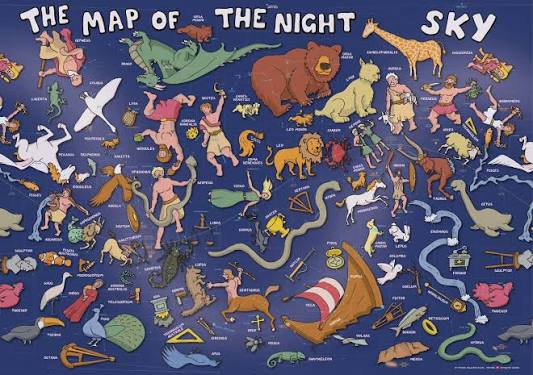
When you look up on a clear night, you’re seeing a sky that has been mapped, divided, and named over thousands of years. The 88 constellations recognized today weren’t always so neatly defined. They emerged from a messy history of myth, exploration, and scientific standardization.
This is the story of how ancient stargazers’ patterns became a universal system—and why, even in an age of space telescopes, we still use the same Latin names that Ptolemy wrote down in 150 CE.
From Babylon to Greece: The First Sky Maps
Long before the IAU, Babylonian astronomers were the first to record constellations. The Mul.Apin tablets, dating to around 1200 BCE, list star groups that later showed up in Greek astronomy. Leo, Scorpius, and Taurus all have clear Mesopotamian roots. When Homer wrote about Orion and the Pleiades in the 8th century BCE, he was tapping into a tradition that was already centuries old.
The Greeks didn’t just inherit these patterns—they wove them into mythology. Heroes, monsters, and gods filled the sky: Perseus, Andromeda, Hercules, and the rest. Each constellation became a visual story, preserving myths for generations. When Claudius Ptolemy compiled his Almagest around 150 CE, he catalogued 48 constellations, drawing on this rich Greek tradition. His book became the definitive star guide for the next 1,400 years.
The Great Southern Gap
The ancient Mediterranean skywatchers had a blind spot: they couldn’t see the southernmost stars. As European explorers sailed south in the 16th and 17th centuries, they encountered a sky full of unfamiliar stars. Dutch navigators Pieter Dirkszoon Keyser and Frederick de Houtman mapped these southern skies in the 1590s, and astronomer Petrus Plancius turned their observations into new constellations.
Plancius introduced about 12 new southern constellations, including the Toucan and the Bird of Paradise. Later, in the 1750s, French astronomer Nicolas-Louis de Lacaille added 14 more. But instead of mythological heroes, he chose scientific instruments: the Air Pump, the Furnace, the Clock. This was a radical departure from the old naming tradition—a nod to the Enlightenment’s obsession with observation and measurement.
Chaos in the Heavens: The Need for Standardization
By the 19th century, the sky was getting crowded. Different astronomers had proposed over 100 constellations, often overlapping or conflicting. Charts disagreed, and navigators and scientists needed a common reference. In 1922, the International Astronomical Union (IAU) stepped in and voted to standardize the list at 88. Eight years later, Belgian astronomer Eugène Delporte drew precise boundaries along lines of right ascension and declination, ensuring every point in the sky belonged to exactly one constellation.
Since 1930, the 88 have remained fixed. No new constellations have been added, and none have been removed. The boundaries Delporte drew are still in use today.
The Naming Game: Latin, Genitives, and Asterisms
Each official constellation has a Latin name, like Ursa Major or Orion. But you’ll often hear English versions: the Great Bear, the Hunter. The Latin names aren’t just for show—they’re used in star catalogues. To name a star, you use the genitive (possessive) form of the constellation: Alpha Centauri means “Alpha of Centaurus,” and Beta Orionis means “Beta of Orion.”
This grammatical quirk means that learning constellation names is also a lesson in Latin declensions. Vela (the Sails) becomes Velorum, but Puppis (the Stern) stays Puppis. It’s a hidden grammar that astronomers must master.
Asterisms are different from constellations. They’re recognizable patterns that aren’t officially recognized. The Big Dipper, for example, is an asterism within the constellation Ursa Major. The Summer Triangle and the Teapot in Sagittarius are other famous asterisms.
A Sky of Many Cultures
The 88 official constellations are a product of Western history. They represent just one way of organizing the stars. Other cultures have entirely different systems. Chinese astronomers divided the sky into 28 “mansions,” grouping stars in ways that don’t match the Greek constellations. Indigenous Australian cultures saw the Emu in the Sky, not as a pattern of stars but as a dark nebula—a shape traced by the absence of light.
The naming of the southern constellations by Europeans was a colonial act. It overwrote or ignored the indigenous star knowledge that had existed for centuries. The sky, like the land, was claimed and renamed by explorers. Today, there’s growing recognition of this lost knowledge, and efforts to preserve and revive indigenous astronomy are gaining momentum.
Why These Names Stick
Despite the cultural baggage, the 88 constellations have endured for nearly a century. Their Latin names provide a stable, universal reference. The boundaries are exact, making them useful for astronomers. And the myths behind them—Orion the hunter, Cassiopeia the queen—still capture our imagination.
The language of stars is a blend of ancient storytelling and modern science. It’s a map of the sky that has been drawn and redrawn, but the lines have held. That’s a remarkable achievement for a system that began with Babylonian priests and Greek poets.
The 88 constellations are more than just patterns in the sky. They’re a living record of human history—from Babylonian tablets to Dutch ships to the IAU’s meeting rooms. The next time you spot Orion’s belt, remember that you’re seeing the same stars that a poet in Homer’s time described, and that the name you use was formalized less than a century ago. The sky may be ancient, but its map is still being written.
Summary
- The 88 official constellations were standardized by the IAU in 1922, with boundaries fixed in 1930 by Eugène Delporte.
- Ptolemy’s Almagest (c. 150 CE) catalogued 48 constellations, forming the foundation of Western astronomy.
- Southern constellations were added by European explorers like Petrus Plancius and Nicolas-Louis de Lacaille, who chose scientific names over mythology.
- Asterisms like the Big Dipper are not official constellations but recognizable patterns within them.
- The official system reflects a Western, Greco-Roman perspective, while other cultures—like Chinese and Indigenous Australian—have entirely different star groupings.
FAQ
Q: How many constellations are officially recognized?
A: There are 88 official constellations, as defined by the International Astronomical Union (IAU) since 1922.
Q: What is the difference between a constellation and an asterism?
A: A constellation is an officially recognized region of the sky with defined boundaries. An asterism is a recognizable pattern of stars that isn’t an official constellation, like the Big Dipper.
Q: Why are constellation names in Latin?
A: Latin was the language of scholarship in Europe when the constellations were catalogued. The IAU kept Latin names to ensure a universal, unchanging reference.
Q: Did ancient Greeks see the same constellations we do?
A: They saw many of the same patterns, but the official list includes additions made later for the southern sky, which they couldn’t see.
Q: Can new constellations be added?
A: No. The 88 constellations have been fixed since 1930, and the IAU has no plans to change them.