In September 1940, as German bombs rained on London, a social experiment began that would reshape Britain forever. Children from the East End, pale and underfed, were packed onto trains and sent to rural villages. Their hosts, comfortable middle-class families, were shocked to see rickets, lice, and malnutrition up close. This was the ‘national revelation’ that cracked open the door to the modern welfare state.
By 1948, just three years after the war ended, Britain had a health service free at the point of use, universal social insurance, and family allowances. The journey from those crowded railway platforms to the founding of the NHS was not smooth or inevitable. It took a war, a bestselling report, and a landslide election to turn shared sacrifice into permanent social rights.
The Hungry Thirties: A Patchwork of Punishment
Before the war, Britain’s social safety net was a cruel contradiction. The 1911 National Insurance Act covered only select workers for health and unemployment, leaving millions to fall back on the Poor Law a system designed to deter, not help. Means tests were intrusive and humiliating; benefits were inconsistent. In Jarrow, South Wales, and Clydeside, unemployment peaked at 22% in 1932, and whole communities were left to rot.
Public health was equally dire. Malnutrition was widespread, and medical care was simply unaffordable for many working-class families. A hospital visit could mean bankruptcy. Voluntary hospitals relied on charity, and the sick poor often went untreated. This was the Britain that went to war in 1939.
Wartime Transformations: Bombs, Rationing, and a New Solidarity
The war changed everything, starting with the evacuation. In just four days in September 1939, 1.5 million people mostly children were moved from cities to the countryside. For the first time, the middle classes saw how the other half lived. Rickets, lice, and chronic malnutrition were not abstract statistics; they were children sleeping in their spare rooms. This ‘national revelation’ made poverty a national scandal.
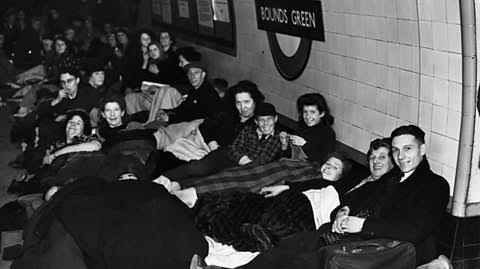
The Blitz deepened the shift. Bombing did not discriminate between rich and poor neighborhoods. Rich and poor huddled together in underground stations, sharing the same risk. The state organized shelters, emergency services, and, from 1940, universal rationing. Everyone got the same rations, whether they lived in Mayfair or Manchester. This was a radical experiment in equality, and it worked. The state proved it could run large-scale operations effectively — from the Ministry of Food to the Ministry of Supply.
Full employment was the final proof. By 1943, unemployment had fallen below 1%. The state had managed the economy to mobilize for war, and it had succeeded. If it could do that, why could it not conquer poverty in peacetime?
The Beveridge Report: A Bestseller That Changed the Debate
In December 1942, economist Sir William Beveridge — a Liberal, not a Labour man — published his report on social insurance. It was commissioned by the wartime coalition, which included Labour ministers like Clement Attlee and Ernest Bevin. Beveridge proposed a universal system of social insurance, funded by flat-rate contributions, covering every citizen ‘from cradle to grave.’ He structured his plan around five ‘Giant Evils’: Want, Disease, Ignorance, Squalor, and Idleness.
The report sold over 600,000 copies. It was read in factories, pubs, and army camps. People queued to buy it. The government initially tried to downplay it, but the public demand was unstoppable. All parties were forced to accept its broad framework. The question after the war was not whether to implement Beveridge, but how quickly and how completely.
1945: The Landslide That Made It Happen
The July 1945 election was a shock. Winston Churchill, the victorious wartime leader, was defeated in a landslide. Labour won 393 seats to the Conservatives’ 213. The people wanted more than victory; they wanted a new Britain. Clement Attlee became Prime Minister, and his government moved with remarkable speed.
One of the first acts was the Family Allowances Act of 1945, which gave a universal cash benefit to mothers. Then came the National Insurance Act of 1946, a comprehensive contributory scheme covering sickness, unemployment, retirement, and widowhood. The National Health Service Act of 1946 created the NHS, which launched on 5 July 1948. The National Assistance Act of 1948 provided a safety net for those outside the insurance system. By 1948, the welfare state was complete.
Aneurin Bevan, the Health Minister, was the architect of the NHS. He faced fierce opposition from doctors who feared losing their independence. But Bevan held firm, famously saying that he would ‘stuff their mouths with gold’ — in the end, he won them over with a compromise that allowed private practice alongside NHS work. The NHS was born on 5 July 1948, offering free healthcare to everyone, regardless of income.
The Wartime Roots of the Welfare State
The war did not just create the conditions for the welfare state; it created the political will. The evacuation and the Blitz exposed inequality in a way that could not be ignored. Rationing normalized state intervention in daily life. Full employment proved the state could manage the economy. And the phrase ‘People’s War’ captured the idea that this was a war of the whole nation, deserving a post-war reward.
But the war alone was not enough. It took a Labour landslide and a government determined to implement Beveridge’s vision. The war created the opportunity; Labour seized it. The welfare state was not a gift from the wartime coalition — it was a victory won by the people, through their votes and their sacrifices.
The welfare state was built on the ruins of war, but it was not an accident of history. It was a deliberate choice, made by a people who had endured the Blitz and rationing and decided they deserved better. The NHS, the National Insurance scheme, and family allowances were not just policies; they were promises that the sacrifices of war would not be in vain. Today, as debates about the welfare state continue, it is worth remembering that its foundations were laid in the fires of the People’s War.
Summary
- The Beveridge Report (1942) sold over 600,000 copies and framed the post-war social settlement around five ‘Giant Evils’: Want, Disease, Ignorance, Squalor, and Idleness.
- Evacuation and the Blitz exposed middle-class Britons to urban poverty, creating a ‘national revelation’ that fueled demand for change.
- Universal rationing and full employment during the war normalized state intervention and proved the government could manage the economy effectively.
- Labour’s landslide victory in 1945 gave Attlee’s government a mandate to implement Beveridge’s plan with remarkable speed.
- By 1948, the NHS, National Insurance, and National Assistance had created a universal welfare state ‘from cradle to grave.’
FAQ
Q: Why is the Beveridge Report considered so important?
A: It was the first comprehensive plan for a universal welfare state, covering all citizens ‘from cradle to grave’ and identifying five ‘Giant Evils’ to be conquered. Its popularity (over 600,000 copies sold) forced all parties to accept its framework.
Q: What role did the war play in creating the welfare state?
A: The war exposed social inequality through evacuation and the Blitz, normalized state intervention through rationing, and proved the state could manage the economy through full employment. It created the political will for change.
Q: Was the welfare state a Labour achievement?
A: Yes, the Labour government elected in 1945 implemented the legislation. But the wartime coalition, which included Labour ministers, commissioned the Beveridge Report and passed the 1944 Education Act. The war created the conditions; Labour provided the political will.
Q: Why did the 1945 election result in a Labour landslide?
A: The public associated the Conservatives with the pre-war depression and wanted a new Britain after the war. Labour’s promise to implement the Beveridge Report resonated with voters, leading to 393 seats for Labour versus 213 for the Conservatives.
Q: What were the five ‘Giant Evils’?
A: Beveridge identified Want (poverty), Disease (ill health), Ignorance (lack of education), Squalor (poor housing), and Idleness (unemployment) as the five major social problems the welfare state was designed to overcome.