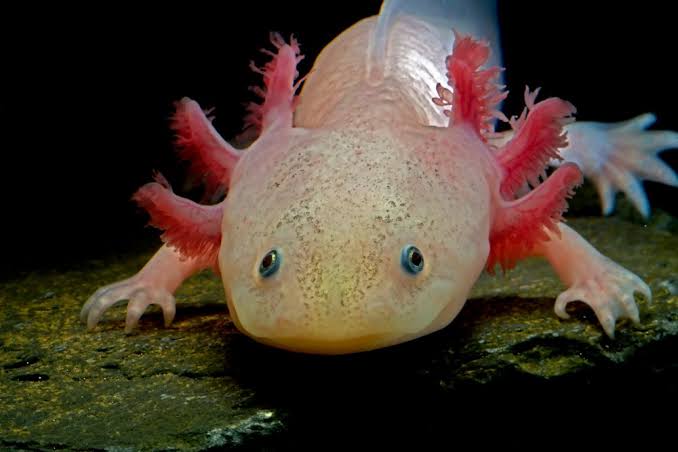
Imagine a creature that keeps its baby features for its entire life—external gills like feathery crowns, a tadpole-like tail fin, and a permanent, slightly goofy smile. That’s the axolotl (Ambystoma mexicanum), a salamander that never really grows up. But this ‘Peter Pan of the pond’ isn’t just cute; it holds one of the most astonishing abilities in the animal kingdom: it can regenerate entire limbs, parts of its heart, and even bits of its brain, without a trace of scarring.
Native to the ancient lake complex of Xochimilco near Mexico City, axolotls are now critically endangered in the wild, with fewer than 1,000 individuals believed to remain. Yet they thrive in laboratories worldwide, where scientists have studied them for over a century. From Aztec mythology to cutting-edge genetics, the axolotl is a creature of paradox: a living fossil of evolutionary adaptation, a medical marvel, and a cultural icon. Let’s explore what makes this salamander so special and what it might teach us about healing, aging, and even cancer.
The Salamander That Refuses to Grow Up
Most salamanders start life in water as larvae with gills, then undergo metamorphosis—losing their gills, developing lungs, and moving onto land. The axolotl, however, hits the pause button. It reaches sexual maturity while still in its larval form, a condition called paedomorphosis or neoteny. This means adult axolotls keep their feathery external gills, a fin-like tail, and an entirely aquatic lifestyle.
Why would an animal do this? It’s an evolutionary trade-off. In the stable, permanent waters of ancient lakes Xochimilco and Chalco, food was abundant and there was little pressure to leave the water. Metamorphosing into a land-dwelling salamander would be risky and unnecessary. So, the axolotl’s ancestors simply stopped completing the life cycle. This isn’t unique—some related species, like the tiger salamander, can be neotenic or metamorphose depending on their environment—but the axolotl is the most extreme and consistent example.
Interestingly, axolotls can be artificially forced to metamorphose by exposing them to thyroid hormones like thyroxine or iodine. In 1864, Auguste Duméril in Paris accidentally induced metamorphosis in some axolotls, producing land-dwelling forms. However, this process is stressful and shortens their lifespan, so it’s rarely done outside of specific experiments. In the wild, natural metamorphosis almost never occurs.
The Regeneration Marvel
If the axolotl’s neoteny is fascinating, its regenerative powers are nothing short of miraculous. An axolotl can regrow an entire limb after amputation—complete with bones, muscles, nerves, and skin—in about 40 to 50 days. And it can do this repeatedly, dozens of times, without any loss of function or scarring. The wound heals perfectly, and a new limb grows back as if nothing happened.
But limbs are just the beginning. Axolotls can also regenerate their tail, spinal cord, heart tissue, gills, skin, and even parts of their brain. Scientists have implanted electrodes into axolotl brains and observed that the tissue regenerates around them, restoring function. This remarkable ability is due to special cells at the wound site that dedifferentiate—essentially reverting to a stem-cell-like state—and then re-differentiate into the needed tissues. The process is tightly regulated, and the axolotl somehow knows exactly what to regrow and when to stop.
Another astonishing feature is their immune tolerance. Axolotls can accept tissue grafts from other axolotls without rejection, a trait that has puzzled immunologists for decades. This tolerance likely contributes to their regenerative success, as inflammation and scarring are minimized.
A Giant Genome Holds Secrets
The axolotl’s genome is enormous—about 32 billion base pairs, roughly 10 times the size of the human genome. This massive genome made sequencing a challenge, but in 2018, scientists published the full sequence in the journal Nature. With this genetic blueprint, researchers are now identifying the key genes responsible for regeneration. One notable finding is that the axolotl has a version of the p53 gene that may contribute to their low cancer rates. Despite their incredible cell proliferation during regeneration, axolotls rarely develop tumors, and studying this could inform cancer biology.
The genome also reveals insights into their negligible aging. Axolotls maintain their telomere length throughout life, which is unusual—most animals’ telomeres shorten as they age. This may explain why they show no signs of biological aging, a phenomenon called negligible senescence. They seem to stay ‘young’ in many ways, both in appearance and at the cellular level.
From Aztec God to Research Icon
The axolotl’s name comes from Xolotl, the Aztec god of fire, lightning, and deformity. According to mythology, Xolotl transformed into a salamander to avoid being sacrificed, and the axolotl is his earthly form—a shape-shifter that never fully transforms. This cultural heritage is a reminder of the creature’s deep roots in Mexican history.
Western science first encountered the axolotl in the early 1800s, thanks to Alexander von Humboldt. By the 1860s, they were being studied in Paris, and in 1957, the Ambystoma Genetic Stock Center was established at the University of Kentucky, which still maintains the oldest continuous research colony. Since then, axolotls have been a model organism for developmental biology, embryology, and regeneration research.
Today, axolotls are a pop culture phenomenon—appearing in video games like Minecraft and Pokémon (think Wooper and Mudkip), and memes celebrating their perpetual smile. They’ve even graced Mexico’s 50-peso note, cementing their status as a national icon.
The Paradox of Conservation
Despite their abundance in laboratories, axolotls are critically endangered in the wild. The lakes they inhabited have largely disappeared: Lake Chalco was drained, and only the canals of Xochimilco remain. Urban expansion, water pollution, and the introduction of predatory fish like tilapia and carp have decimated their numbers. Recent surveys estimate fewer than 1,000 individuals remain, with some counts as low as 50–100.
This creates a paradox: a species that thrives in captivity while vanishing in its natural habitat. Conservation efforts are underway, focusing on restoring the chinampas—traditional floating gardens that provide habitat—and involving local farmers in stewardship. Xochimilco is a UNESCO World Heritage Site, and saving the axolotl is tied to preserving these ancient agricultural practices.
The axolotl’s story is a powerful reminder that conservation isn’t just about saving a species; it’s about preserving ecosystems and cultural heritage. And for scientists, the axolotl is a living library of regenerative secrets that could one day transform medicine.
What Axolotls Could Teach Us
The axolotl’s abilities have profound implications for human health. If we can unlock the mechanisms behind limb regeneration, we might develop therapies for spinal cord injuries, heart damage, or even organ repair. The axolotl’s cancer resistance could offer clues for preventing or treating cancer. Its negligible aging might inform longevity research.
But these are long-term goals. For now, the axolotl remains a fascinating creature of wonder—a smiling salamander that never grows up and can regrow its body parts on demand. Its secret life is a testament to the power of evolution and the untapped potential hidden in nature’s oddities.
The axolotl is more than a cute face; it’s a biological marvel that defies conventional rules. By refusing to grow up, it has unlocked a suite of abilities—regeneration, cancer resistance, and apparent agelessness—that scientists are only beginning to understand. As we continue to study this remarkable salamander, we may unlock secrets that could change the future of medicine. But we must also remember that its wild home is disappearing. The axolotl’s survival, both in nature and in our labs, is intertwined with our own curiosity and responsibility.
Summary
- Axolotls are neotenic salamanders that retain juvenile features into adulthood, never naturally undergoing metamorphosis.
- They can regenerate entire limbs, tail, spinal cord, heart tissue, and parts of the brain without scarring.
- Their genome is 10 times larger than humans, and sequencing in 2018 revealed genes linked to regeneration and low cancer rates.
- Axolotls show negligible aging and are resistant to cancer, offering insights into regenerative medicine and aging.
- Critically endangered in the wild (fewer than 1,000 individuals), but common in labs; conservation efforts focus on habitat restoration in Xochimilco.
FAQ
Q: Can axolotls regrow their limbs more than once?
A: Yes, axolotls can regenerate the same limb repeatedly, dozens of times, without any loss of function or scarring.
Q: Why don’t axolotls grow up like other salamanders?
A: Axolotls have evolved to retain their larval features into adulthood due to a stable aquatic environment with abundant food, making metamorphosis unnecessary. This is called neoteny or paedomorphosis.
Q: Are axolotls endangered?
A: Yes, axolotls are critically endangered in the wild, with fewer than 1,000 individuals estimated in Xochimilco, Mexico City. However, they are common in captivity and laboratories worldwide.
Q: Can axolotl regeneration help humans?
A: Scientists hope that understanding axolotl regeneration could lead to breakthroughs in human medicine, such as limb regrowth, spinal cord repair, and cardiac regeneration, though these are still long-term goals.
Q: What does the name ‘axolotl’ mean?
A: The name comes from the Aztec god Xolotl, who transformed into a salamander. ‘Axolotl’ is often translated as ‘water monster’ or ‘water dog’ in Nahuatl.