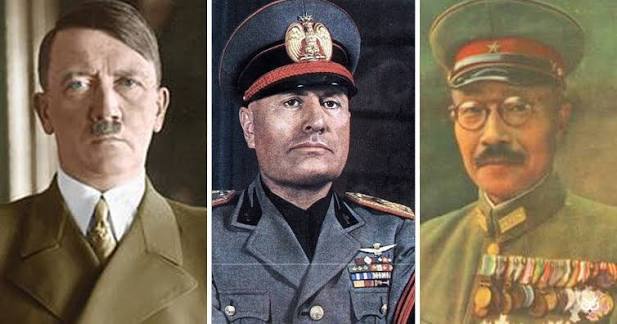
When World War II broke out in 1939, the Axis Powers Germany, Italy, and Japan united to challenge the Allied forces. Their leaders Adolf Hitler, Benito Mussolini, and Japan’s Emperor Hirohito with Prime Minister Hideki Tojo each shaped the conflict in distinct ways. But their alliance was less a unified bloc and more a pragmatic pact of convenience, driven by divergent ambitions and ideologies. This article examines who these leaders were, how they rose to power, and why their partnership ultimately unraveled.
The Rise of Dictators
Adolf Hitler came to power in Germany in 1933, capitalizing on the chaos of the Weimar Republic and the humiliation of the Treaty of Versailles. His Nazi Party fused extreme nationalism, racial antisemitism, and a vision of territorial expansion to win over a desperate population. By 1934, he declared himself Führer, merging the roles of chancellor and president, and began dismantling German democracy.
Benito Mussolini had already seized control in Italy a decade earlier. In 1922, his March on Rome pressured King Victor Emmanuel III to appoint him Prime Minister. Mussolini’s Fascist ideology emphasized authoritarian nationalism, corporatism, and imperial revival a stark contrast to Germany’s race-based Nazi doctrine. Yet both men shared a thirst for power and a disdain for the post-WWI order.
In Japan, the path to militarism was different. The 1930s saw the military and ultranationalist factions gain dominance over civilian government, fueled by economic crisis and a desire for resource security. Emperor Hirohito viewed as a divine figure reigned as a constitutional monarch, but his exact role in wartime decisions remains contested. Hideki Tojo, a hardline general, became Prime Minister in 1941 and effectively led the nation’s war efforts, though he always acted in the Emperor’s name.
The Axis Alliance: A Marriage of Convenience
The term “Axis” was coined by Mussolini in 1936, referring to the Rome–Berlin line around which other European states might align. The Rome–Berlin Axis was formalized in 1939 with the Pact of Steel, a military alliance between Germany and Italy. Japan joined the following year with the Tripartite Pact, creating the Berlin-Rome-Tokyo axis.
But this was not a united front. Germany and Italy shared a fascist kinship, yet clashed over ambitions in Austria and the Balkans. Japan was primarily anti-communist and expansionist in Asia, with little ideological affinity for European fascism. The alliance lacked a unified strategy or command each power pursued its own war aims. Hitler, for instance, declared war on the United States after Pearl Harbor, a decision that ultimately dragged Germany into a two-front war and sealed its fate.
The Personal Dynamics
Hitler and Mussolini’s relationship evolved from admiration to strain. Mussolini initially viewed Hitler with a mix of respect and rivalry, but Italy’s military failures in Greece and North Africa exposed its weaknesses. In 1943, Allied forces invaded Sicily, and Mussolini was deposed and arrested. Hitler, determined to rescue his ally, sent commandos to free him from the Gran Sasso mountain hotel. Mussolini was then installed as the puppet leader of the Italian Social Republic in northern Italy, but his power was hollow.
Germany and Japan had even less coordination. They fought separate wars Germany in Europe, Japan in the Pacific with minimal strategic cooperation. The two powers were separated by vast distances and had no shared war plan.
The Fall of the Axis Leaders
The end of the war brought violent deaths for most of the Axis leadership. Mussolini attempted to flee to Switzerland in April 1945, but was captured by Italian partisans and executed. His body was hung upside down in Milan, displayed to a vengeful public.
Hitler, surrounded by Soviet forces in Berlin, committed suicide on April 30, 1945, by gunshot and cyanide. His body was burned in the Chancellery garden, and his ashes were scattered a deliberate attempt to prevent any future shrine.
Tojo attempted suicide but survived and was captured by Allied forces. He was convicted of war crimes by the International Military Tribunal for the Far East and executed by hanging in 1948.
Hirohito escaped prosecution. The Allies, eager to maintain stability in occupied Japan, shielded him from trial, arguing that he had been a passive figure manipulated by militarists. This decision remains controversial in East Asia, where many hold him responsible for wartime atrocities.
The Broader Axis Leadership
Beyond the “Big Three,” the Axis included a network of lesser leaders with varied motivations. Ion Antonescu of Romania, Miklós Horthy of Hungary, and Ante Pavelić of Croatia led regimes aligned with the Axis, either out of ideological sympathy, territorial gain, or coercion. In China, Wang Jingwei headed a Japanese puppet state, and Thailand’s Plaek Phibunsongkhram collaborated with Japan to expand Thai territory.
These leaders often had more in common with their own survival instincts than with any shared Axis ideology. Their alliances were pragmatic, shifting with the fortunes of war.
Ideological Fault Lines
Nazism was rooted in racial theory, culminating in the Holocaust the systematic murder of six million Jews and millions of others. Italian Fascism was less racially extreme, though Mussolini enacted antisemitic laws in 1938 to align with Germany. Japanese militarism centered on emperor worship and pan-Asianism the idea of “Asia for Asians” but was not based on a racial hierarchy in the same way as Nazism. Instead, it saw Japan as the natural leader of Asia, liberating the region from Western colonialism.
These ideological differences contributed to the alliance’s fragility. The Axis was never a coherent force; it was a temporary alignment of convenience that collapsed under the weight of its own contradictions.
The Legacy
By 1945, all three principal Axis powers had been defeated. Their leaders were dead or disgraced, and their ideologies were thoroughly discredited. The post-war world was rebuilt on the principles of the Allied powers, shaping international institutions like the United Nations.
The Axis leaders remain a stark reminder of the dangers of totalitarianism, militarism, and unchecked nationalism. Their rise and fall offer lessons about the fragility of democracy and the catastrophic consequences of aggressive expansion.
The Axis leaders Hitler, Mussolini, and Japan’s wartime command were driven by a shared desire to overturn the existing world order, but their alliance was never more than a marriage of convenience. Their divergent ideologies and ambitions ultimately undermined their cause, leading to their complete defeat. The war they unleashed cost millions of lives and reshaped the global landscape, leaving a legacy that still informs international relations today.
Summary
- The Axis Powers were primarily led by Adolf Hitler (Germany), Benito Mussolini (Italy), and Japan’s Emperor Hirohito with Prime Minister Hideki Tojo.
- The alliance was pragmatic, not ideological, with each power pursuing its own expansionist goals.
- Personal relationships among the leaders were strained, particularly between Hitler and Italy’s failing military efforts.
- The fall of the Axis leaders came through suicide, execution, or—in Hirohito’s case—preservation under Allied occupation.
- The broader Axis included numerous lesser leaders with varied motivations, from ideological alignment to coercion.
FAQ
Q: What was the Axis alliance?
A: The Axis was a military coalition formed by Germany, Italy, and Japan, formalized through agreements like the Pact of Steel (1939) and the Tripartite Pact (1940). It was a pragmatic alliance of convenience rather than a unified ideological bloc.
Q: Why did Italy join the Axis?
A: Benito Mussolini sought to revive the Roman Empire’s glory and saw an alliance with Germany as an opportunity for territorial expansion in Africa and the Mediterranean.
Q: What was Hirohito’s role in Japan’s war effort?
A: Emperor Hirohito was the constitutional monarch, but historians debate his actual involvement. Some argue he was a passive figurehead manipulated by militarists, while others contend he actively supported key decisions, including the attack on Pearl Harbor.
Q: How did the Axis leaders die?
A: Hitler committed suicide in 1945, Mussolini was executed by partisans, and Tojo was executed after a war crimes trial. Hirohito died of natural causes in 1989 after retaining his throne under Allied occupation.
Q: Were there other Axis leaders besides the ‘Big Three’?
A: Yes, many other countries and puppet states were part of the Axis, including Hungary (Miklós Horthy), Romania (Ion Antonescu), Croatia (Ante Pavelić), and the Japanese puppet state in China (Wang Jingwei).