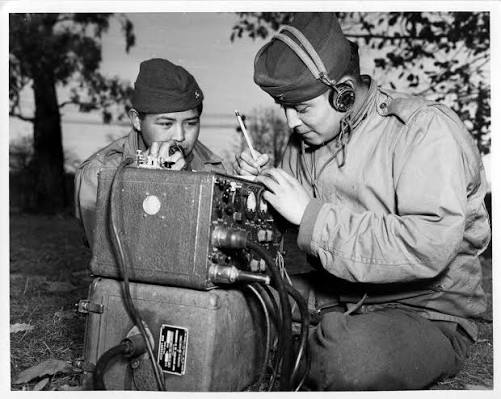
In the spring of 1942, on a windswept parade ground at Camp Pendleton, California, a small group of Navajo men stood at attention. They were not carrying rifles or grenades—they carried something far more powerful: a language that had been banned in American schools, ridiculed by missionaries, and dismissed as primitive. Within months, that language would become the United States’ most closely guarded secret and the key to victory in the Pacific.
These were the Original 29—the first Navajo Code Talkers. Their task was to build a code from their native tongue that the Japanese could never break. They succeeded beyond anyone’s imagination. By the end of World War II, more than 400 Navajo men had served as Code Talkers in every major Marine offensive, transmitting thousands of messages with a speed and accuracy that mechanical encryption machines could not match—and the Japanese never cracked it.
A Language Built for Secrecy
Navajo—or Diné bizaad—is an Athabaskan language with a grammar so complex, tonal qualities so subtle, and sounds so foreign (glottal stops, gutturals, and sounds that don’t exist in English) that it’s nearly impossible for an adult to learn fluently. At the time, it was unwritten, spoken by fewer than 30,000 people, almost all confined to the Navajo Nation in the American Southwest. To most outsiders, it was an impenetrable mystery. That obscurity made it perfect for a code.
The idea came from Philip Johnston, a World War I veteran who grew up on the Navajo reservation as the son of a missionary. In early 1942, he walked into a Marine Corps office with a proposal: use Navajo as a secure communication method. The Marines were skeptical, but Johnston gave a demonstration. He set up a test with Navajo speakers, who transmitted a message in Navajo over a field telephone and translated it back in under a minute. The Marines were convinced.
By May 1942, the first 29 recruits—many of them teenagers fresh from boarding schools where they had been punished for speaking their own language—began training at Camp Pendleton. Their assignment: invent a code from scratch.
Building the Code: Two Layers of Genius
The code they created was ingeniously simple and maddeningly complex at the same time. It had two layers. The first was a word-for-word substitution for military terms. A fighter plane became da-he-tih-hi—”hummingbird”—because of its speed and agility. A submarine was besh-lo—”iron fish”—for its metallic hull and silent movement. A grenade became ni-ma-si—”potato”—because it was round and thrown like a potato. These were not arbitrary; they were visual metaphors that any Navajo speaker could instantly grasp.
The second layer was a letter-substitution system for spelling out words that had no direct equivalent. Each English letter got a Navajo word: A became wol-la-chee (ant), B became shush (bear), C became moasi (cat). To encode a word like “Pacific,” a Code Talker would say “pig, ant, cat, ice, fox, ice, cat”—but in Navajo, and often with multiple choices for each letter to confuse eavesdroppers.
By the end of the war, the code had grown to about 500 distinct terms. It was not a simple cipher; it was a living language, adapted on the fly as new weapons and tactics emerged. And it was fast. A Code Talker could encode, transmit, and decode a three-line message in about 20 seconds. Mechanical encryption machines took 30 minutes for the same task. In combat, where seconds meant lives, that speed was decisive.
The Crucible of the Pacific
The Code Talkers served in all six Marine divisions, from the jungles of Guadalcanal to the coral reefs of Tarawa, from the blood-soaked sands of Peleliu to the volcanic ash of Iwo Jima. At each battle, they proved their worth.
At Iwo Jima, the fighting was so intense that six Code Talker networks operated continuously. In the first 48 hours, they transmitted over 800 messages—everything from troop movements to artillery coordinates—with zero errors. Major Howard Connor, the signal officer at Iwo Jima, later declared, “Were it not for the Navajos, the Marines would never have taken Iwo Jima.”
Throughout the war, the Japanese never broke the code. They intercepted the strange, guttural transmissions and tried desperately to decipher them, but the language was too alien, the code too layered, the messages too fast. Some Japanese soldiers even reported hearing “tortured animal sounds” coming from American radios. The code was, and remains, the only military code in modern history that was never cracked.
The Irony of Service
The Code Talkers’ story is steeped in irony. Many of these men had been sent to government boarding schools as children, where they were beaten for speaking Navajo. They were told their language was worthless—a relic of a savage past. Yet they used that same language to defeat a formidable enemy and save countless American lives.
Their service occurred against a backdrop of systemic discrimination. Native Americans served in the U.S. military at a higher per-capita rate than any other ethnic group during WWII, yet they returned home to find their voting rights restricted in several states, their children still forced into English-only schools, and their contributions erased from history.
The Code Talkers themselves were sworn to secrecy. They could not tell their wives, their children, or their parents what they had done. For decades, the code remained classified. Many carried the burden of that silence—some with pride, others with trauma. One Code Talker, Chester Nez, later recalled that he “felt like a traitor” to his own people for using a language that the U.S. government had tried to kill, even as he fought for that government.
Decades of Silence, Then Honor
It took nearly 60 years for the U.S. government to fully recognize the Code Talkers. In 1968, the code was finally declassified. In 1982, President Ronald Reagan declared August 14 as National Navajo Code Talkers Day. But it wasn’t until 2000 that President Bill Clinton signed the Navajo Code Talkers Congressional Gold Medal Act, awarding the Congressional Gold Medal to the Original 29 and silver medals to all other Code Talkers. The following year, the surviving members of the Original 29 received their medals in a ceremony on the Capitol steps.
By then, many of the heroes were gone. Of the 29 original recruits, only a handful lived to see the recognition. Their story, once hidden, is now taught in schools, memorialized in museums, and celebrated by the Navajo Nation. But the recognition came late—a reflection, many argue, of a nation’s lingering discomfort with acknowledging the contributions of its indigenous peoples.
The Code That Outlived Its Creators
Today, the Navajo Code Talkers are remembered as symbols of ingenuity and sacrifice. Their code, once a weapon of war, is now a source of cultural pride. It proved that a language once suppressed could become a nation’s greatest asset. And it stands as a reminder that the people who are often marginalized are also the ones who can save us.
As the last of the Code Talkers have passed away—including Chester Nez, who died in 2014—their legacy endures. The hummingbirds and iron fish and potato-grenades of their language still echo across the Pacific, a ghostly transmission of courage and cleverness that the enemy never understood and can never forget.
The Navajo Code Talkers did not just win battles; they rewrote the rules of warfare. In a world of machines and ciphers, they proved that a human language—ancient, unwritten, and nearly extinct—could be the most unbreakable code of all. Their story is not just a chapter of military history; it is a testament to the power of language, the resilience of a people, and the unexpected ways that the oppressed can become heroes. As we remember them, we honor not only their service but also the beautiful, complex language they turned into a weapon of freedom.
Summary
- Approximately 400–450 Navajo men served as Code Talkers in the U.S. Marine Corps during WWII, with the first 29 recruits creating the code in 1942.
- The code had two layers: word-for-word substitutions (e.g., “fighter plane” = “hummingbird”) and a letter-substitution system (A = “ant”).
- Speed and accuracy were crucial: a Code Talker could transmit a three-line message in 20 seconds vs. 30 minutes for mechanical encryption.
- The code was never broken by the Japanese, and at Iwo Jima, over 800 messages were sent in 48 hours with zero errors.
- Recognition came late: declassified in 1968, National Navajo Code Talkers Day in 1982, and Congressional Gold Medals in 2000–2001.
FAQ
Q: How many Navajo Code Talkers were there?
A: Approximately 400–450 Navajo men served as Code Talkers in the U.S. Marine Corps during World War II, starting with the 29 original recruits in 1942.
Q: Why was the Navajo language chosen for the code?
A: Navajo was an unwritten, tonal, and extremely complex language spoken by fewer than 30,000 people, almost all within the Navajo Nation. Its obscurity and difficulty made it nearly impossible for the Japanese to understand or decipher.
Q: How fast could Code Talkers send messages?
A: A Code Talker could encode, transmit, and decode a three-line message in about 20 seconds, compared to 30 minutes for mechanical encryption machines.
Q: Was the Navajo code ever broken by the Japanese?
A: No. The code was never broken by the Japanese during the entire war. It remains the only military code in modern history that was not cracked.
Q: When were the Code Talkers officially recognized?
A: The code was declassified in 1968, National Navajo Code Talkers Day was declared in 1982, and the Congressional Gold Medal Act was signed in 2000, with medals awarded in 2001.