In 2022, the U.S. government restricted the export of advanced AI chips to China, sending shockwaves through the global tech industry. Almost overnight, countries around the world realized that their AI ambitions and by extension, their economic and military security depended on a handful of foreign companies and a single island nation, Taiwan. This moment crystallized a new geopolitical imperative: AI sovereignty.
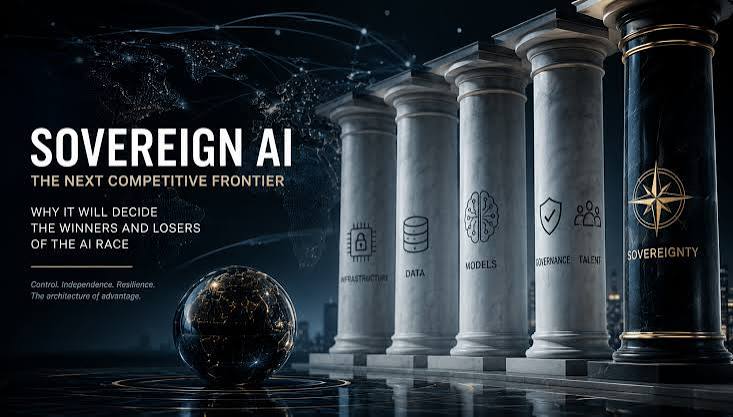
AI sovereignty is the ability of a nation to develop, deploy, and control its own AI capabilities compute hardware, data, algorithms, and talent—without undue dependence on foreign entities. It’s not about building everything from scratch; it’s about ensuring that critical nodes of the AI supply chain are under domestic control. As nations pour billions into domestic chip fabs, data centers, and AI research, understanding this concept is essential to grasping the future of technology and international relations.
The Compute Bottleneck: Why Chips Became the New Oil
AI models like GPT-4 are trained on tens of thousands of graphics processing units (GPUs), each costing thousands of dollars. These GPUs, manufactured primarily by NVIDIA, are produced in a handful of foundries, with the most advanced chips fabricated by TSMC in Taiwan and Samsung in South Korea. This concentration creates a bottleneck: if a geopolitical crisis disrupts supply, countries without domestic alternatives would find their AI development grinding to a halt.
The U.S. recognized this vulnerability and passed the CHIPS and Science Act in 2022, committing over $50 billion to boost domestic semiconductor manufacturing. The EU followed with its European Chips Act, a €43 billion package to double its global market share in semiconductors. China, facing direct restrictions on access to advanced chips, has been investing heavily in its own fabs, though it lags in cutting-edge lithography equipment.
But sovereignty isn’t just about chips. It’s about the entire stack—data, algorithms, and talent. A nation with chips but no data or skilled workforce is still dependent. For example, Japan has strong semiconductor materials but relies on foreign AI models. To address this, Japan announced a national AI compute initiative in 2023, aiming to build domestic supercomputing infrastructure and foster local AI startups.
The Geopolitical Chessboard: Export Controls and Strategic Hedging
The U.S.-China tech war has accelerated sovereignty efforts. In October 2022, the U.S. imposed export controls on advanced semiconductors (A100/H100-class chips) and chip-making equipment, citing national security concerns. This move forced China to double down on domestic alternatives, but it also prompted other nations to hedge their bets. If the U.S. can cut off China, what stops it from doing the same to other countries?
Countries like Saudi Arabia and the UAE, with deep pockets and energy resources, are building sovereign AI infrastructure to diversify their economies beyond oil. They are creating massive data centers and investing in AI research, aiming to become regional hubs. Meanwhile, India, with its large pool of software engineers, is launching national AI missions to build indigenous models and reduce reliance on foreign cloud providers.
Beyond Chips: Data Localization and Sovereign Clouds
Imagine your country’s health records, financial data, and social media interactions are stored on servers owned by a foreign company. If that company’s government decides to restrict access, you lose control. This is why data localization is a key driver of AI sovereignty. The EU’s General Data Protection Regulation (GDPR) already mandates strict data protection, but sovereignty takes it further: countries want their own cloud infrastructure to keep data within borders.
This has led to the concept of “sovereign clouds”—cloud services that comply with local laws and keep data resident in the country. Major providers like AWS and Azure offer sovereign cloud options, but critics argue that this still leaves control in foreign hands. Startups and national champions, such as Mistral in France and Aleph Alpha in Germany, are developing AI models on European infrastructure, with government support, to create true alternatives.
The Energy Factor: Powering the AI Revolution
AI data centers are power-hungry beasts. Training a single large model can consume as much electricity as a small town. This makes energy supply a hidden determinant of AI sovereignty. Nations with cheap, reliable, and low-carbon energy have a strategic advantage. Nordic countries like Iceland and Norway, with abundant geothermal and hydroelectric power, are attracting data centers. The Middle East, with its solar potential, is also positioning itself.
Conversely, countries with energy constraints may struggle to scale AI infrastructure. This creates an interesting dynamic: sovereignty isn’t just about tech; it’s about energy policy. For example, the U.S. is considering repurposing nuclear reactors to power data centers, while China is expanding its grid to support massive AI clusters.
The Global South: Risk of Becoming AI Colonies
Not all nations can afford sovereign AI. Smaller and developing countries often lack the capital, technical expertise, and energy resources to build their own compute infrastructure. They risk becoming “AI colonies”—consumers of foreign AI services with no control over data or models. This could perpetuate digital dependencies and widen the gap between the haves and have-nots.
To address this, some experts advocate for regional compute pools or shared infrastructure. The EU’s GAIA-X project, which aims to create a federated data infrastructure, is one example. Similarly, the African Union is exploring continental AI strategies to pool resources. However, these efforts are in early stages and face significant hurdles, including political coordination and funding.
The Human Rights Angle: Sovereignty as a Double-Edged Sword
AI sovereignty has a dark side. Authoritarian governments can use it as a pretext for surveillance and control. China’s social credit system and Russia’s AI-driven censorship are often cited as examples. Sovereignty can also fragment the internet, making it harder to share data and collaborate globally. This creates tension: while sovereignty protects against foreign interference, it can also enable domestic abuse.
Civil liberties advocates warn that “AI sovereignty” should not become a license for mass surveillance. They call for safeguards to protect human rights in any national AI strategy. The challenge is to balance national security and economic interests with individual freedoms and global cooperation.
The Corporate View: Fragmentation vs. Innovation
Big tech companies often oppose strict sovereignty measures because they fragment markets and increase compliance costs. They prefer “sovereign cloud” solutions that keep data local while using their infrastructure. For example, Microsoft’s Azure and AWS offer sovereign cloud options that comply with local laws, allowing countries to maintain control without building from scratch.
However, national champions and startups see sovereignty as an opportunity. By partnering with governments, they can gain funding and market access to compete with the giants. This dynamic is reshaping the global tech landscape, as countries like France and Germany invest in homegrown AI companies to reduce dependence on U.S. hyperscalers.
Building a Sovereign AI Ecosystem: What It Takes
Achieving AI sovereignty isn’t a single project; it’s an ecosystem. Here are the key components:
- Compute: Domestic data centers, supercomputers, and access to advanced chips.
- Data: Local data repositories, data governance frameworks, and data-sharing mechanisms.
- Talent: Education, research programs, and incentives to retain or attract AI experts.
- Algorithms: Development of local models, open-source initiatives, and research collaborations.
- Standards: Participation in global standards-setting bodies to shape AI norms.
- Energy: Reliable, affordable, and sustainable power supply.
Countries like Japan, South Korea, and India are addressing these areas through public-private partnerships. Japan’s planned Fugaku successor, South Korea’s AI chips development, and India’s AI for All initiative are examples. The key is to avoid autarky—total self-sufficiency—which is unrealistic. Instead, nations should aim for strategic control over critical nodes, ensuring they can function even if global supply chains are disrupted.
AI sovereignty is not a fleeting trend; it’s a fundamental shift in how nations approach technology. As AI becomes more integral to economic and military strength, control over compute, data, and talent will define power dynamics. While no country can be fully self-sufficient, the race to build domestic capabilities is reshaping global alliances and sparking innovation. The stakes are high: those who lag risk becoming dependent on others, while those who lead may set the rules for the AI era. Understanding these dynamics is the first step in navigating this new landscape.
Summary
- AI sovereignty means a nation controls its own AI compute, data, algorithms, and talent, avoiding foreign dependence.
- Key drivers include supply chain vulnerabilities, geopolitical tensions, data localization needs, and economic competitiveness.
- The U.S., EU, China, India, Japan, and others are investing billions in domestic chip fabs, data centers, and AI research.
- Sovereignty isn’t just about chips; it involves energy, talent, and data governance.
- There are risks of fragmentation, surveillance, and a widening gap with developing nations.
FAQ
Q: What is AI sovereignty?
A: AI sovereignty is a nation’s ability to develop, deploy, and control its own AI capabilities—including hardware, data, algorithms, and talent—without undue reliance on foreign countries or companies.
Q: Why are countries investing so much in AI sovereignty?
A: The main reasons are supply chain vulnerabilities (most advanced chips are made in Taiwan and South Korea), geopolitical tensions (like U.S.-China trade restrictions), data privacy concerns, and the desire to capture economic value from AI.
Q: Does AI sovereignty mean a country has to produce everything itself?
A: No. True sovereignty is about strategic control over critical components, not total self-sufficiency. For example, a country might still import some parts but ensure it has domestic alternatives or stockpiles.
Q: How does AI sovereignty affect developing countries?
A: Developing countries often lack resources to build sovereign AI infrastructure, risking dependence on foreign AI services without control. This could widen the gap between developed and developing nations.
Q: Can AI sovereignty lead to negative outcomes?
A: Yes. It can be used as a pretext for mass surveillance and authoritarian control, and it can fragment the internet, hindering global cooperation. Balancing sovereignty with human rights is a major challenge.