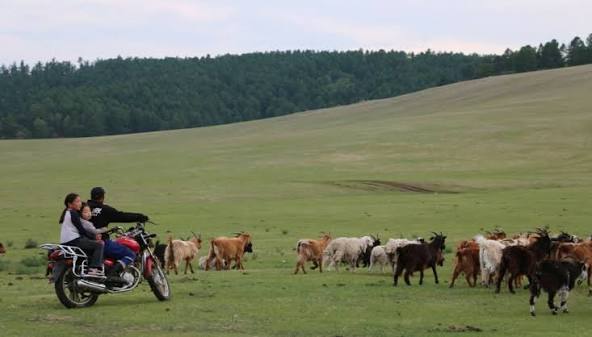
On the windswept steppes of Mongolia, a quarter of the population still lives as their ancestors did thousands of years ago. They move with the seasons, follow the pastures, and raise the five animals—horse, sheep, goat, cattle, and camel—that define their culture. But this ancient way of life is under siege from climate change, mining, and the pull of the city.
Yet, the nomads are not fading away. They are adapting, blending old wisdom with new tools, and proving that a 3,000-year-old tradition can survive in the 21st century. This is the story of Mongolia’s herders and the delicate balance they strike between preservation and change.
A Life on the Move
Mongolia’s nomads move between two and four times a year, following the rhythm of the seasons. Each camp—winter, spring, summer, autumn—is chosen for its pasture and shelter. The ger, a portable felt dwelling, can be taken down and set up in under an hour, making this mobility possible.
The ger itself is a marvel of design and symbolism. Its collapsible wooden lattice, roof poles, and crown ring are covered with felt and canvas. The door faces south, and the interior is laid out with strict purpose: the men’s side to the west, the women’s side to the east, and an altar at the north. Every element has meaning, reflecting a worldview that sees the home as a microcosm of the cosmos.
The Five Snouts and the Steppe Economy
At the heart of nomadic life are the “five snouts”—horses, sheep, goats, cattle or yaks, and camels. Each animal serves a purpose. Sheep and goats provide meat, milk, and cashmere. Cattle and yaks give milk and meat, while camels are beasts of burden in the Gobi. Horses are companions, sources of mare’s milk, and symbols of freedom.
The numbers are staggering. Mongolia has roughly 70 million livestock, outnumbering its human population by more than 20 to one. For the 800,000 to 900,000 people who still herd, these animals are not just a livelihood—they are a way of life.
This economy is not self-sufficient. Cashmere from goats is a major export, making Mongolia the world’s second-largest producer after China. But market integration brings volatility, and herders must navigate price swings and rising costs.
The Cultural Fabric
Nomadic life is woven into Mongolia’s cultural identity. Shamanism and Buddhism coexist, and sacred mountains and rivers are honored with offerings at stone cairns called ovoo. The Naadam Festival, held every July, celebrates the “Three Manly Games”: wrestling, horse racing, and archery—all skills born of the herding life.
Music, too, reflects the steppe. Mongolian throat singing (khoomei) and long songs (urtiin duu) capture the vastness and solitude of the landscape. These traditions are passed down orally, from generation to generation, just as knowledge of weather, animal husbandry, and navigation has been for millennia.
The Pressures Mount
But this way of life is facing unprecedented challenges. The most immediate threat is dzud, a severe winter that follows a summer drought, leaving livestock without pasture and vulnerable to extreme cold. The 2023–2024 dzud killed over 7 million animals—roughly 10% of the national herd. Such events are becoming more frequent and more severe.
Climate change is a driving force. Mongolia’s average temperature has risen about 2.2°C since 1940, faster than the global average. Desertification and pasture degradation are accelerating, shrinking the land available for grazing.
At the same time, a mining boom has brought over 3,000 mining licenses, with mines consuming water and pasture and displacing herder families. And the lure of the city is strong: Ulaanbaatar’s population has swelled from 500,000 in 1990 to over 1.6 million today, nearly half the country’s people, many of them former herders.
Adaptation and Resilience
Despite these pressures, nomads are not simply victims. They are adapting in ways that honor tradition while embracing change. Some herders now use motorcycles and solar panels, and many have cell phones to check weather forecasts and market prices.
The government supports a semi-nomadic model, with fixed winter bases and better infrastructure, as a compromise between full nomadism and settlement. This approach recognizes that complete settlement would be ecologically disastrous—the steppe cannot support intensive agriculture—while also acknowledging the harsh realities of nomadic life.
Many herders want their children to become doctors, engineers, or civil servants, not necessarily to inherit the herd. Yet the knowledge and skills of herding are still valued, and there is a growing recognition that nomadic pastoralism is a sophisticated, sustainable system that has kept the steppe healthy for centuries.
A Deliberate Choice
Herding remains a deliberate national policy choice. The government supports it for food security, cultural identity, and rural employment. For many, it is not a fallback but a chosen way of life.
There are real tensions. Overgrazing, especially by goats for cashmere, degrades pasture, and some argue for reducing herd sizes. Others insist that traditional mobility is the solution, not the problem. International NGOs and researchers are working with herders to find a balance.
The Future of the Steppe
The nomads of Mongolia are not a relic of the past. They are a living, adaptive culture, rooted in a 3,000-year-old tradition but very much of the present. As climate change and economic pressures reshape the steppe, herders are finding ways to preserve what matters most: their connection to the land, their animals, and their way of life.
Whether they can continue to do so remains an open question. But if their history is any guide, the nomads will find a way to endure—moved by the seasons, guided by the stars, and driven by a resilience that is as much a part of Mongolia as the steppe itself.
Mongolia’s herders are the last of a kind, but they are not disappearing. They are adapting, and in doing so, they are preserving a unique cultural heritage that offers lessons in sustainability and resilience for a warming world. The steppe is changing, but the spirit of the nomad endures.
Summary
- About 25–30% of Mongolia’s population still practices nomadic or semi-nomadic herding, moving with the seasons to follow pastures.
- The ger, a portable felt dwelling, is central to nomadic life, with a design that is both practical and symbolic.
- Herders raise the “five snouts”—horses, sheep, goats, cattle/yaks, and camels—and are deeply connected to the steppe ecosystem.
- Climate change, dzud events, mining, and urban migration are major pressures, but herders are adapting with modern tools and government support.
- Nomadic herding is a deliberate policy choice, valued for food security, cultural identity, and sustainable land use.
FAQ
Q: How many nomads are left in Mongolia?
A: Approximately 800,000–900,000 people, or 25–30% of the population, still practice nomadic or semi-nomadic pastoralism.
Q: What is a ger?
A: A ger is a portable, felt-covered dwelling used by Mongolian nomads. It can be assembled or dismantled in under an hour and has a strict symbolic interior layout.
Q: What are the “five snouts”?
A: The five snouts are the primary livestock of Mongolian herders: horses, sheep, goats, cattle/yaks, and camels. They are central to nomadic identity and economy.
Q: How does climate change affect nomads?
A: Mongolia’s temperature has risen about 2.2°C since 1940, leading to desertification and more frequent dzud (severe winter) events, which can kill millions of livestock.
Q: Are nomads moving to cities?
A: Yes, many former herders have moved to Ulaanbaatar, whose population has grown from 500,000 in 1990 to over 1.6 million. However, many still choose to remain in rural areas.