
Tag: Modernism

  • The Bauhaus School: How a German Art School Redesigned the Modern World

    The Bauhaus School: How a German Art School Redesigned the Modern World

    Bauhaus - Wikipedia

    In 1919, in the German city of Weimar, an architect named Walter Gropius founded a school that would change everything. It was called the Bauhaus, and it had a radical idea: art, craft, and technology could be united to create a new kind of design for a new kind of world. For just 14 years, this small school operated in three German cities, enrolling roughly 1,250 students. Yet its influence has spread far beyond its short life, shaping the look of everything from skyscrapers to desk lamps, and from typefaces to teapots.

    Today, when you see a sleek glass building, a minimalist chair, or a clean, sans-serif font, you’re seeing the Bauhaus legacy. But the school’s story is not just about aesthetics. It’s about a group of artists and thinkers who, in the chaos after World War I, dared to imagine that design could make life better for everyone. Their ideas were controversial, their products sometimes impractical, and their school was shut down by the Nazis. Yet the Bauhaus idea survived, spread across the globe, and continues to shape our world.

    From Cathedral to Machine: The Bauhaus Idea

    The Bauhaus was born from the ashes of World War I. Germany was defeated, economically broken, and politically unstable, but the Weimar Republic was also a time of intense cultural experimentation. Gropius, who had served in the war and been horrified by its destruction, wanted to rebuild society. He merged the Grand-Ducal Saxon Academy of Fine Art and the School of Arts and Crafts to create a school that would break down the traditional hierarchy of fine arts over crafts.

    Gropius’s vision was inspired by the Arts and Crafts movement and the Deutscher Werkbund, but he went further. He imagined a “cathedral of socialism” that would unite all creative disciplines. The school’s motto, later formalized, was “Art and Technology – a new unity.” This was a radical idea: that artists should work with industry to create well-designed, affordable objects for everyday life.

    The Bauhaus was structured around a groundbreaking curriculum. Every student began with the Vorkurs, a six-month preliminary course that explored materials, color, and form. Johannes Itten, a mystic and educator, pioneered this course, but it was later systematized by László Moholy-Nagy and Josef Albers. After the preliminary course, students entered workshops—metal, wood, textiles, ceramics, typography, stage, and wall-painting—where they learned by doing. Each workshop had two masters: a “Master of Form” (an artist) and a “Master of Craft” (an artisan). This dual model emphasized both design and handcraft.

    The ultimate goal was the Gesamtkunstwerk, a total work of art. Architecture was seen as the highest expression of this idea, the ultimate aim of all design. The Bauhaus building itself, designed by Gropius in Dessau, became a physical manifesto of this philosophy.

    The Signature Looks: From the Wassily Chair to the Bauhaus Building

    Certain objects from the Bauhaus have become icons of modern design. Marcel Breuer’s Wassily Chair (1925) was inspired by bicycle handlebars and used tubular steel to create a sleek, minimalist form. Wilhelm Wagenfeld and Carl Jakob Jucker’s MT8 Table Lamp (1924) is a perfect example of the Bauhaus aesthetic: geometric, functional, and beautiful in its simplicity. Josef Hartwig’s Chess Set (1924) reduced the pieces to basic geometric shapes, reflecting the Bauhaus belief that form should follow function.

    Herbert Bayer’s “Bauhaus” typeface (1925) was a universal, geometric sans-serif that stripped away unnecessary ornament. The experimental Haus am Horn (1923) in Weimar was a “prototype house” that showcased the Bauhaus’s ideas for efficient, affordable living.

    Perhaps the most iconic creation was the Bauhaus Building in Dessau (1925–26). Gropius’s design featured a glass curtain wall that revealed the structure’s inner workings, a bold statement of transparency and modernity. It was a building that embodied the school’s principles: functional, clean, and radically new.

    The People and the Politics

    The Bauhaus was a magnet for some of the most innovative artists of the 20th century. Paul Klee, Wassily Kandinsky, Oskar Schlemmer, Lyonel Feininger, and Anni Albers were among the faculty. The school also had a strong contingent of women students, though their experiences were often shaped by gender bias. Women were frequently steered toward textiles and ceramics, and the metal workshop was largely male-dominated. Gunta Stölzl, who led the weaving workshop, had to fight for her position, but her work was groundbreaking.

    The school’s politics were complex. It was criticized by both the left and the right. Some on the left saw it as elitist, despite its rhetoric of design for the people. Many Bauhaus products were expensive, small-batch items that were not accessible to the working class. On the right, the Nazis viewed the school as “degenerate” and “un-German.” This hostility eventually forced the school to move from Weimar to Dessau, and then to Berlin, where it was finally closed in 1933 under pressure from the Nazi regime.

    The school’s second director, Hannes Meyer (1928–1930), emphasized functionalism and architecture over craft, but his Marxist politics made him unpopular. The third director, Ludwig Mies van der Rohe (1930–1933), oversaw the school’s final, architecture-focused years, but it was too late. In April 1933, the Bauhaus was shut down.

    The Bauhaus Goes Global

    After the closure, Bauhaus faculty and students scattered around the world, taking their ideas with them. László Moholy-Nagy founded the New Bauhaus in Chicago in 1937, which later became the Institute of Design. Josef and Anni Albers moved to Black Mountain College in North Carolina, where they became influential teachers. Marcel Breuer and Mies van der Rohe went to the United States, where they became leading figures in modern architecture. Other alumni migrated to Palestine, Mexico, Japan, and beyond.

    This diaspora spread Bauhaus pedagogy and aesthetics across the globe, influencing mid-century modernism, Scandinavian design, and corporate identity. The Bauhaus-Universität Weimar and the Bauhaus Dessau Foundation continue to operate today, and in 1996, UNESCO designated the Bauhaus sites in Weimar and Dessau as World Heritage.

    The Legacy and the Critique

    The Bauhaus is often celebrated as the origin of modern design, and its influence is undeniable. The clean lines, functionalism, and “form follows function” ethos can be seen in everything from Braun and Apple products to contemporary architecture. But there is also a critical view. Some argue that the Bauhaus’s functionalism became an ideology that ignored human needs for ornament and decoration. Others point out that the school’s products were not truly democratic, and that its gender politics were often regressive.

    Despite these critiques, the Bauhaus remains a powerful symbol of creativity and innovation. It was a school that, for a brief moment, brought together art, craft, and technology in a way that had never been done before. Its story is a reminder of what can happen when artists and designers are given the freedom to experiment and imagine a better world.

    The Bauhaus lasted only 14 years, but its impact has been lasting and global. It redesigned the modern world not just by changing the look of objects, but by changing the way we think about design. The Bauhaus idea—that good design can improve everyday life—remains as relevant today as it was in 1919. As you look around at the buildings, furniture, and fonts that shape your world, you may be seeing the Bauhaus legacy, a revolutionary school that dared to unite art and technology.

    Summary

    • The Bauhaus was founded in 1919 by Walter Gropius in Weimar, Germany, and operated until 1933, when it was closed by the Nazis.
    • The school’s revolutionary curriculum included a preliminary course and a workshop model that united art, craft, and technology.
    • Iconic designs like the Wassily Chair, the MT8 Table Lamp, and the Bauhaus Building in Dessau emerged from the school.
    • After the school’s closure, its faculty and alumni spread Bauhaus ideas worldwide, influencing modern design and architecture.
    • The Bauhaus legacy is a mix of innovation and critique, but its impact on the modern world is undeniable.

    FAQ

    Q: What was the Bauhaus school?
    A: The Bauhaus was a German art school founded in 1919 by Walter Gropius. It aimed to unite art, craft, and technology in a new way of design and architecture. Despite being closed in 1933, it had a significant influence on modern design.

    Q: Why is the Bauhaus so influential?
    A: The Bauhaus’s influence comes from its innovative curriculum and its emphasis on functional, geometric design. Its ideas spread through alumni and faculty who emigrated after the school’s closure, shaping mid-century modernism and contemporary design.

    Q: What were the key principles of the Bauhaus?
    A: The key principles included the unity of art and technology, the importance of craft, and the idea that design should be functional and accessible. The school also emphasized a total work of art, with architecture as the ultimate goal.

    Q: How did women contribute to the Bauhaus?
    A: Women were admitted to the Bauhaus, but were often steered into textiles and ceramics. Gunta Stölzl led the weaving workshop and created groundbreaking work. However, gender bias was a challenge, and women had to fight for recognition.

    Q: What happened to the Bauhaus after World War II?
    A: After World War II, the Bauhaus’s legacy continued through the New Bauhaus in Chicago, Black Mountain College, and the work of its emigrant faculty. The Bauhaus-Universität Weimar and the Bauhaus Dessau Foundation also carry on its traditions today.
  • How the Trenches Reshaped Art and Literature: WWI’s Cultural Aftermath

    How the Trenches Reshaped Art and Literature: WWI’s Cultural Aftermath

    On a grey morning in July 1916, near the Somme River in France, a young British officer named Wilfred Owen led his men into a hail of machine-gun fire. He would survive that day, but the experience would strip away every romantic notion of war he had carried into battle. Two years later, he wrote ‘Dulce et Decorum Est,’ a poem that described a soldier dying from a gas attack—’guttering, choking, drowning.’ The poem’s title, a Latin phrase meaning ‘it is sweet and fitting to die for one’s country,’ became the bitterest irony of a generation.

    Owen was one of millions whose lives were broken by the First World War, and his poetry—published after his death in 1918—helped spark a cultural revolution that would redefine how the West saw art, literature, and humanity itself. The war did not just kill soldiers; it killed a way of seeing the world. In its place rose movements that rejected beauty, order, and meaning, because the war had shown those to be lies.

    The Death of Romantic War

    Before 1914, European culture still carried the torch of the 19th century. War was something that happened to other people—far away, brief, and noble. Paintings showed cavalry charges and brave officers waving swords. Poetry spoke of glory and sacrifice. The Italian Futurists even celebrated war as ‘the world’s only hygiene,’ a cleansing force that would sweep away the old and usher in the new.

    Then the guns of August 1914 fired, and the world learned what industrial warfare truly meant. The numbers are staggering: nearly 10 million soldiers dead, 21 million wounded, 7 million civilians killed. But those statistics obscure the reality of the trenches—mud, rats, poison gas, and corpses rotting in the wire. The Battle of the Somme alone produced a million casualties in five months, most of them in the first day. The British Army lost 57,000 men on July 1, 1916, the bloodiest day in its history.

    This was not war as anyone had imagined it. The machine gun made charging infantry obsolete. Artillery shells could kill from miles away. Gas attacks burned lungs and eyes. Soldiers died anonymously, often unrecognizable, their bodies swallowed by the earth. The romantic imagination simply could not process this. It needed new forms, new language, new art.

    The Poets Who Spoke the Unspeakable

    No group captured the shift more powerfully than the British war poets. Rupert Brooke, writing in 1914, still believed in the old ideals. His poem ‘The Soldier’ begins: ‘If I should die, think only this of me: / That there’s some corner of a foreign field / That is forever England.’ It was patriotic, beautiful, and utterly out of touch with what lay ahead. Brooke died in 1915, before the Somme, before he could see the truth.

    Wilfred Owen and Siegfried Sassoon saw it. Sassoon, who served in the trenches and won the Military Cross, wrote ‘Counter-Attack’ in 1918, describing a soldier’s corpse caught on a wire—’his face / A white, long, writhing horror.’ Owen went further. His poem ‘Dulce et Decorum Est’ showed a man drowning in his own lungs after a gas attack, and ended by calling the old lie—’dulce et decorum est pro patria mori’—a lie. Both men were decorated heroes. Both were also traumatized, and both used their poetry to tell the public what the politicians and censors would not.

    Their work did not just describe the war; it created a new poetic language. Broken rhythms, harsh imagery, and a refusal to smooth things over. This was the beginning of Modernism in literature, a movement that would explode after the war with T.S. Eliot’s The Waste Land (1922), a poem of fragments and despair, and James Joyce’s Ulysses, which shattered the conventional novel with stream of consciousness.

    The Shattered World of Modernism

    The war broke the idea that the world made sense. How could it, after the Somme? Modernist writers responded by breaking narrative itself. Eliot’s The Waste Land is a collage of voices, myths, and quotations, all of them decaying. It opens with ‘April is the cruellest month,’ a reversal of the old springtime hope. Virginia Woolf’s Mrs Dalloway (1925) sets a shell-shocked veteran, Septimus Smith, against the genteel world of post-war London. His suicide is not a personal failure but a verdict on a society that refuses to acknowledge what the war did to its young men.

    Ernest Hemingway, an ambulance driver on the Italian front, took a different approach. In A Farewell to Arms (1929), he wrote in a stripped-down, declarative style—no decorative adjectives, no moralizing. The hero, Frederic Henry, makes his own separate peace, deserting an army that has become meaningless. Hemingway called his generation the ‘Lost Generation,’ a term he borrowed from Gertrude Stein, and he made it famous in The Sun Also Rises (1926), a novel about aimless expatriates drinking their way through Paris and Spain.

    Erich Maria Remarque’s All Quiet on the Western Front (1929) became the definitive soldier’s novel. Written by a German veteran, it shows the war from the other side of the wire. The narrator, Paul Bäumer, speaks for his whole generation: ‘We were eighteen and had begun to love life and the world; and we had to shoot it to pieces.’ The book was banned and burned by the Nazis, who understood its power.

    Dada: The Anti-Art Response

    If the writers rebuilt language, the artists of Dada tried to destroy it. The movement was born in 1916 at the Cabaret Voltaire in Zurich, a neutral city where refugees, pacifists, and deserters gathered. Its founders—Hugo Ball, Tristan Tzara, Hans Arp—were horrified by the war’s irrational slaughter. Their answer was to make art that was just as irrational, absurd, and meaningless as the war itself.

    Marcel Duchamp’s Fountain (1917), a urinal signed ‘R. Mutt,’ was the ultimate Dada gesture. It was not a painting of a war scene; it was a rejection of the very idea of art. If the world had gone mad, then art should be mad too. Dada produced collages made from war debris, nonsense poetry, and performances that mocked the audience. Kurt Schwitters made ‘Merz Pictures’ from tram tickets, wire, and other trash he found on the streets. It was art that said: nothing matters.

    Out of Dada grew Surrealism. Andre Breton, who had worked in a psychiatric hospital during the war, saw the madness of the trenches and concluded that the rational mind had failed. Surrealism would explore the unconscious, dreams, and the irrational. Its imagery—melting clocks, floating objects, impossible spaces—was a direct response to a world where reality had become impossible.

    The German Expressionists and New Objectivity

    Germany, defeated and humiliated, produced some of the war’s most devastating art. Expressionism had already existed before the war, with its distorted forms and raw emotion, but the conflict intensified it. Artists like Otto Dix and George Grosz had served in the trenches, and they brought that experience back with them.

    Dix’s work is unflinching. His triptych War (1929–1932) shows soldiers crawling through a blasted landscape, their faces masks of horror. The Trench (1920–23) depicts the aftermath of a battle—bodies half-buried in mud, faces eaten by rats. These images were so graphic that they were hidden for decades. Dix was labeled a ‘degenerate artist’ by the Nazis, who understood that such art could not coexist with their glorification of war.

    By the mid-1920s, a new movement emerged in Germany: New Objectivity (Neue Sachlichkeit). It was a cold, realistic response to Expressionism’s emotionalism. Artists like Dix and Grosz rejected both romanticism and abstraction. They painted what they saw: crippled veterans begging on the streets, prostitutes, corrupt businessmen, the social decay of the Weimar Republic. This was the world the war had made, and they would not look away.

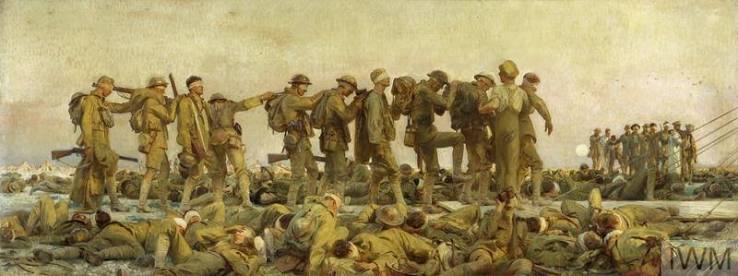
    The war’s impact was not limited to the Western Front. Paul Nash, a British artist, painted the blasted landscapes of Ypres and Passchendaele. His We Are Making a New World (1918) shows a devastated field, the title dripping with irony. John Singer Sargent’s Gassed (1919), a massive canvas of soldiers blinded by gas, is one of the most famous war paintings ever made—not heroic, but tragic.

    A Generation Lost and Found

    The war did not end in 1918. It lived on in the minds of those who survived. ‘Shell shock’—the era’s term for what we now call PTSD—affected hundreds of thousands of soldiers. At first, it was dismissed as cowardice. Some were executed for it. But gradually, doctors and writers forced a recognition of psychological trauma. Woolf’s Mrs Dalloway and Hemingway’s stories are full of men like Septimus Smith, unable to reconnect with a world that did not understand what they had been through.

    The ‘Lost Generation’ was not just a literary label. It described a real cohort—men and women who came of age during the war, who had seen too much, and who often abandoned their homelands. Many moved to Paris, where Hemingway, Fitzgerald, Stein, and Joyce created an expatriate community that produced some of the century’s greatest literature. They were exiles, not just geographically, but psychologically. They had lost faith in the institutions that had lied to them—governments, churches, schools, families.

    The war also shattered the old class structures. The Battle of the Somme killed an entire generation of British public school officers, the ‘lions led by donkeys.’ The war levelled aristocrats and laborers in the same mud, and post-war writers like Robert Graves (Good-Bye to All That, 1929) and David Jones (In Parenthesis, 1937) documented this leveling. Jones, an artilleryman, wrote his book in a mixture of prose and verse, reflecting the shattered consciousness of men who had lived through the absurdity.

    The Enduring Legacy

    By 1930, the war’s cultural impact was everywhere. The optimism of the Belle Époque was dead. The idea that progress was inevitable was dead. The belief that art could be beautiful and uplifting was dead. In their place came fragmentation, irony, and a deep suspicion of authority. Modernism, Dada, Surrealism, Expressionism, New Objectivity—all were children of the trenches.

    The war also changed how we think about trauma. Before 1914, there was no language for what soldiers experienced. After the war, there was. The poems of Owen and Sassoon, the novels of Remarque and Hemingway, the paintings of Dix and Nash—they gave a voice to the voiceless. They told the truth about war, and in doing so, they made it harder for future generations to lie about it.

    When World War II came, there was no initial patriotic enthusiasm. The poets who wrote about it—Auden, Spender, Keith Douglas—had learned from their predecessors. They knew that war was not glorious. This was a direct consequence of the cultural revolution of 1914–1918. The artists and writers of the Great War had done something extraordinary: they had turned horror into art, and in doing so, they had changed the world.

    The War’s Art in Context

    It is impossible to fully separate the art from the war. Every work—whether Owen’s poetry or Dix’s paintings—was a response to a specific historical event. But these works have outlived the trenches. They speak to us today because they deal with timeless themes: trauma, loss, the failure of authority, the search for meaning in a meaningless world.

    A young person today, reading All Quiet on the Western Front for the first time, can still feel the mud and the fear. Looking at The Waste Land, we still recognize the fragmentation of modern life. The war’s cultural impact was not limited to its own generation. It created the artistic language we still use to make sense of catastrophe.

    The First World War was a catastrophe that killed millions, but it also birthed some of the most powerful art and literature ever created. The poets, novelists, and painters of the Lost Generation did not simply document the war; they transformed human understanding. They showed us that war is not glorious, that trauma leaves invisible wounds, and that the old ways of seeing—romantic, ordered, certain—were never true to begin with. A century later, their work remains a warning and a testament, a reminder of what happens when the world breaks, and the artists who help us see it.

    Summary

    • WWI shattered the pre-war romantic view of war, leading to Modernism’s fragmented narratives in literature and the rise of Dada’s anti-art.
    • Poets like Wilfred Owen and Siegfried Sassoon rejected the ‘glory’ of war in works like ‘Dulce et Decorum Est,’ exposing the horror of industrial slaughter.
    • The ‘Lost Generation’ writers—Hemingway, Eliot, Woolf—explored trauma, shell shock, and alienation in works like The Waste Land and Mrs Dalloway.
    • German Expressionism and New Objectivity reflected the brutal aftermath of war, with artists like Otto Dix depicting crippled veterans and social decay.
    • The war gave birth to modern psychological understanding of trauma, and its cultural impact shaped how we remember and represent conflict today.

    FAQ

    Q: What was the ‘Lost Generation’?
    A: The Lost Generation refers to the cohort of men and women who came of age during World War I, and who were disillusioned and alienated by the war’s horrors. The term was popularized by Gertrude Stein and used by Ernest Hemingway in his memoir A Moveable Feast. Many of them became expatriate writers and artists in Paris, including Hemingway, Fitzgerald, and Joyce.

    Q: How did Dada respond to the war?
    A: Dada was an anti-art movement founded in 1916 in Zurich’s Cabaret Voltaire. It rejected traditional artistic values—beauty, order, and reason—because those values had failed to prevent the war. Dadaists used absurdity, chaos, and nonsense to reflect a world that had become irrational. Marcel Duchamp’s Fountain, a urinal displayed as art, is a famous example.

    Q: What is shell shock, and why did it matter?
    A: Shell shock was the World War I term for what we now call post-traumatic stress disorder (PTSD). It was initially dismissed as cowardice, and some affected soldiers were executed. Over time, its recognition forced a rethinking of psychological trauma, and it became a major theme in post-war literature, such as Virginia Woolf’s Mrs Dalloway.

    Q: What was the New Objectivity movement?
    A: New Objectivity (Neue Sachlichkeit) was a German artistic movement from the 1920s that reacted against Expressionism’s emotionalism. It used cold, realistic, and detached styles to depict the brutal aftermath of war, including crippled veterans, poverty, and social decay. Otto Dix and George Grosz were key figures.

    Q: How did WWI change literature’s portrayal of war?
    A: Before WWI, war was often depicted as heroic and glorious. After the war, writers like Wilfred Owen, Erich Maria Remarque, and Ernest Hemingway depicted it as horrific, senseless, and dehumanizing. This marked a permanent shift in how war is represented in literature, influencing all subsequent war writing.