When Berry Gordy founded Motown Records in 1959, he called it ‘The Sound of Young America.’ The label’s polished pop hits ‘My Girl,’ ‘Stop! In the Name of Love’—topped charts and crossed racial lines. But the rhythmic engine driving those records, the call-and-response between lead and background vocals, the bent blue notes in the melodies none of that started in Detroit. It traces back centuries, across the Atlantic, to West and Central Africa.
This is a story that standard music histories often miss. Jazz gets called ‘America’s classical music,’ rock is framed as teenage rebellion, and Motown is treated as a pop phenomenon. Each genre is severed from its deeper roots. Yet the musical DNA of nearly everything we listen to—from blues to hip-hop—carries the unmistakable fingerprints of African performance traditions. Understanding that lineage changes how we hear familiar songs.
The Journey: From Africa to the Americas
The transatlantic slave trade brought over 12 million Africans to the Americas between the 16th and 19th centuries. They came from diverse regions—Senegambia, the Gold Coast, Angola, Congo—each with distinct musical systems. But despite this diversity, shared structural features allowed a pan-African musical sensibility to survive the Middle Passage and recombine on American soil.
These features included rhythmic complexity, communal participation, and the integration of music into every aspect of life. In many African cultures, music wasn’t a separate art form; it was woven into work, worship, and celebration. This holistic approach traveled with enslaved people.
The drum, central to African music, was often banned in slave societies. After the 1739 Stono Rebellion in South Carolina, for example, drums were prohibited for fear they could be used to coordinate uprisings. So enslaved Africans transferred rhythmic expression to their bodies—hand-clapping, foot-stomping, and a practice called “patting juba.” They also channeled rhythm into vocal forms: field hollers, work songs, and spirituals. These became the foundation of later American music.
Minstrelsy: The First Pop Culture Paradox
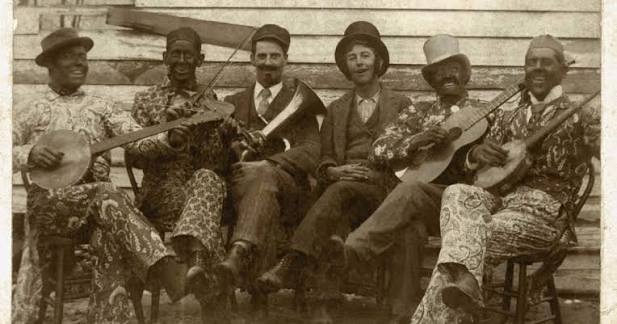
In 1843, the Virginia Minstrels formalized blackface minstrelsy, the first distinctly American mass entertainment form. White men darkened their faces with burnt cork and performed caricatured imitations of Black speech, dance, and song. It was brutal, racist, and wildly popular.
But here’s the paradox: minstrelsy was also the conduit through which white audiences first encountered—albeit distorted—Black musical elements. The banjo, an African-derived instrument, became a minstrel staple. Syncopated rhythms and dance steps like the cakewalk filtered into mainstream entertainment. This set a recurring pattern: Black innovation, white mediation, mainstream success, and erasure of Black authorship.
This pattern would repeat for over a century. White artists like Elvis Presley and the Beatles achieved massive success covering or adapting Black R&B, often receiving greater credit and compensation. The music was loved, but its creators were marginalized.
Ragtime, Blues, and the Birth of Commercial Black Music
By the 1890s, Black musical forms began moving into published, commercially viable territory. Scott Joplin’s ragtime compositions, with their syncopated “ragged” rhythms, became piano sheet music sensations. W.C. Handy, “Father of the Blues,” published “Memphis Blues” in 1912, bringing the blues to a broader audience.
The blues, with its “blue notes”—flattened 3rd, 5th, and 7th scale degrees—drew directly on African pitch traditions that didn’t map neatly onto Western equal temperament. These bent or “worried” notes conveyed emotional depth and were a signature of African-derived vocal styles.
In the 1920s, “race records” marketed Black music to Black audiences. Ma Rainey and Bessie Smith sold millions of records. Jazz, led by Louis Armstrong and Duke Ellington, became a national phenomenon. Improvisation, a core African performance principle, became jazz’s defining feature. Musicians didn’t just play written notes; they created in the moment, treating each performance as a living, participatory event.
The Sound of Young America: Motown and the Mainstream Crossover
Berry Gordy’s Motown Records represented a deliberate strategy to bring Black artistry to mainstream pop. He crafted a polished sound—tight harmonies, catchy hooks, and a steady backbeat—that appealed to white and Black audiences alike. But the African roots were always there: the call-and-response between lead and background vocals, the syncopated bass lines, the gospel-inflected vocal embellishments.
Motown wasn’t a break from the lineage; it was a continuation. The label’s artists—Smokey Robinson, Marvin Gaye, Stevie Wonder—drew directly from blues, gospel, and R&B traditions that had been evolving for a century. By presenting Black music in a pop-friendly package, Motown made African-derived aesthetics mainstream without disguising their origins.
The Legacy: From James Brown to Hip-Hop
The lineage continued into funk and soul. James Brown’s “funky drummer” beat, with its emphasis on the downbeat and polyrhythmic layering, was a direct descendant of West African drumming patterns. Sister Rosetta Rosetta Tharpe, a queer Black woman, pioneered rock guitar techniques in the 1940s and 1950s, earning her the title “Godmother of Rock.”
In the 1970s, hip-hop emerged in the Bronx, built on breakbeats and sampling. DJ Kool Herc, a Jamaican immigrant, extended the instrumental breaks of funk records, creating a new rhythmic foundation for MCs to rap over. Sampling itself is a form of communal reclamation—taking existing music and recontextualizing it, much like African musicians who recombine traditional rhythms in new ways.
Why This History Is Hidden
Standard genre histories often treat jazz, rock, R&B, and hip-hop as discrete American inventions. The African lineage is obscured for several reasons:
- Segregation of music history: Jazz is taught as “America’s classical music,” rock as youth rebellion, Motown as pop—each severed from African roots.
- The Great Migration narrative: Black Southerners moving north (1910–1970) brought blues and gospel to Chicago, Detroit, and New York, but histories emphasize geography (Delta → Chicago) over deeper African structural inheritance.
- Commercial erasure: White artists who covered Black music often received more credit, and the originators were pushed into the background.
Understanding the full lineage changes how we hear everything. The backbeat in a Taylor Swift song, the call-and-response in a gospel choir, the blue notes in a rock guitar solo—all carry echoes of Africa. This isn’t about diminution; it’s about recognition. American popular music is a rich, complex tapestry woven from African threads, and the pattern is clearer when we look closely.
From minstrelsy’s distorted borrowings to Motown’s polished crossover, American popular music has never been far from its African roots. The elements—syncopation, call-and-response, blue notes, improvisation—are not just stylistic quirks; they’re the structural DNA of the music we love. Recognizing this heritage isn’t about rewriting history; it’s about completing it. The next time you tap your foot to a backbeat, you’re participating in a tradition that survived the Middle Passage, defied bans, and continues to evolve. That’s a story worth hearing.
Summary
- American popular music is deeply rooted in African musical traditions, including polyrhythms, call-and-response, blue notes, and improvisation.
- Blackface minstrelsy was the first mass entertainment form, both a vehicle for racist stereotypes and a distorted conduit for Black musical elements.
- Ragtime, blues, jazz, R&B, soul, funk, and hip-hop all trace their lineage to African performance practices.
- Motown’s crossover success brought African-derived aesthetics to mainstream pop without disguising their origins.
- Standard genre histories often obscure this lineage, but recognizing it changes how we understand and appreciate the music.
FAQ
Q: What is a ‘blue note’?
A: A blue note is a flattened 3rd, 5th, or 7th scale degree, often bent or ‘worried’ in pitch. It comes from African scales that don’t map neatly onto Western equal temperament, and it gives blues and jazz their distinctive emotional quality.
Q: How did the banjo get to America?
A: The banjo is derived from West African stringed instruments like the akonting. Enslaved Africans brought the instrument and its playing techniques to the Americas, where it became a staple of American folk and minstrel music.
Q: Why is Motown considered part of the African musical lineage?
A: Motown’s sound relied on syncopated bass lines, call-and-response vocals, and gospel-inflected embellishments—all African-derived elements. Berry Gordy packaged these in a polished pop format, but the roots remained.
Q: What is call-and-response?
A: Call-and-response is a conversational structure where a soloist makes a musical statement (‘call’) and the ensemble or audience responds. It’s present in African ritual music, spirituals, blues, gospel, jazz, and hip-hop.
Q: How did drums get banned during slavery?
A: After the 1739 Stono Rebellion in South Carolina, authorities banned drums on plantations because they could be used to coordinate uprisings. Enslaved people adapted by using body percussion and vocal rhythms instead.