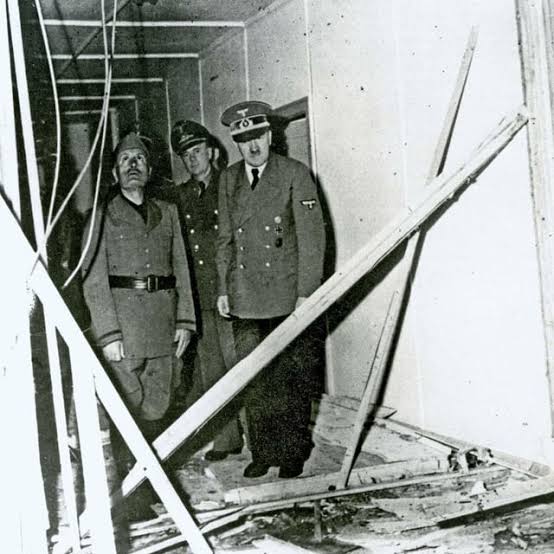
At 12:42 PM on 20 July 1944, a bomb ripped through a wooden briefing hut at Hitler’s East Prussian headquarters, the Wolf’s Lair. Four men were killed instantly, but the intended target Adolf Hitler stumbled out alive, his trousers torn, his eardrums burst, and his arm bruised. The explosion was the culmination of years of plotting, a desperate, last-ditch attempt by a group of German officers to end the Nazi regime. This is the story of that conspiracy, the men behind it, and why it failed.
The Man with the Bomb
Colonel Claus Schenk Graf von Stauffenberg was not an obvious revolutionary. A decorated officer, a count, and a man who had once admired Hitler’s early successes, he had become a leading figure in the military resistance by 1944. He had lost his right hand, two fingers on his left, and an eye while serving in North Africa injuries that would complicate his mission but not deter it.
Stauffenberg was Chief of Staff to the Replacement Army, a post that gave him direct access to Hitler’s military briefings. He carried two 1-kilogram blocks of British-made plastic explosive in his briefcase, armed with a chemical time fuse. Only one was primed his injuries made it difficult to handle both. That single bomb, placed in a briefcase, would be the instrument of the most serious attempt on Hitler’s life.
The Plan: Operation Valkyrie
The assassination was only the first step. The conspirators had adapted a contingency plan originally designed to suppress internal unrest Operation Valkyrie into a mechanism for a military coup. The plan called for the Replacement Army to seize control of Berlin, arrest Nazi leaders, and take over communications, all under the guise of responding to an SS coup attempt.
Key figures included General Friedrich Olbricht, who was instrumental in operational planning; General Ludwig Beck, a former Chief of the General Staff who was to become head of state; and Major-General Henning von Tresckow, the spiritual leader of the resistance, who had tried to kill Hitler the year before by placing a bomb on his plane it failed to detonate.
The Failure: A Table Leg and a Kicked Briefcase
On the day of the attempt, the briefing was moved from a concrete bunker to a wooden hut because of the heat. The wood should have made the blast more effective. Stauffenberg placed the briefcase under the conference table, close to Hitler. Then, with an excuse, he left the room to make a phone call.
But Colonel Heinz Brandt, an officer attending the briefing, found the briefcase in his way. He kicked it behind the heavy oak table leg. When the bomb exploded at 12:42 PM, that leg deflected the blast away from Hitler. The Führer survived with minor injuries: a bruised arm, burst eardrums, singed hair, and torn trousers. Brandt was not so lucky; he was killed, along with three others.
Stauffenberg, hearing the explosion from outside, was convinced Hitler was dead. He flew to Berlin to trigger Operation Valkyrie. But the coup failed within hours. Indecision among the conspirators, communication failures, and the news that Hitler was alive unraveled the plan. By nightfall, Stauffenberg, Olbricht, and others were executed by firing squad at the Bendlerblock, the War Ministry in Berlin.
The Brutal Aftermath
Hitler’s revenge was swift and merciless. Approximately 200 people were executed, though some estimates suggest up to 5,000 were arrested. The People’s Court under Roland Freisler conducted show trials, with victims hanged from meat hooks, filmed for Hitler’s viewing. Among those killed were Field Marshal Erwin Rommel, who was forced to commit suicide; General Hans Oster; Admiral Wilhelm Canaris; and the theologian Dietrich Bonhoeffer, executed in a concentration camp.
The conspirators were not democrats in the modern sense. Most were conservative nationalists who wanted to end the war and preserve Germany’s honor, hoping to make peace with the Western Allies while continuing against the Soviets. Some, like Tresckow and Bonhoeffer, were driven by Christian ethics. Tresckow had said: “The assassination must be attempted, whatever the cost. Even if it fails, we must do something in Berlin.”
The Long Road to Resistance
Resistance to Hitler had existed since the mid-1930s but was fragmented. The 1938 September Conspiracy, led by General Beck and Admiral Canaris, planned a coup if Hitler invaded Czechoslovakia, but it was abandoned after the Munich Agreement. The early military victories made a coup seem treasonous. The turning point came with the Eastern Front, the Stalingrad defeat, and the growing awareness of war crimes the Einsatzgruppen massacres and the Holocaust.
Stauffenberg himself had been sympathetic to some Nazi goals early on but was radicalized by the atrocities in the East. The July 20 attempt was the culmination of a long-running conspiracy that included the Kreisau Circle and the Abwehr resistance, with multiple attempts planned since 1938. The briefcase bomb was the closest they ever came.
The July 20th plot failed, but it remains a testament to the courage of a few who were willing to sacrifice everything to stop a monster. In the words of Tresckow, the attempt had to be made, even if it failed. The conspirators’ names are remembered not for their success, but for their moral stand in the face of tyranny.
Summary
- The assassination attempt on 20 July 1944 at the Wolf’s Lair involved a 1-kilogram plastic explosive in a briefcase, placed by Colonel Claus von Stauffenberg.
- The bomb killed four men but spared Hitler, who survived with minor injuries because the briefcase was kicked behind a heavy table leg.
- The coup, Operation Valkyrie, failed within hours due to indecision and the news that Hitler was alive.
- The conspirators included military officers and civilians, many of whom were conservative nationalists or driven by religious ethics.
- Hitler’s retaliation was brutal: about 200 executions, with some victims hanged from meat hooks, and thousands arrested.
FAQ
Q: Why did Stauffenberg only arm one bomb?
A: Stauffenberg had lost his right hand and two fingers on his left hand in North Africa, making it difficult to handle two bombs. He armed only one due to time constraints and his injuries.
Q: What was Operation Valkyrie?
A: Originally a contingency plan to suppress internal unrest, it was adapted by the conspirators to seize control of Berlin after Hitler’s assassination, using the Replacement Army to arrest Nazi leaders and take over communications.
Q: Who were the key leaders of the conspiracy?
A: Key figures included Stauffenberg, General Friedrich Olbricht, General Ludwig Beck (designated head of state), General Erich Hoepner, and Major-General Henning von Tresckow.
Q: How many people were executed after the plot?
A: Approximately 200 people were executed, though some estimates suggest up to 5,000 were arrested. Notable victims include Field Marshal Erwin Rommel (forced suicide) and Dietrich Bonhoeffer.
Q: Were the conspirators democrats?
A: No, most were conservative nationalists who wanted to end the war and preserve Germany’s honor, hoping to negotiate peace with the Western Allies while continuing against the Soviets.