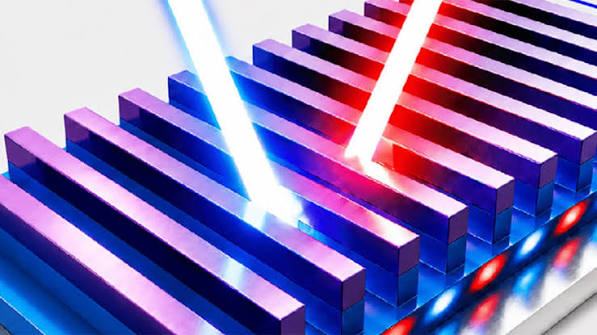
For over 160 years, Kirchhoff’s law of thermal radiation stood as an unbreakable rule of physics: a material that absorbs heat well must also emit it well. This symmetry seemed as fundamental as gravity. But now, researchers have engineered a material that breaks this symmetry and remembers its new settings even after power is removed.
The breakthrough isn’t just a neat trick. It opens the door to passive thermal switches, smarter energy harvesting, and even thermal camouflage that works without a battery. Here’s how they did it, and why it matters.
The law that seemed unbreakable
In 1859, German physicist Gustav Kirchhoff formulated a principle that became a cornerstone of thermal physics: at thermal equilibrium, a body’s absorptivity equals its emissivity at every wavelength and angle. In plain terms, a surface that soaks up heat is just as good at radiating it back out. This symmetry is why a black car gets hotter in the sun than a white one—both absorb and emit proportionally.
For generations, engineers worked within this rule. If you wanted a material that emitted heat efficiently, you had to accept that it would absorb just as much. But a new study, published in a leading physics journal, demonstrates a material that breaks this symmetry on demand—and holds its new properties even after the power is switched off.
Breaking the symmetry
The key is a thermal metamaterial—a structure engineered at the nanoscale—combined with a phase-change material like germanium-antimony-tellurium (GST). GST is already familiar from rewritable CDs and DVDs, where a laser flips it between crystalline and amorphous states. Each state has different optical and thermal properties.
The researchers patterned a thin film of GST with a carefully designed photonic structure—essentially a grid of nanoscale features that interact with light in specific ways. By applying a brief electrical or optical pulse, they can switch the material into a state where its absorptivity and emissivity are no longer equal. The asymmetry is “frozen in” because the structural change is stable: once set, it stays that way without any ongoing power.
This is a stark departure from earlier attempts to violate Kirchhoff’s law. Those required continuous external input—like a strong magnetic field or active pumping—to maintain non-reciprocal behavior. The new material needs no such crutch. It’s a passive, programmable thermal surface.
Not a perpetual motion machine
It’s important to be clear: this doesn’t violate thermodynamics. The material doesn’t create or destroy energy. It simply changes the way it exchanges heat with its surroundings. In a sense, it’s like a one-way mirror for heat—but one that you can reprogram.
The trick relies on the fact that the system isn’t in true equilibrium. While the material’s overall temperature is uniform, the engineered structure creates an asymmetry in how radiation is absorbed versus emitted. Some physicists might argue that the law is “bypassed” rather than truly broken, but the practical effect is the same: independent control over absorption and emission.
What this enables
Thermal management with memory: Imagine a solid-state heat switch that can be set to ‘insulate’ or ‘conduct’ and then left alone, no power required. This could revolutionize building insulation, data center cooling, or even clothing that adapts to your body’s needs.
Better thermophotovoltaics: These devices convert heat into electricity by capturing thermal radiation. By decoupling absorption and emission, engineers could design cells that absorb heat efficiently but emit very little, boosting conversion efficiency.
Thermal camouflage: A material that absorbs radar or heat from one side but emits differently on the other could make objects invisible to thermal cameras. The fact that it’s programmable means you could change your thermal signature on the fly.
Spacecraft thermal control: Satellites and probes need to manage heat in extreme environments. A passive, programmable radiator could be set once and left to work, saving power and weight.
Challenges ahead
The path to real-world applications isn’t smooth. Fabricating nanoscale metamaterials is expensive and difficult to scale. GST contains tellurium, a relatively rare element, and germanium, which raises cost and supply concerns. And the switching process itself—while energy-efficient—still requires a pulse to change states, so it’s not entirely passive.
But the field is moving fast. Similar phase-change materials have already made the leap from labs to consumer products (rewritable discs). With continued investment in nanofabrication and materials science, these thermal metamaterials could follow the same trajectory.
The bigger picture
This work is a reminder that even the most established laws of physics can be bent with clever engineering. It’s not a violation of nature’s rules—it’s a workaround, a way to achieve a capability that was once thought impossible.
The ability to program heat flow with memory opens a new frontier in thermal engineering. We’re not just controlling temperature anymore; we’re controlling the very way heat behaves at the nanoscale. And that’s a game-changer for energy, electronics, and beyond.
By breaking Kirchhoff’s law in a way that sticks, researchers have turned a 160-year-old rule into a design tool. The material’s non-volatile memory means thermal devices could be set once and left to work, opening up applications from smarter energy harvesting to stealth technology. While practical challenges remain, the principle is proven: heat can now be controlled in ways once thought impossible.
Summary
- Researchers have demonstrated a material that can independently control absorption and emission of thermal radiation, breaking Kirchhoff’s law of thermal radiation.
- The material uses a phase-change material (like GST) and a nanoscale photonic structure to create a stable, non-volatile asymmetry.
- Unlike previous attempts, this doesn’t require continuous external power—the settings are ‘frozen in’.
- Potential applications include passive thermal switches, improved thermophotovoltaics, thermal camouflage, and spacecraft thermal control.
- Challenges include scalability, cost, and material scarcity, but the field is progressing rapidly.
FAQ
Q: Does this violate the laws of thermodynamics?
A: No. It doesn’t create or destroy energy. It simply changes how a material exchanges heat with its surroundings, operating in a non-equilibrium state.
Q: How is this different from previous violations of Kirchhoff’s law?
A: Earlier approaches required continuous external input (like magnetic fields) to maintain asymmetry. This material retains its asymmetric properties even after power is removed, thanks to a structural phase change.
Q: What is a phase-change material?
A: It’s a material that can switch between different structural states (e.g., crystalline and amorphous) when heated or pulsed with electricity or light. GST (germanium-antimony-tellurium) is a common example used in rewritable discs.
Q: What is a thermal metamaterial?
A: It’s an engineered structure whose thermal properties come from its geometry (nanoscale patterning) rather than its chemistry alone. This allows properties not found in natural materials.
Q: When will this be used in real products?
A: It’s still early-stage research. Scaling up nanofabrication and reducing costs are major hurdles, but the underlying technology is similar to what’s used in optical data storage, so progress could be relatively rapid.