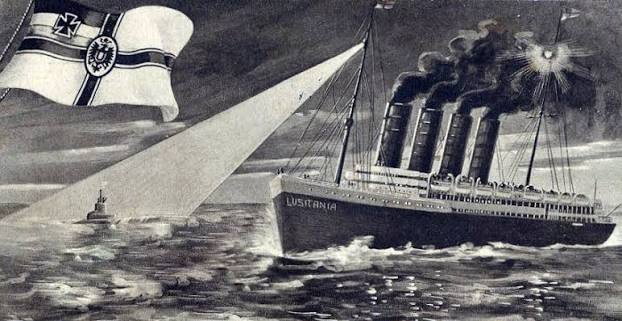
In the spring of 1941, a convoy of 42 merchant ships lumbered across the North Atlantic, their holds stuffed with food, fuel, and aircraft parts. They were the lifeline of an island nation that imported 70% of its food and nearly all of its oil. But in the dark waters around them, a pack of German U-boats was closing in. Over three nights, they sank 21 ships, sending over 100,000 tons of cargo to the bottom. The convoy’s escorts a handful of corvettes and destroyers could only watch as their charges exploded and burned.
This was the Battle of the Atlantic, the longest continuous campaign of World War II, and it nearly killed Britain. Between 1939 and 1945, German submarines waged a war of attrition against the ships that kept Britain alive, sinking over 14 million tons of Allied shipping and killing tens of thousands of merchant seamen. Winston Churchill later admitted, “The only thing that ever really frightened me during the war was the U-boat peril.”
The Lifeline That Had to Be Cut
Britain’s vulnerability was not a secret. Before the war, the nation imported roughly 55 million tons of goods annually everything from wheat to tungsten. Once the fighting began, that flow became a matter of survival. The British war economy required about 1 million tons of imports per week to sustain itself. By 1942, imports had fallen to just 23 million tons. The country was bleeding out, slowly.
Germany knew this. Admiral Karl Dönitz, commander of the U-boat fleet, had studied Britain’s dependence on the sea and concluded that if his submarines could cut the transatlantic lifeline, they could starve the island into submission. His strategy was simple: sink more ships than the Allies could build.
The U-Boat Armada and the Wolf Packs
The U-boats that prowled the Atlantic were not the sleek nuclear submarines of the Cold War. They were cramped, diesel-electric boats mostly Type VIIs of about 770 tons that spent most of their time on the surface, diving only to attack or evade. They carried about 14 torpedoes and a crew of 44 men who lived in conditions that were, by any measure, appalling.
Dönitz’s innovation was the wolf pack tactic. Instead of hunting alone, U-boats would spread out in a patrol line across the likely convoy routes. When one boat spotted a convoy, it would shadow it, sending position reports via radio to call in other boats. At night, they would attack on the surface, where their small silhouettes made them almost invisible to escort lookouts. In 1940 and 1941, this tactic worked devastatingly well. The “Happy Time,” as German crews called it, saw U-boats sinking ships faster than Allied yards could replace them. In 1942 alone, they sank more than 1,000 ships in the Atlantic.
The Merchant Navy: Civilians Under Fire
The men who bore the brunt of this onslaught were not soldiers. They were merchant seamen—civilian volunteers who signed on to crew the cargo ships, tankers, and transports that carried the goods. They had no combat training, and their ships were often unarmed. Their casualty rate was among the highest of any service branch: roughly one in four merchant seamen who served in the Atlantic did not survive.
A torpedo strike was a sudden, violent end. A 500-ton freighter could break apart and sink in minutes. Survivors often found themselves in lifeboats or clinging to wreckage, adrift for days or weeks in the freezing North Atlantic. Some were picked up by the same U-boats that had sunk them; others were never found. The psychological toll was immense—many men refused to go back to sea after a single attack, while others returned again and again, knowing the odds.
The Allies Fight Back: Convoys and Technology
The first line of defense was the convoy system, revived from World War I. Grouping merchant ships into columns, protected by escorts, dramatically reduced losses. Independent sailers were easy prey; convoyed ships were not. In 1940, the loss rate for independent ships was about 10%; for convoyed ships, it was less than 1%.
The escorts improved over time. Flower-class corvettes—small, rugged ships built on merchant hulls—were joined by frigates and destroyers equipped with ASDIC (sonar), radar, and depth charges. The introduction of high-frequency direction finding (Huff-Duff) allowed escorts to pinpoint a U-boat’s position the moment it transmitted a radio message, forcing them to stay silent and breaking up wolf pack coordination.
Air power was the final piece. For the first three years, a “Mid-Atlantic Gap”—a stretch of ocean beyond the range of land-based aircraft—provided a safe hunting ground for U-boats. In 1943, long-range B-24 Liberators and escort carriers closed that gap, and the U-boats lost their sanctuary.
The Secret Weapon: Ultra
The most decisive advantage, though, was invisible. At Bletchley Park, a team of codebreakers—many of them women—had cracked the German Enigma cipher. The intelligence, codenamed Ultra, allowed Allied commanders to read U-boat signals and reroute convoys around wolf packs. This was not a perfect system; the Germans periodically changed their codes, and there were times when the Allies were blind. But overall, Ultra gave the Allies an enormous edge.
Some historians argue that Ultra’s contribution has been overstated, pointing out that convoys and air cover were the primary defensive measures. But even the skeptics concede that knowing where the U-boats were—or at least where they weren’t—saved thousands of lives and millions of tons of shipping.
Black May: The Turning Point
The campaign reached its climax in May 1943. The Allies had finally assembled enough escorts, enough aircraft, and enough intelligence to take the offensive. In a single month, they sank 41 U-boats—more than one per day—while losing only 34 merchant ships. It was a massacre. The Kriegsmarine’s wolf packs were forced to withdraw from the North Atlantic, and they never returned in strength.
Dönitz later admitted that the battle was lost. The U-boat arm continued to fight, but it was a losing struggle against overwhelming Allied industrial might. The United States was launching Liberty ships in as little as 42 days, while Germany’s shipyards could not replace U-boats fast enough. In the end, of the roughly 1,170 U-boats that served, about 785 were sunk. Of the 40,000 men who served in the U-boat arm, some 28,000 died—a casualty rate of 70%, the highest of any German service branch.
The Human Cost and the Legacy
The Battle of the Atlantic was not a clean, heroic struggle. It was a brutal war of logistics, fought by men in cold, dark, dangerous places. On the German side, U-boat crews were romanticized as “iron coffins”—a grim nickname that proved all too accurate. On the Allied side, merchant seamen were often forgotten, their sacrifices overshadowed by the more glamorous battles of the war.
But Britain survived. The imports kept flowing, the convoys got through, and the island became the launching pad for the liberation of Europe. The U-boat war was a close-run thing, but in the end, the Allies’ combination of intelligence, technology, and sheer industrial capacity won out. As Churchill put it, the U-boat peril was the only thing that truly frightened him. It was a fear that proved justified—and a fight that was won against the odds.
The submarine war was a test of endurance, a struggle between a nation that needed to import 1 million tons of supplies every week and an enemy determined to stop it. For nearly four years, the outcome hung in the balance. But the Allies adapted, innovated, and out-produced their enemy. By May 1943, the U-boats had been driven from the Atlantic, and Britain’s lifeline was secure. The cost was enormous—in ships, in cargo, and above all in lives—but the lesson of the Battle of the Atlantic is clear: even a near-fatal blow can be survived if you have the will, the technology, and the industrial might to keep fighting.
Summary
- The Battle of the Atlantic was the longest continuous campaign of WWII, lasting from 1939 to 1945, and was a close-run struggle for Britain’s survival.
- Germany’s U-boats sank over 14 million tons of Allied shipping and killed thousands of merchant seamen, nearly cutting off Britain’s vital imports.
- The turning point came in May 1943 when Allied forces sank 41 U-boats in a single month, forcing the Germans to abandon the North Atlantic.
- Key Allied advantages included the convoy system, new technologies like Huff-Duff and radar, and the breaking of the Enigma code (Ultra).
- The human cost was staggering: 28,000 of 40,000 U-boat crewmen died, and one in four Allied merchant seamen perished.
FAQ
Q: What was the ‘Happy Time’ for U-boats?
A: The ‘Happy Time’ (1940-1941) was a period when German U-boats sank Allied ships faster than they could be replaced, thanks to wolf pack tactics and the lack of effective Allied countermeasures.
Q: How did the Allies close the Mid-Atlantic Gap?
A: The gap was closed in 1943 by using long-range B-24 Liberator bombers and escort carriers that could provide air cover for convoys across the entire Atlantic.
Q: What was the role of Ultra intelligence?
A: Ultra was the Allied codebreaking effort that decrypted German Enigma messages, allowing convoys to be rerouted around U-boat wolf packs and saving countless ships and lives.
Q: Why was Britain so dependent on imports?
A: Britain imported about 70% of its food and nearly all of its oil and strategic materials, requiring roughly 1 million tons of imports per week to sustain its war economy.
Q: What was the casualty rate for U-boat crews?
A: U-boat crews suffered a casualty rate of about 70%—28,000 out of 40,000 men died—the highest of any German service branch.