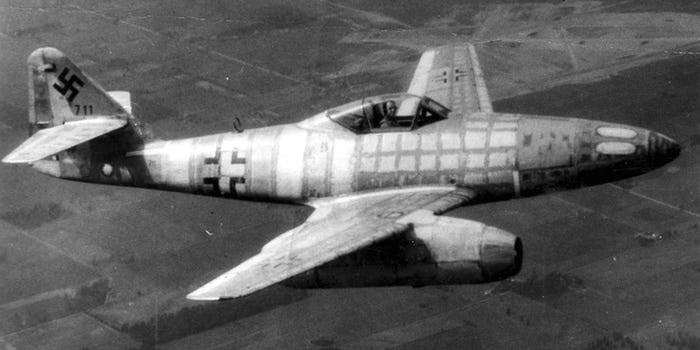
On a July afternoon in 1942, test pilot Fritz Wendel climbed into a sleek, twin-engine Messerschmitt and roared down a German runway. When he lifted off, he was flying faster than any propeller-driven aircraft ever had and the world of aerial combat shifted forever. The Me 262, Germany’s ‘Schwalbe’ (Swallow), wasn’t just another fighter; it was a technological leap that would render every piston-engine fighter obsolete.
The First Jet Combat Aircraft
The Me 262 was the first operational jet fighter in history. Its two Junkers Jumo 004B turbojets the world’s first operational turbojet engines propelled it to roughly 540 mph at altitude, about 100 mph faster than the famed P-51 Mustang. Its four 30 mm MK 108 cannons in the nose could tear a B-17 apart with just a few hits, and its climb rate made it a terror at high altitude.
But the Me 262’s story is not just one of triumph. It was a weapon born from desperation, plagued by production delays, strategic blunders, and a fuel crisis that grounded many of its sorties. By the time it entered combat in 1944, Germany was already losing the war. The jet could outrun any Allied fighter, but it couldn’t outrun the inevitable.
The Race to Build a Jet
Germany and Britain were in a parallel race to harness jet propulsion in the 1930s. German physicist Hans von Ohain and British engineer Frank Whittle independently developed jet engine concepts, but Germany got a head start. The Heinkel He 178, flown in August 1939, was the world’s first jet aircraft. By 1941, Germany had multiple jet programs underway, including the Me 262 and the He 280.
The British Gloster Meteor entered service in July 1944, but it was deliberately kept out of German airspace to prevent capture and it was slower than the Me 262. So, when the Me 262 finally took to the skies in combat, it faced no equal in speed or firepower.
A Wonder Weapon in a Burning Reich
By 1943, the Allied bombing offensive was devastating German industry. The USAAF’s daylight raids, escorted by P-51 Mustangs and P-47 Thunderbolts, were grinding down the Luftwaffe in an attrition war. Germany needed a miracle. The Me 262 was touted as a ‘wonder weapon’ that could restore air superiority.
But production was a nightmare. The Jumo 004 engine required strategic materials like chrome, nickel, and cobalt for turbine blades all in short supply. Factories were dispersed and bombed. Skilled labor was scarce. Only about 1,430 Me 262s were ever produced, and fewer than 300 saw combat.
Hitler’s Fatal Interference
Perhaps the most damaging blow was self-inflicted. Adolf Hitler insisted the Me 262 be built primarily as a fast bomber, or ‘Blitzbomber,’ believing it could blunt the Allied invasion of France. This forced a change in production priorities, delaying fighter production by several months and diverting resources.
The debate over Hitler’s meddling remains a major historical controversy, but the outcome is clear: the Me 262 was never used to its full potential as a fighter. Instead of intercepting the bomber streams that were leveling German cities, many jets were held back for a bomber role that never materialized.
Combat: The Brief, Violent Encounters
The first operational unit, Kommando Nowotny, formed in April 1944. By July, Me 262s were flying combat sorties against Allied reconnaissance aircraft. The first confirmed kill came in October 1944, when a British Mosquito was shot down.
For Allied bomber crews, the sight of a Me 262 was terrifying. It approached so fast that gunners barely had time to react. Its 30 mm cannons could destroy a B-17 with a few hits, and its speed meant it could strike and escape before escort fighters could respond.
But the jet had fatal vulnerabilities. The Jumo 004 engine was unreliable, with a lifespan of only about 25 hours. It was prone to compressor stalls and flameouts. Pilot training was inadequate many pilots had minimal time in jets. And by 1945, Germany’s synthetic fuel plants were destroyed, leaving many Me 262s grounded for lack of fuel.
Allied pilots quickly learned to exploit these weaknesses. They attacked Me 262s during takeoff and landing, when they were slow and vulnerable. They strafed German airfields to catch jets on the ground. The jet’s speed became irrelevant if it couldn’t get off the runway or couldn’t land safely.
The Legacy: Shaping the Post-War Skies
Despite its strategic failure, the Me 262’s engineering was revolutionary. Its swept-wing design, about 18.5 degrees, was a pioneering aerodynamic feature that would influence post-war jet design, including the Soviet MiG-15 and the American F-86 Sabre. The axial-flow turbojet, the cannon armament, and the concept of a high-speed interceptor all shaped the future of military aviation.
When the war ended in May 1945, many Me 262s were destroyed by their crews or captured by the Allies. The technology was divided among the victors, who would spend the next decade developing their own jet fighters based on what they learned from the Schwalbe.
The Paradox of the Me 262
The Me 262 was a tactical marvel and a strategic failure. It was the fastest, most heavily armed fighter of its time, yet it couldn’t change the outcome of the war. It was a weapon of desperation, a glimpse of the future that arrived too late and in too few numbers.
For the pilots who flew it, the Me 262 offered a taste of what was possible—a machine that could outrun anything in the sky, if only it could stay in the air long enough. For the Allies, it was a warning of what lay ahead, a preview of the jet age that would define the Cold War.
The Me 262 didn’t just change aerial combat; it ended an era and began another. It was the first step toward a future where speed was king, and nothing would ever be the same.
The Me 262’s story is a reminder that technological brilliance alone cannot win a war. It was a revolutionary machine that outclassed everything in the sky, but it was hobbled by leadership, resources, and time. Its legacy, however, is undeniable: it set the template for every jet fighter that followed, and its influence is still felt in the skies today.
Summary
- The Me 262 was the world’s first operational jet fighter, with a top speed of ~540 mph, about 100 mph faster than the P-51 Mustang.
- It was armed with four 30 mm cannons and optional R4M rockets, capable of destroying a B-17 with a few hits.
- Only ~1,430 were built, and fewer than 300 saw combat due to production problems, Hitler’s insistence on a bomber role, and fuel shortages.
- Its first confirmed kill was a British Mosquito in October 1944.
- The swept-wing design and axial-flow turbojets influenced post-war jets like the MiG-15 and F-86 Sabre.
FAQ
Q: What made the Me 262 so fast?
A: Its two Junkers Jumo 004B turbojets were the world’s first operational turbojet engines, providing a top speed of ~540 mph—about 100 mph faster than the P-51 Mustang.
Q: Why didn’t the Me 262 change the outcome of the war?
A: It was produced in small numbers (fewer than 300 saw combat), was grounded by fuel shortages, and was delayed by Hitler’s insistence on using it as a bomber rather than a fighter.
Q: How did Allied pilots counter the Me 262?
A: They attacked it during takeoff and landing, when it was slow and vulnerable, and strafed German airfields to destroy jets on the ground.
Q: What was the Me 262’s first confirmed kill?
A: A British Mosquito reconnaissance aircraft, shot down in October 1944.
Q: How did the Me 262 influence post-war aviation?
A: Its swept-wing design and axial-flow turbojets were copied by the Soviets and Americans, leading to jets like the MiG-15 and F-86 Sabre.