Tag: mathematics

  • The Human Computers Who Fueled America’s Space Race


    Before NASA had supercomputers, it had a team of brilliant women with pencils, paper, and an unerring ability to calculate the path to orbit. Their job title was ‘computer’—a human one. From the segregated West Area Computing pool at Langley to the rocket trajectory teams at JPL, these women performed the complex math that made early spaceflight possible, yet their stories remained largely untold for decades.

    Their work wasn’t just about number-crunching. It was about accuracy when failure meant disaster. In 1962, astronaut John Glenn reportedly refused to fly unless Katherine Johnson, a Black mathematician, personally verified the orbital equations that a new IBM computer had produced—he didn’t trust the machine. Her handwritten calculations were the final check before he became the first American to orbit Earth.

    This article uncovers who these women were, why they were hired, the obstacles they faced, and how their contributions shaped the space race—and the field of STEM itself.

    The ‘Computer’ Was a Person

    Today, ‘computer’ means a machine. But from the 1940s through the 1960s, it was a job title. At NACA (the National Advisory Committee for Aeronautics, NASA’s predecessor) and later at NASA, women with mathematics degrees were hired to perform complex calculations by hand. They computed trajectory equations, orbital mechanics, and aerodynamic data—the mathematical backbone of early spaceflight.

    This practice wasn’t new. In the late 1800s, astronomers at Harvard employed women like Henrietta Swan Leavitt to catalog stars—they were called ‘Pickering’s Harem.’ The space race was the final chapter of this tradition, as electronic computers gradually took over.

    But why women? During World War II, men were deployed overseas, creating a labor shortage. NACA and military labs turned to women with math degrees. The work was considered detail-oriented and clerical, and thus ‘women’s work,’ even though it required advanced mathematical skill. It was also cheap: women were paid roughly half what men earned for comparable roles. Cost efficiency, not altruism, drove the hiring.

    The West Area Computers: Breaking Barriers at Langley

    At Langley, Virginia, a group of Black women mathematicians formed a segregated pool known as the West Area Computers. They were housed separately, used separate restrooms and dining facilities, and were initially excluded from projects assigned to white women. Despite this, their brilliance couldn’t be contained.

    Dorothy Vaughan joined Langley in 1943 and became NACA’s first Black supervisor in 1949, managing the West Area Computers. She was a forward-thinker: when IBM mainframes arrived in the early 1960s, she taught herself and her team FORTRAN, the programming language of the new machines. This proactive move saved many of their jobs when electronic computing replaced manual calculation.

    Mary Jackson, another West Area Computer, aspired to be an engineer. But to take graduate courses in engineering, she needed permission to attend classes at a whites-only school in Hampton, Virginia. She petitioned the city and won, becoming NASA’s first Black female engineer in 1961.

    And then there was Katherine Johnson. Her trajectory calculations were critical to John Glenn’s 1962 Friendship 7 mission, and she later helped calculate the trajectory for Apollo 11’s lunar landing in 1969. Her story, along with Vaughan’s and Jackson’s, was brought to mainstream attention by the 2016 film Hidden Figures, based on Margot Lee Shetterly’s book. In 2019, Johnson received the Congressional Gold Medal.

    The JPL Women: Calculating Paths to the Planets

    While the West Area Computers worked on aeronautics and Earth orbit, women at the Jet Propulsion Laboratory (JPL) in Pasadena, California, tackled the even more complex mathematics of deep-space navigation. They calculated rocket trajectories for missions to the Moon, Mars, and beyond.

    Barbara Paulson, Helen Ling, and Sue Finley were among the key figures. Finley would become one of the longest-serving JPL employees, working there for over 60 years. These women didn’t just compute; they developed methods for navigating spacecraft across millions of miles, methods that are still used today.

    At its peak in the 1960s, NASA employed hundreds of female computers across multiple centers. They were a critical workforce, yet they were paid less than male mathematicians and had restricted promotion paths. Their contributions were often invisible, subsumed under the names of their male supervisors.

    The Unreliable Machine: Why Human Verification Mattered

    By the early 1960s, IBM mainframes were faster than any human. But they were also unreliable. Early computers were prone to errors, and a single mistake could mean a rocket veering off course. Engineers knew this, which is why they still trusted human verification.

    John Glenn’s request for Katherine Johnson to check the IBM’s numbers was not an anomaly. It was standard practice to have a human computer double-check the machine’s work. Johnson’s calculations were not just a formality; she was checking the very equations that would determine whether Glenn would return safely from orbit.

    This trust in human computers was a testament to their skill—and a practical necessity. Until machines could be fully trusted, human minds were the final safety net.

    The End of an Era: Transition to Electronic Computing

    The arrival of electronic computers spelled the end of the human computer era. But it didn’t happen overnight. The transition was gradual, and many female computers were retrained as programmers. Dorothy Vaughan’s foresight in learning FORTRAN ensured that her team was ready for the change.

    Others were not so fortunate. Some were laid off as machines took over. But the legacy of these women endures. They proved that women could handle the most demanding mathematical work, breaking down gender and racial barriers in the process.

    Why This History Matters

    The story of the female computers intersects with two major struggles of mid-20th-century America: gender discrimination and racial segregation. These women were often doubly marginalized, yet they contributed to some of the greatest achievements in human history.

    Their story is part of a broader hidden history of women in STEM, alongside figures like Rosalind Franklin and the ENIAC programmers. The Cold War urgency of the space race created unusual opportunities for marginalized groups—not out of a sense of fairness, but out of necessity. The nation needed the best minds it could get, and it found them in women like Johnson, Vaughan, Jackson, and Finley.

    Today, their names are finally being recognized. But there were hundreds of others, nameless calculators who helped put humans on the Moon. Their work, done by hand, laid the foundation for the digital age we live in now.

    The human computers of the space race were not just assistants; they were essential contributors to some of the most complex engineering feats in history. They faced discrimination based on both their gender and their race, yet they persevered, driven by a love of mathematics and a sense of duty to their country. As we look back on the Apollo missions and the early days of space exploration, we should remember that behind every successful launch was a room full of women, pencils in hand, calculating the way to the stars.

    Summary

    • From the 1940s to the 1960s, women employed as ‘computers’ performed complex math by hand for NACA and NASA, including trajectory and orbital calculations.
    • The West Area Computers at Langley were a segregated pool of Black women mathematicians, including Katherine Johnson, Dorothy Vaughan, and Mary Jackson.
    • JPL women like Sue Finley calculated deep-space trajectories, contributing to planetary missions.
    • Human computers were often used to verify the calculations of early electronic computers, which were prone to errors.
    • The transition to electronic computing led to the end of the human computer role, but many women were retrained as programmers.
    • Their stories highlight the intersection of gender and racial discrimination in STEM, and their contributions were finally brought to light by the 2016 film Hidden Figures.

    FAQ

    Q: What exactly did a ‘human computer’ do?
    A: A human computer performed mathematical calculations by hand, often for engineering and scientific projects. In the context of the space race, they calculated things like rocket trajectories, orbital mechanics, and aerodynamic data. This was a job title, not a reference to a machine.

    Q: Why were women hired as computers?
    A: During World War II, many men were deployed, creating a labor shortage. NACA and military labs hired women with math degrees to fill the gap. It was also cost-effective, as women were paid less than men. The work was seen as detail-oriented and clerical, fitting the era’s gender stereotypes, even though it required advanced math.

    Q: Who were the ‘Hidden Figures’?
    A: The term refers to a group of Black women mathematicians at NASA’s Langley Research Center, including Katherine Johnson, Dorothy Vaughan, and Mary Jackson. They worked as ‘computers’ and faced both racial segregation and gender discrimination. Their story was popularized by the 2016 film Hidden Figures.

    Q: Why did John Glenn insist on Katherine Johnson checking the calculations?
    A: John Glenn trusted Katherine Johnson’s mathematical abilities. Early electronic computers were prone to errors, and Glenn didn’t want to risk his life on a machine’s output without human verification. Johnson’s calculations confirmed the IBM’s numbers, and he flew successfully.

    Q: What happened to the human computers when electronic computers came?
    A: The transition was gradual. Some human computers were retrained as programmers, like Dorothy Vaughan who learned FORTRAN and taught her team. Others were laid off as machines became more reliable. By the late 1960s, the role of the human computer had largely disappeared.
  • The Art of the Impossible: How M.C. Escher’s Geometry Inspired a Generation of Scientists

    The Art of the Impossible: How M.C. Escher’s Geometry Inspired a Generation of Scientists

    In 1958, mathematician Roger Penrose and his father Lionel published a paper describing an impossible triangle a shape that looks like a solid 3D object but cannot actually exist. When M.C. Escher saw it, he was electrified. Within a few years, he used it to create Waterfall (1961) and Ascending and Descending (1960), two of his most famous works, where water flows uphill and monks climb stairs that loop forever.

    Escher, a Dutch graphic artist with no formal mathematical training, had been exploring impossible geometries and interlocking patterns for decades. His work from tessellating lizards to the infinite Circle Limit prints turned abstract mathematical concepts into tangible, mind-bending images. What started as an artistic curiosity became a two-way street of inspiration: mathematicians saw their ideas visualized, and Escher found new creative fuel from their theories.

    This article explores how Escher’s art did more than just look cool — it became a reference point for mathematicians, physicists, and cognitive scientists. His work helped make complex geometry accessible, influenced the study of quasicrystals, and continues to appear in scientific publications and classrooms today.

    A Self-Taught Geometer

    Maurits Cornelis Escher was born in 1898 in the Netherlands. He was a poor student, except in drawing, and initially pursued architecture before switching to graphic arts. He traveled extensively, and a visit to the Alhambra in Spain in 1922 and again in 1936 changed his artistic direction. The Moorish tile patterns — intricate, repeating, interlocking — fascinated him. He began to experiment with tessellations, the regular division of a plane with shapes that fit together without gaps or overlaps.

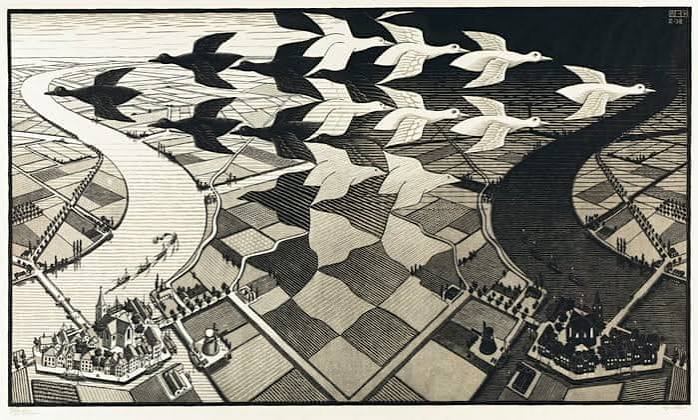
    What set Escher apart was his transformation of abstract tiles into recognizable forms: birds, fish, reptiles, and even human figures. In prints like Day and Night (1938), white birds fly one way and black birds the other, interlocking to fill the sky. His work captured the eye because it combined mathematical precision with artistic whimsy.

    Escher wasn’t trained in geometry beyond basic school math. He reportedly said that mathematicians “opened the door” for him, but he often struggled with formal theory. Instead, he worked intuitively, sketching endlessly until a pattern clicked. His tessellations, it turns out, correspond perfectly to the 17 wallpaper groups — the different ways to repeat a pattern in a plane using translations, rotations, reflections, and glide reflections. Escher discovered these groups on his own, long before he learned about the formal classification.

    The Penrose Connection

    In the late 1950s, Roger Penrose, then a young mathematician (and later a Nobel laureate in physics), and his father Lionel published their work on impossible objects. The Penrose triangle and Penrose stairs — structures that look plausible in a drawing but violate the laws of Euclidean geometry — captured Escher’s imagination. He had already played with impossible perspectives in works like Belvedere (1958), but the Penrose diagrams gave him a new toolkit.

    Escher incorporated the Penrose triangle into Waterfall, where a stream appears to flow downhill, over a waterfall, and then somehow back to the top, forming an endless loop. The Penrose stairs appear in Ascending and Descending, where hooded monks march eternally up a staircase that returns them to the same level. These works became iconic examples of impossible constructions, delighting and puzzling viewers for decades.

    For mathematicians, Escher’s use of these objects was more than a clever trick. The impossible triangle illustrates the difference between local and global consistency: each corner looks fine on its own, but the whole figure cannot exist in 3D. This theme resonates in physics, where locally plausible events can lead to globally impossible situations, and in cognitive science, where the brain tries to construct a coherent 3D interpretation from 2D images.

    Hyperbolic Inspiration

    Perhaps Escher’s most profound scientific connection was with H.S.M. Coxeter, a Canadian geometer who specialized in non-Euclidean geometry. In the late 1950s, Coxeter sent Escher a diagram of a hyperbolic tessellation — a pattern that fills a disk with infinitely shrinking shapes, illustrating the Poincaré disk model of hyperbolic space. In hyperbolic geometry, there are infinitely many lines through a point parallel to a given line, and the angles and lengths behave differently from Euclidean space.

    Escher was captivated. He wrote to Coxeter, “I am trying to learn something from your figure.” The result was the Circle Limit series (1958–1960), four woodcuts that depict a finite disk filled with fish, angels, or devils that get smaller and smaller as they approach the edge. The figures are arranged in a way that mimics the hyperbolic plane, where distances increase exponentially as you move outward.

    Coxeter later verified that Escher’s Circle Limit III was mathematically accurate to within a tiny margin of error — an extraordinary feat for an artist working without formal training. Escher had essentially visualized a concept that many people find counterintuitive, even after years of study. His prints made hyperbolic space tangible, and they remain among the best visualizations of the concept ever created by hand.

    From Art to Science

    Escher’s influence extended beyond mathematics into physics and crystallography. In 1982, scientist Dan Shechtman discovered quasicrystals — materials with ordered but non-repeating atomic patterns, which seemed to violate the established rules of crystallography. His discovery, which earned him the 2011 Nobel Prize in Chemistry, was initially met with skepticism because the patterns did not fit the periodic repetition seen in ordinary crystals.

    Researchers quickly noticed a conceptual parallel between quasicrystals and Escher’s tessellations. Escher had created patterns that fill the plane without ever repeating exactly, using clever manipulations of symmetry. His works, like the tessellating horsemen in Metamorphosis II, demonstrate that non-repeating patterns can be orderly and aesthetically pleasing. For crystallographers, Escher’s art provided a visual analogy for the strange world of quasicrystals, where order exists without periodicity.

    Escher’s prints also became a staple in cognitive psychology. His impossible objects and ambiguous figures are used to study how the brain processes visual information. For example, Relativity (1953) shows multiple staircases and platforms that connect in impossible ways, challenging the viewer’s assumptions about gravity and space. Researchers use such images to probe how the brain constructs a coherent picture from incomplete or contradictory visual cues.

    A Cultural and Educational Icon

    During his lifetime, Escher was not considered a “serious” artist by the fine-art establishment. He was viewed as a craftsman, and his works were often dismissed as mere optical illusions. But in the 1960s, his popularity soared among a counterculture fascinated with altered perception and psychedelic visuals. His prints became posters in dorm rooms and album covers, and new generations discovered the mind-bending possibilities of geometry.

    Posthumously, Escher’s reputation has grown. The Escher Museum in The Hague, which opened in 2002, houses a vast collection of his work. His images appear in textbooks, on journal covers, and in conference materials across mathematics, physics, computer science, and psychology. Douglas Hofstadter’s 1979 book Gödel, Escher, Bach used Escher’s art as a central metaphor, linking his paradoxes to Gödel’s incompleteness theorems and Bach’s musical fugues. The book, which won the Pulitzer Prize, introduced Escher to countless scientists and thinkers.

    A Dialogue of Discovery

    Escher’s collaboration with scientists was a true two-way exchange. He drew inspiration from mathematical concepts, and scientists found in his art a way to visualize abstract ideas. His tessellations demonstrate symmetry groups that mathematicians had catalogued but rarely illustrated so beautifully. His Circle Limit prints brought hyperbolic geometry to life in a way that no diagram had before.

    His work also shows that visual intuition can sometimes outpace formal description. Escher created patterns that scientists later categorized and explained, proving that art can be a form of exploration. As Roger Penrose noted, “Escher managed to depict concepts that many people, including mathematicians, find difficult to grasp.” His art continues to bridge the gap between the scientific and the artistic, inviting us to see the impossible as a gateway to deeper understanding.

    M.C. Escher was not a mathematician, but his work has become inseparable from scientific discovery. His impossible geometries, hyperbolic visions, and non-repeating tessellations continue to inspire researchers, educators, and students. By making abstract concepts visible, Escher showed that creativity and logic are not opposites — they are partners in understanding the universe. His legacy is a testament to the power of visual thinking, and his images remain as fresh and challenging today as they were decades ago.

    Summary

    • Escher’s tessellations correspond to the 17 wallpaper groups, though he discovered them intuitively.
    • His Circle Limit prints accurately visualize hyperbolic space, verified by mathematician H.S.M. Coxeter.
    • Escher used the Penrose triangle and stairs in his works, illustrating impossible objects that challenge perception.
    • His non-repeating patterns provide a visual analogy for quasicrystals, discovered decades later.
    • Escher’s art is widely used in cognitive science, textbooks, and as a bridge between art and mathematics.

    FAQ

    Q: Did M.C. Escher have formal mathematical training?
    A: No, Escher was largely self-taught. He had basic schooling in math but no advanced training. He worked intuitively and often said that mathematicians ‘opened the door’ for him, but he discovered many geometric patterns on his own.

    Q: What is the ‘Circle Limit’ series?
    A: It is a series of four woodcuts (1958–1960) that depict hyperbolic geometry using the Poincaré disk model. The prints show figures shrinking as they approach the edge of a circle, illustrating the infinite and non-Euclidean nature of hyperbolic space.

    Q: How did Escher’s work influence scientists?
    A: Escher’s art helped scientists visualize abstract concepts like group theory, hyperbolic geometry, and non-repeating patterns. His work has been used in crystallography to explain quasicrystals and in cognitive science to study visual perception.

    Q: What are the Penrose stairs?
    A: The Penrose stairs are an impossible object where a staircase loops back to its starting point while continuously going upward. They were published by Lionel and Roger Penrose in 1958 and later used by Escher in his print Ascending and Descending.

    Q: Why is Escher’s art popular in science education?
    A: Because his prints make complex mathematical concepts tangible and engaging. They are used in textbooks and lectures to illustrate symmetry, infinity, and optical illusions, helping students grasp ideas that are otherwise highly abstract.