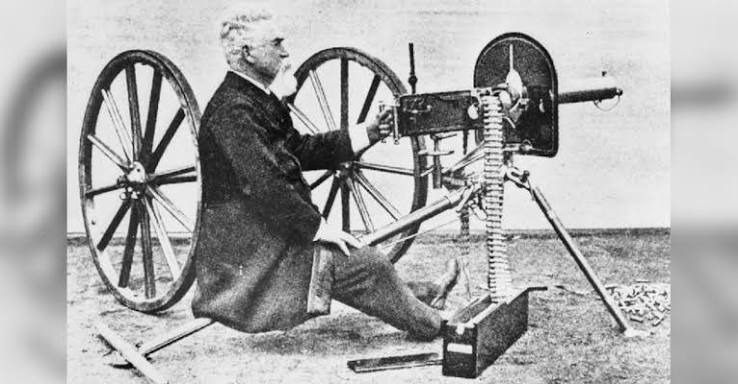
In 1884, Hiram Maxim patented a weapon that could fire 500 rounds per minute—a rate equivalent to the firepower of dozens of riflemen. Within three decades, it would mow down massed infantry charges, entrench armies in mud, and kill more soldiers than any other weapon of its era. The machine gun didn’t just change battlefields; it upended centuries of military doctrine and reshaped the very nature of conflict.
This article traces the machine gun’s journey from a mechanical curiosity to the centerpiece of modern warfare. We’ll explore its technical evolution, its brutal debut in colonial wars, its role in the stalemate of World War I, and how it continues to influence tactics today.
The Pre-Machine Gun Battlefield: A World of Volleys and Charges
Before the machine gun, infantry tactics revolved around massed volley fire. Muskets and rifles had effective ranges of 100–300 meters, and a trained soldier could fire 2–4 rounds per minute with a muzzle-loader, or 10–15 with a bolt-action repeater. Battles were often decided by disciplined volleys, cavalry charges, and bayonet assaults. Artillery provided indirect fire, but it was slow to adjust and vulnerable to counter-battery fire.
The machine gun shattered this world. It wasn’t just a faster rifle—it was a fundamentally different tool. A single Maxim gun could lay down a continuous stream of lead, turning open ground into a kill zone. The implications were clear to anyone paying attention, but the weapon’s true impact wouldn’t be felt until it met the massed armies of the 20th century.
The Industrial Revolution and the Maxim Breakthrough
The machine gun was a child of the Industrial Revolution. Precision machining, mass production of cartridges, and advances in metallurgy made reliable automatic fire possible. But one invention was crucial: smokeless powder. Introduced in the 1880s, it produced less smoke and fouling than black powder, allowing sustained fire without obscuring the gunner’s view or revealing his position.
Hiram Maxim, an American-born inventor living in Britain, combined these elements in 1884. His design used the recoil energy of the fired round to eject the spent cartridge, chamber a new round, and cock the hammer—all automatically. The Maxim gun could fire 500–600 rounds per minute, roughly the firepower of 30–50 riflemen. It was a self-contained cycle requiring no external power. This was the first true machine gun.
Colonial Wars: The Weapon as a Grim Reaper
The machine gun found its first brutal application in European colonial expansion. At the Battle of Omdurman in 1898, British forces with Maxim guns killed thousands of Sudanese Dervishes while suffering only dozens of casualties. In the Matabele War (1893–94), 50 British soldiers with four Maxims held off thousands of Ndebele warriors. These one-sided victories created a myth of European invincibility and demonstrated the weapon’s devastating potential. But they also set a grim precedent: the machine gun could turn a battlefield into a slaughterhouse.
World War I: The Machine Gun’s Coming of Age
When World War I broke out in 1914, every major power had machine guns, but military doctrine lagged. They were treated as artillery or special weapons, not integrated into infantry tactics. The reality of 1914–1918 was brutal: defensive machine gun fire, especially from German MG 08s, made frontal infantry assaults suicidal. The machine gun was the primary cause of the trench warfare stalemate. Some estimates suggest it caused 50–60% of all battlefield deaths in the war.
The machine gun didn’t just cause casualties—it changed the geometry of warfare. It forced armies underground, creating the vast trench systems that stretched from the English Channel to the Swiss border. The weapon’s defensive power made offensive breakthroughs nearly impossible without overwhelming artillery support or innovative new tactics like infiltration and armor.
Interwar and WWII Developments: The General-Purpose Machine Gun
Between the wars, designers sought to make machine guns more mobile and versatile. Germany led the way with the MG 34 and MG 42, which introduced the concept of the general-purpose machine gun (GPMG)—a single weapon usable as a light, medium, or heavy machine gun. The MG 42’s rate of fire of 1,200–1,500 rounds per minute earned it the nickname “Hitler’s Buzzsaw.” Its sound was so distinctive that it struck fear into Allied soldiers.
The United States relied on the Browning M1919 (medium) and the M2 .50 cal (heavy), the latter still in service today. The Soviet Union produced the DP-27 and later the PKM, providing rugged, reliable squad-level firepower. These weapons were lighter, air-cooled, and more portable than their WWI predecessors, allowing them to be used in mobile offensives rather than just static defense.
Post-WWII and Modern Systems: From SAWs to Miniguns
After World War II, the machine gun continued to evolve. Squad automatic weapons (SAWs) like the M249 and light machine guns like the RPK provided infantry squads with portable automatic fire using intermediate cartridges like 5.56×45mm NATO. These weapons were lighter and more controllable, but they retained the core principle of automatic fire.
Modern systems have pushed the concept even further. The M134 Minigun, an electric-powered Gatling-style weapon, can fire 2,000–6,000 rounds per minute, devastating at close range. Advanced optics, suppressors, and smart fire-control systems have made machine guns more accurate and versatile. Yet the fundamental calculus remains: a machine gun multiplies the firepower of a few soldiers into that of a much larger force.
The Machine Gun’s Legacy: A Weapon That Changed Everything
The machine gun’s legacy is profound. It made massed infantry assaults obsolete, forced armies to adopt new tactics like fire-and-maneuver, and accelerated the development of tanks, aircraft, and other countermeasures. It also raised the human cost of war to unprecedented levels. In a sense, the machine gun is a mirror of 20th-century warfare: efficient, industrial, and utterly unforgiving.
Today, machine guns remain a staple of every military force, from the M249 to the PKM. They are no longer the dominant weapon they once were—guided munitions and drones have taken that role—but they still hold a vital place on the battlefield. The machine gun changed battlefields forever because it solved a timeless problem: how to deliver maximum firepower with minimum manpower. That solution came at a terrible price, but it reshaped warfare in ways that continue to echo.
The machine gun is more than a weapon; it’s a turning point in military history. From Maxim’s first recoil-operated design to the electric-powered Minigun, it has forced armies to adapt, innovate, and confront the grim arithmetic of industrial warfare. Its legacy is visible in every modern infantry squad, every defensive position, and every military doctrine that prioritizes firepower. The machine gun didn’t just change battlefields—it defined them for a century and continues to shape how wars are fought today.
Summary
- The first true machine gun was patented by Hiram Maxim in 1884, using recoil energy to automate the firing cycle.
- Machine guns caused 50–60% of World War I combat casualties and were the primary driver of trench warfare stalemate.
- Colonial wars like the Battle of Omdurman demonstrated the weapon’s devastating one-sided effectiveness.
- Germany’s MG 34 and MG 42 introduced the general-purpose machine gun, which could serve as a light, medium, or heavy weapon.
- Modern machine guns range from squad automatic weapons like the M249 to electric-powered Miniguns firing 2,000–6,000 rounds per minute.
FAQ
Q: What was the first true machine gun?
A: The Maxim gun, patented by Hiram Maxim in 1884, is widely considered the first true machine gun because it was self-powered, using recoil energy to automate the firing cycle.
Q: How did the machine gun affect World War I tactics?
A: The machine gun’s defensive firepower made frontal infantry assaults suicidal, forcing armies to dig trenches and creating a stalemate that lasted for years. It also spurred the development of tanks and new infantry tactics.
Q: What is a general-purpose machine gun?
A: A general-purpose machine gun (GPMG) is a single weapon that can serve multiple roles—light, medium, or heavy—by changing its mount and feed system. Examples include the German MG 42 and the modern PKM.
Q: Why was smokeless powder important for machine guns?
A: Smokeless powder produced less smoke and fouling than black powder, allowing sustained fire without obscuring the gunner’s view or revealing the weapon’s position. It was essential for the machine gun’s practicality.
Q: Are machine guns still used in modern warfare?
A: Yes, machine guns like the M249 SAW, M2 .50 cal, and PKM remain standard equipment in most militaries. They provide suppressive fire and are used in both offensive and defensive roles, though their dominance has been challenged by guided munitions and drones.