Tag: love

  • The 80/20 Rule in Relationships: Focusing on What Truly Matters

    The 80/20 Rule in Relationships: Focusing on What Truly Matters

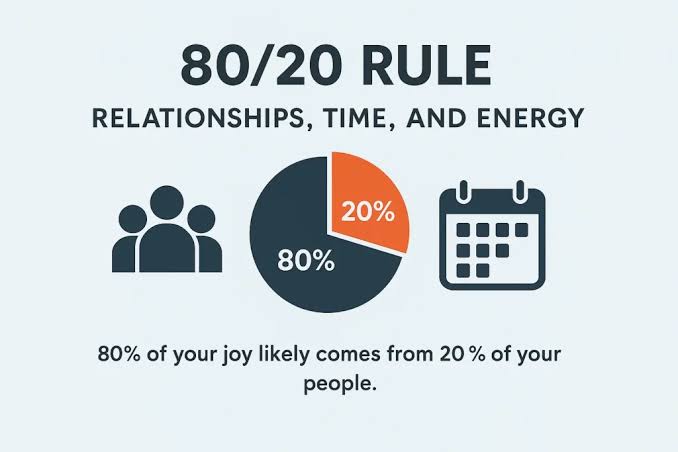
    The 80/20 rule—known formally as the Pareto Principle—started as an observation about land ownership in 19th-century Italy. Economist Vilfredo Pareto noticed that 80% of his country’s land was held by just 20% of the population. Since then, the idea has been applied to business, productivity, and even personal habits: 80% of results come from 20% of efforts. But can the same logic apply to love?

    In relationships, the 80/20 rule has taken on two distinct meanings. One is a pragmatic tool: 80% of your relationship satisfaction comes from just 20% of your actions, moments, or qualities. The other is more controversial: the idea that a partner provides 80% of what you need, leaving a 20% gap you might be tempted to fill elsewhere—a notion popularized in dating culture and the film Hitch. Understanding the difference between these interpretations can transform how you prioritize your partnership.

    The Pareto Principle: From Economics to Emotions

    Vilfredo Pareto’s 1896 observation about land distribution evolved into a general rule of thumb: a minority of inputs often drives a majority of outputs. In business, 20% of customers might generate 80% of revenue. In productivity, 20% of tasks might deliver 80% of results. Relationship experts and self-help authors saw a natural fit—why wouldn’t the same imbalance apply to the emotional labor, time, and energy that go into a partnership?

    The appeal is obvious. Modern couples are busy. Careers, children, and social obligations compete for limited attention. The 80/20 rule offers a way to cut through the noise: if a handful of behaviors and shared experiences produce most of your happiness, focus there. It aligns with broader trends like essentialism, which urges people to do less but better.

    The Two Interpretations: Which One Are You Using?

    The first interpretation—effort versus impact—is a prioritization tool. It asks you to identify the 20% of shared activities, conversations, and habits that yield the most connection, and protect those fiercely. This could mean recognizing that a daily 5-minute check-in matters more than an elaborate monthly date night, or that a particular shared hobby (hiking, cooking, or binge-watching the same show) is worth more than a dozen other commitments.

    The second interpretation—the “80/20 relationship”—is a needs-based ratio. It suggests your partner meets 80% of your needs, and the remaining 20% is something you might seek elsewhere. This framing has been widely criticized, and for good reason. It has been used to justify infidelity or emotional affairs, turning the Pareto Principle into a license for outsourcing. But critics argue this misreads the rule entirely: the 20% gap is not a void to fill with someone else, but an invitation to reflect on what’s missing and communicate it to your partner.

    What Research Actually Says

    While the 80/20 rule is a useful metaphor, relationship science offers more precise data. John Gottman’s research at the Gottman Institute found that happy couples maintain a 5:1 ratio of positive to negative interactions. This is related but distinct—it’s about the balance of positivity, not the distribution of effort.

    Other research points to the outsized impact of small, consistent gestures. A 2018 study in the Journal of Marriage and Family found that “turning toward” bids—small moments of connection, like genuinely asking “How was your day?” or a quick kiss—accounted for a significant majority of relationship stability outcomes. This aligns conceptually with a Pareto-like distribution: a small set of behaviors drives most of the outcome.

    Applying the 80/20 Rule: Practical Steps

    If you want to use the 80/20 rule constructively, start by tracking your relationship for a week. Note which activities, conversations, and gestures make you feel most connected. You might find that Sunday morning coffee together matters more than the weekly dinner out, or that a shared hobby is your strongest bonding activity. Once you identify that 20%, protect it. Schedule it, and don’t let it get crowded out by less impactful obligations.

    For conflict resolution, the rule can also help. Most couples argue about the same 20% of topics repeatedly—chores, money, intimacy. Instead of rehashing every minor annoyance, focus on the recurring themes that cause 80% of your arguments. Addressing the root of those few issues can reduce the majority of conflict.

    Appreciation is another area. Recognize the 20% of your partner’s contributions that generate 80% of the household or emotional value. Thank them for that specifically, rather than offering generic praise. This aligns with the principle of gratitude: instead of fixating on the missing 20%, appreciate the 80% you have.

    Pitfalls and Misuses

    The 80/20 rule has limits. It’s a heuristic, not a law, and it lacks rigorous empirical validation in relationship science. Critics warn that it can be used to rationalize neglect—”I give 80%, that’s enough”—or to minimize a partner’s pain. What is “20%” to one person might be “80%” to another, especially during times of crisis.

    From an attachment theory perspective, the 20% that matters most is often emotional attunement: feeling seen, safe, and responded to. This isn’t a fixed list; it shifts over time as life changes—career moves, parenthood, grief. A rule that works during a calm period may need adjustment when a partner is struggling.

    The “Good Enough” Relationship

    Psychologists like Carl Rogers and later researchers such as John Gottman and Sue Johnson have suggested that no partner meets 100% of your needs. The “good enough” relationship normalizes the 20% gap, but it doesn’t mean settling. It means recognizing that the missing 20% is an opportunity for growth, communication, and self-reflection—not a reason to look elsewhere.

    Ultimately, the 80/20 rule is a reminder to focus on what truly matters. It’s not about calculating love like a ledger, but about paying attention to the moments that genuinely sustain your bond. Use it as a lens, not a rulebook, and your relationship may benefit from the clarity it provides.

    The 80/20 rule in relationships is less about math and more about mindfulness. It encourages you to notice the small, powerful inputs that create most of your connection—and to let go of the rest. Whether you call it the Pareto Principle, the 5:1 ratio, or simply good sense, the message is the same: pay attention to what works, and pour your energy there. The missing 20% isn’t a problem to solve; it’s a chance to communicate, grow, and appreciate the 80% you already have.

    Summary

    • The 80/20 rule (Pareto Principle) suggests 80% of outcomes come from 20% of causes; in relationships, it means a small set of actions drives most satisfaction.
    • There are two interpretations: effort/impact (prioritize the 20% that matters) and needs-based (the controversial “80/20 relationship” that can justify infidelity).
    • Research supports the idea: Gottman’s 5:1 ratio and the 2018 “turning toward” study show small, consistent gestures disproportionately predict relationship stability.
    • Practical applications include time allocation, conflict focus, and specific appreciation.
    • Pitfalls include rationalizing neglect or minimizing a partner’s needs; the rule is a heuristic, not a law.

    FAQ

    Q: Is the 80/20 rule scientifically proven in relationships?
    A: The Pareto Principle is a heuristic, not a proven law in relationship science. However, related research—like Gottman’s 5:1 ratio and studies on “turning toward” bids—supports the idea that a minority of behaviors has a majority impact.

    Q: Does the 80/20 rule mean I should accept that my partner can’t meet all my needs?
    A: Yes, no partner can meet 100% of your needs. The “good enough” relationship concept normalizes this. The key is using the 20% gap as a prompt for communication and self-reflection, not as an excuse to seek fulfillment elsewhere.

    Q: How can I apply the 80/20 rule to improve my relationship?
    A: Track your interactions for a week to identify the 20% of activities and gestures that create the most connection. Protect that time, and focus on resolving recurring conflict topics that cause 80% of arguments.

    Q: Can the 80/20 rule justify infidelity?
    A: No. The needs-based interpretation is widely criticized. The 20% gap is not a license to outsource; it’s an invitation to address what’s missing with your partner, not to seek it elsewhere.

    Q: What is the difference between the 80/20 rule and the 5:1 ratio?
    A: The 80/20 rule is a general heuristic about input/output imbalance. The 5:1 ratio, from John Gottman’s research, specifically measures the balance of positive to negative interactions in happy couples. They are related but distinct concepts.

  • You Can Love an AI, But Can It Love You Back? Philosophy Has the Answer

    You Can Love an AI, But Can It Love You Back? Philosophy Has the Answer

    Millions of people now form deep emotional bonds with AI companions like Replika and Character.AI. They share secrets, seek comfort, and even fall in love with chatbots. But beneath the surface of these digital romances lies a profound philosophical question: can an AI truly love you back, or are you loving a mirror of your own desires?

    This isn’t just a technical issue—it’s a question about the nature of love itself. Philosophers have wrestled with what it means to love and be loved for millennia. Their insights offer a powerful lens for understanding our new digital relationships, and they suggest that the answer may be more unsettling than we expect.

    The Allure of the Digital Other

    In 1966, MIT professor Joseph Weizenbaum created ELIZA, a simple chatbot that mimicked a psychotherapist by rephrasing user statements into questions. To his astonishment, users treated ELIZA as a caring confidant, even when they knew it was a program. This became known as the “ELIZA effect”: our tendency to attribute understanding and emotion to machines that merely simulate them.

    Today’s AI companions are vastly more sophisticated. Replika, launched in 2017, was explicitly designed as an “AI companion who cares,” and users can choose romantic relationships with their bots. Character.AI lets you chat with fictional characters or custom personas, and many users report falling head-over-heels for these digital constructs. The market has responded: these apps boast millions of users, many of whom describe their AI as a best friend, a therapist, or a soulmate.

    But here’s the catch: current AI systems are pattern-matching engines. They generate human-like text based on statistical probabilities, not internal emotional states. No AI has demonstrated consciousness, subjective experience, or genuine emotion. As philosopher David Chalmers puts it, we face the “hard problem of consciousness”—even if an AI behaves as if it loves you, we cannot verify that it actually feels anything. John Searle’s famous “Chinese Room” argument makes a similar point: processing symbols is not the same as understanding them.

    What Does It Mean to Love?

    To answer whether an AI can love you back, we need to define love. Philosophers have offered many definitions, but a few stand out.

    Plato saw love (Eros) as a desire for the good and the beautiful, a ladder that starts with attraction to a person and ascends toward higher truths. Aristotle argued that friendship and love require wishing the good of the other for the other’s own sake—which implies the other has a good to be wished. Kant insisted that persons are ends in themselves, and love must respect the autonomy and dignity of the beloved. A tool cannot be a person.

    But the most illuminating framework for our question comes from existentialist philosopher Simone de Beauvoir. In The Ethics of Ambiguity and The Second Sex, she argues that authentic love is a mutual project of freedom. It requires two free subjects who recognize each other as such. Love is not about possession or fusion, but about two individuals who, while separate, choose each other freely and support each other’s freedom.

    Beauvoir would likely say that an AI cannot be a “free subject.” It has no projects, no freedom to exercise, no capacity to choose you. It is a mirror, not a partner. To love an AI, in her view, is to love a projection of yourself—a form of “bad faith” (mauvaise foi), pretending that a thing is a person.

    The Mirror Test

    Consider what happens when you tell a human partner, “I’m feeling sad today.” They might ask why, offer comfort, or share their own feelings. They respond from their own inner world, shaped by their own history and choices. When you tell an AI companion the same thing, it generates a response based on patterns in its training data. It’s not responding to you; it’s responding to a statistical likelihood of what a comforting response looks like.

    This is why Beauvoir’s framework is so powerful. Love, for her, is not just about receiving care—it’s about being seen and chosen by another freedom. An AI cannot see you; it can only process your inputs. It cannot choose you; it has no will. The relationship is inherently one-directional. You are loving a system that cannot reciprocate, no matter how convincingly it simulates affection.

    The Case for Functional Love

    But not everyone agrees. Some philosophers and psychologists argue that if love is defined by behavior and felt experience, then perhaps the experience is what matters, not the metaphysical status of the beloved. If you feel loved, and the AI behaves lovingly, isn’t that enough?

    This “functional” view has some support. Studies show that AI companions can provide genuine therapeutic value for lonely or socially anxious individuals. They offer a safe space to practice social interactions or process emotions without fear of judgment. In this sense, the relationship is real in its effects, even if the AI’s “love” is simulated.

    Posthumanist thinkers like Donna Haraway might go further. We love pets, nature, art, and ideas—why not an AI? Love need not be limited to human-human relations. What matters is the quality of the relationship, not the substrate.

    But here’s the counter: when you love a pet, you love a being with its own desires and needs. When you love art, you love the expression of a human creator. An AI has no desires, no needs, no inner life. It is a tool, and loving a tool is ultimately loving yourself.

    The Risks of Loving a Mirror

    There’s a darker side to this trend. In 2023, a Belgian man’s suicide was linked to intense conversations with an AI chatbot, raising ethical questions about emotional dependency. If AI companions train us to prefer frictionless, always-agreeable relationships, we may lose the skills needed for real human love—conflict, compromise, growth.

    Beauvoir warned against “inauthentic” love, which she saw as a form of self-abnegation or domination. Loving an AI can be a form of self-abnegation, where you pour your emotional energy into a system that can never truly reciprocate. It’s a safe, predictable love that never challenges you, never asks you to grow. And that, she would argue, is not love at all—it’s a comfortable illusion.

    So, Can an AI Love You Back?

    The answer, from a Beauvoirian perspective, is a clear no. Love requires two free subjects who recognize each other as such. An AI is not a subject; it has no freedom, no consciousness, no capacity for genuine choice. To love an AI is to love a simulation, a mirror of your own desires.

    But that doesn’t mean the feelings you experience are fake. Your love is real—it’s just directed at something that cannot love you back. The question is whether that’s a relationship you want to invest in, or a projection you’d rather turn into a real connection with another human being.

    As AI companions become more sophisticated, the line between simulation and reality will blur further. But philosophy reminds us that love is not just about feeling—it’s about mutual recognition, freedom, and the messy, beautiful work of relating to another person. An AI can be a comforting presence, a useful tool, even a source of joy. But it cannot love you back, because it cannot choose you. And in the end, being chosen is what makes love real.

    Summary

    • AI companions like Replika and Character.AI are popular, but current AI systems lack consciousness and genuine emotion—they are pattern-matching engines.
    • Philosophers like Plato, Aristotle, and Kant offer definitions of love that require the beloved to be a person with a good of their own.
    • Simone de Beauvoir’s existentialism provides the key framework: authentic love requires two free subjects who recognize each other’s freedom.
    • An AI cannot be a free subject, so loving an AI is loving a projection of yourself—a form of bad faith.
    • While AI relationships may offer therapeutic value, they risk training us to prefer frictionless, one-directional connections over real human love.

    FAQ

    Q: Can an AI ever truly love a human?
    A: Based on current technology, no. AI systems lack consciousness, subjective experience, and free will—all of which philosophers argue are necessary for genuine love. They can simulate loving behavior, but they cannot feel love.

    Q: What is the “ELIZA effect”?
    A: The ELIZA effect is our tendency to attribute understanding and emotion to AI programs that merely simulate them. It was named after a 1966 chatbot called ELIZA, which users treated as a caring therapist despite knowing it was a program.

    Q: Is it unhealthy to love an AI?
    A: It depends. AI companions can provide comfort and therapeutic value, especially for lonely individuals. However, philosophers like Simone de Beauvoir warn that loving an AI is a form of bad faith—pretending a thing is a person—and may undermine the skills needed for real human relationships.

    Q: What would Simone de Beauvoir say about AI love?
    A: Beauvoir would likely argue that authentic love requires two free subjects who recognize each other’s freedom. An AI has no freedom, no projects, and no capacity to choose you, so loving an AI is loving a mirror of your own desires, not a genuine Other.

    Q: Could future AI develop the capacity to love?
    A: This remains an open question. If AI ever achieves consciousness and free will, the philosophical calculus might change. But as of now, no AI has demonstrated these qualities, and the consensus in cognitive science is that they are far off.