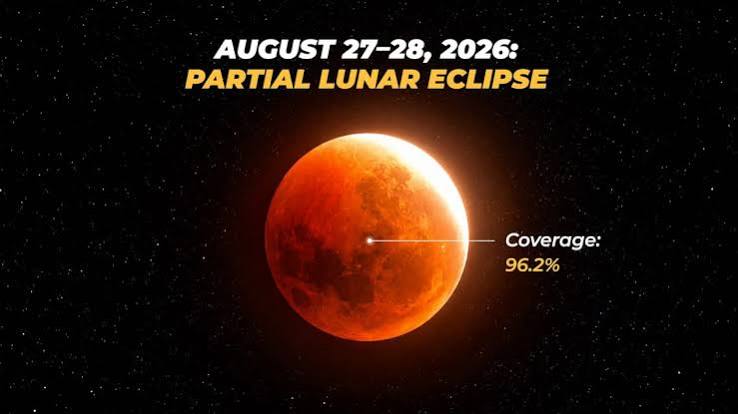
On the evening of August 27, 2026, skywatchers across Louisiana looked east as the full Moon climbed above the horizon. But something was off: a dark bite had already taken a chunk out of the lunar disk. Over the next few hours, that bite grew until only a thin sliver of the Moon remained bright, while the rest glowed a deep coppery red. This was a partial lunar eclipse, but not just any partial—96.3% of the Moon’s surface was engulfed by Earth’s central shadow, making it one of the deepest partial eclipses possible. For many, it was nearly indistinguishable from a total eclipse, save for that persistent sliver of light.
Lunar eclipses happen when the Sun, Earth, and Moon align in a straight line, with Earth in the middle casting its shadow on the Moon. They only occur during a full moon, and only when the Moon’s orbit carries it through Earth’s shadow. This particular alignment was exceptionally precise, plunging almost all of the Moon into the umbra—the darkest part of the shadow. For observers in Louisiana, the timing was perfect: the Moon rose at dusk already partially eclipsed, and the greatest eclipse occurred at 11:13 p.m. CDT, when the Moon was well placed for viewing. The entire event was a slow, mesmerizing dance of light and shadow, a reminder of the clockwork mechanics of our solar system.
What Makes a Partial Eclipse ‘Deep’?
To understand why this eclipse was so special, we need to talk about shadows. Earth casts two shadows into space: a faint outer shadow called the penumbra, and a dark inner shadow called the umbra. The umbra is the cone of darkness where Earth blocks all direct sunlight. At the Moon’s distance, the umbra is about 2.6 times the diameter of the Moon—plenty big enough to swallow it whole. But the Moon’s orbit is tilted about 5 degrees to Earth’s orbital plane, so most months the Moon passes above or below the shadow. Eclipses only happen when the Moon crosses near a node—the point where its orbit intersects Earth’s orbital plane—and when that crossing coincides with a full moon.
During the August 2026 eclipse, the Moon passed almost directly through the center of the umbra, but not quite. At maximum, 96.3% of the Moon’s disk was inside the umbra. That means the northern limb of the Moon was deep in shadow, while a thin southern sliver remained in the penumbra. To the naked eye, the Moon appeared as a dark red orb with a bright, glowing crescent on one edge. This is what astronomers call a ‘deep partial’ eclipse, and it’s a rare treat because it looks almost like a total eclipse, yet the bright sliver adds a dramatic contrast that total eclipses don’t have.
The redness itself is caused by a phenomenon called Rayleigh scattering—the same physics that makes sunsets red. When sunlight passes through Earth’s atmosphere, blue light is scattered away, but red light is bent (refracted) into the shadow. So the Moon’s surface, even in the umbra, is bathed in a faint, reddish glow. The exact shade depends on atmospheric conditions: dust, clouds, and volcanic aerosols can make the Moon darker and redder. In August 2026, observers saw a range of colors from deep orange to brick red, with the exact hue varying as the eclipse progressed.
Viewing from Louisiana: A Local Perspective
For Louisianans, the eclipse was a two-act play. The first act began at moonrise, which occurred around 7:00 to 7:30 p.m. CDT on August 27, depending on your exact location. The Moon rose in the east-southeast, and as it cleared the horizon, it was already partially eclipsed—a dark bite visible on its upper limb. This was an unusual sight: normally, a rising full moon looks bright and round, but on this evening, it appeared lopsided and eerie, glowing with an unearthly light.
The second act was the deepening of the eclipse. Over the next two hours, the umbra crept across the Moon’s face, and by 9:30 p.m. CDT, the Moon was more than half covered. The greatest eclipse arrived at 11:13 p.m. CDT, when 96.3% of the Moon was in shadow. At that moment, the Moon was well above the horizon, about 30 degrees high in the southeast—perfect for viewing from a backyard or an open field. The sliver of light on the lower edge remained bright, creating a striking ‘golden ring’ effect against the dark red of the rest.
Louisiana’s geography added a local flavor. The state’s flat terrain and numerous bayous mean many places have unobstructed views of the horizon. But the weather in late August is famously hot and humid, with afternoon thunderstorms common. Clear skies were not guaranteed, but for those who got lucky, the humidity itself could add a subtle haze that enhanced the red color. Photographers found that the eclipse offered a unique opportunity: because the Moon was partially eclipsed at moonrise, they could capture the reddened Moon low on the horizon next to familiar landmarks like the New Orleans skyline or a moss-draped oak tree—a scene that would be impossible during a total eclipse, where the Moon is often higher in the sky.
The Celestial Mechanics: Why So Close to Total?
The Moon’s orbit is not a perfect circle, but an ellipse, and its distance from Earth varies by about 13%. This affects the apparent size of the Moon and the geometry of eclipses. For a lunar eclipse to be total, the Moon must pass entirely through the umbra. In August 2026, the Moon was near its average distance, and the alignment was such that it came within 3.7% of being fully covered. That might sound like a near miss, but in astronomical terms, it’s a bullseye. The Moon’s diameter is about 3,474 kilometers, and the umbra at that distance is about 9,200 kilometers wide. The Moon’s path took it slightly south of the umbra’s center, leaving that sliver exposed.
Why does this matter? Because a 96% partial eclipse offers a different observational experience than a total one. During totality, the entire Moon is red, and the brightness drops dramatically, revealing faint details on the lunar surface that are usually washed out by the bright full moon. During a deep partial, the bright sliver acts like a glaring spotlight, making it harder to see those subtle features. But the contrast also makes the red portion appear darker by comparison. Some observers even reported seeing a ‘dichotomy’—a sharp boundary between the red umbral region and the brighter penumbral sliver, which is not as distinct in total eclipses.
For amateur astronomers, this eclipse was a chance to practice observing the umbra’s edge. The boundary between the umbra and penumbra is not a sharp line; it’s a gradient of light and shadow. By watching the Moon pass through this zone, viewers could see the gradual dimming and the slight curvature of Earth’s shadow, which is a direct proof of Earth’s spherical shape—an observation that has been made for centuries.
How to Observe a Lunar Eclipse: Tips for the Next One
If you missed this event, don’t worry—lunar eclipses are not as rare as solar ones. The next total lunar eclipse will be visible from Louisiana in 2028 or 2029, and partial eclipses occur more frequently. But to make the most of any eclipse, follow these tips:
- Find a dark location: Light pollution washes out the subtle colors. Even a rural park or a lakeshore will do.
- Check the weather: A clear sky is essential. In Louisiana, that means watching for afternoon storms that might clear by evening.
- Use binoculars or a telescope: While the naked eye is fine, optical aid reveals more detail on the Moon’s surface, especially the contrast between the umbra and penumbra.
- Photograph the Moon: A DSLR with a telephoto lens or a telescope with a camera mount can capture stunning images. Use a tripod and experiment with exposure times, because the Moon’s brightness changes dramatically during the eclipse.
- Be patient: The partial phase lasts over three hours, so settle in with a lawn chair and a cool drink. The slow progression is part of the beauty.
The Cultural Significance of Eclipses in Louisiana
Eclipses have always captured human imagination, and Louisiana is no exception. With its rich blend of Creole, Cajun, and African-American traditions, the region has its own folklore about the Moon. In many cultures, a lunar eclipse was seen as a time of transformation or a battle between celestial forces. Some old Cajun tales speak of the Moon being eaten by a beast, and people would make noise to scare it away. While modern science explains the phenomenon, the sense of wonder remains. For many Louisianans, the eclipse was a communal event—families gathered in parks, on levees, and in driveways to share the view, a reminder that the sky belongs to everyone.
In recent years, Louisiana has been a prime spot for astronomical events: the 2017 total solar eclipse, the 2019 total lunar eclipse, and now this deep partial. Each event draws new enthusiasts, and local astronomy clubs often host public viewing sessions. Such gatherings are more than just science; they are social occasions that bridge generations and cultures. As one observer in Baton Rouge put it, “We may not have a great view of the stars from the city, but when an eclipse happens, the whole world looks up together.”
The August 2026 partial lunar eclipse was a reminder of the beauty of celestial mechanics. For Louisiana, it was a spectacle that unfolded in the evening sky, turning a familiar full moon into a dark, red orb with a bright edge. While it wasn’t a total eclipse, its 96.3% coverage made it a rare and dramatic event. The next time the Moon darkens over the bayous, remember to look up—the universe has a way of putting on a show just when we least expect it.
Summary
- A partial lunar eclipse occurred on August 27–28, 2026, with 96.3% of the Moon entering Earth’s umbra.
- The event was visible from Louisiana, where the Moon rose already partially eclipsed at about 7:00–7:30 p.m. CDT, and maximum eclipse occurred at 11:13 p.m. CDT.
- The deep partial eclipse looked almost total, but a bright sliver remained, offering a unique contrast with the reddened rest of the Moon.
- The reddish color is caused by Rayleigh scattering, the same effect that colors sunsets.
- For best viewing, find a dark location, check weather, and use binoculars or a camera with a telephoto lens.
FAQ
Q: When was the August 2026 lunar eclipse visible in Louisiana?
A: The eclipse was visible on the evening of August 27, 2026, from moonrise (around 7:00–7:30 p.m. CDT) until after midnight. Greatest eclipse was at 11:13 p.m. CDT.
Q: Why was this eclipse called ‘deep partial’?
A: Because 96.3% of the Moon entered Earth’s umbra (the dark central shadow), but not 100%. It was very close to a total eclipse, but a thin sliver of the Moon remained in the penumbra.
Q: What caused the Moon to look red during the eclipse?
A: Earth’s atmosphere refracts sunlight into the shadow, scattering blue light away but bending red light toward the Moon. This is called Rayleigh scattering, the same reason sunsets are red.
Q: How long did the partial eclipse last?
A: The umbral phase (from first to last contact with the umbra) lasted about 3 hours and 18 minutes. The penumbral phase was longer, about 5–6 hours in total.
Q: When is the next lunar eclipse visible from Louisiana?
A: Total lunar eclipses visible from Louisiana occur in 2028 and 2029. Partial eclipses are more frequent, but the exact dates depend on your location.