From Rome’s legions to Britain’s global navy, empires have shaped the map of the world. But their stories share a common arc: a meteoric rise, a plateau of power, and a fall that often feels sudden—yet was years in the making. This article pulls back the curtain on the patterns behind imperial decline, exploring why even the mightiest powers eventually crumble.
It’s easy to see empires as relics of the past, but the dynamics that drove them still play out in modern geopolitics. By examining the economic stresses, internal fractures, and strategic overreach that toppled historical giants, we can spot the same warning signs in today’s superpowers. History doesn’t repeat itself, but it rhymes—and understanding those rhymes helps us make sense of the present.
What Makes an Empire?
An empire isn’t just a big country. It’s a multi-ethnic, multi- political entity where a central power controls distant territories, often through conquest. The relationship between the ‘center’ (like Rome or London) and the ‘periphery’ (the provinces or colonies) is hierarchical: the center extracts resources and manpower, while the periphery provides them.
That structure creates inherent tension. Empires must constantly balance the cost of controlling their borders against the benefits of what they extract. The Roman Empire at its peak under Trajan in 117 CE covered about 5 million square kilometers and ruled roughly 20% of the world’s population. The British Empire in 1920 spanned about 35.5 million square kilometers—a quarter of Earth’s land—and governed around 412 million people, or 23% of humanity. But size and power never last forever.
The Lifecycle of Empires: Patterns of Decline
Historians have long noticed that empires follow a predictable arc. Sir John Bagot Glubb, in his 1976 essay ‘The Fate of Empires,’ observed that the average lifespan of an empire is about 250 years, though the range is huge: the Byzantine Empire endured over a millennium, while the Mongol Empire lasted barely 160 years. The exact number matters less than the pattern.
Three recurring pressures show up again and again.
Fiscal Crisis: When the Money Runs Out
Empires often spend themselves into oblivion. Rome’s third-century inflation crisis weakened the economy and made it harder to pay soldiers. Spain, despite flooding Europe with gold and silver from the Americas under Philip II, declared bankruptcy multiple times because the cost of wars and administration outpaced the influx of precious metals.
Overextension is a close cousin. When maintaining borders becomes more expensive than the economic return, the empire starts to bleed. Britain faced exactly that after World War II: it could no longer afford to police a global empire, and the empire dissolved in a couple of decades.
Internal Decay vs. External Pressure
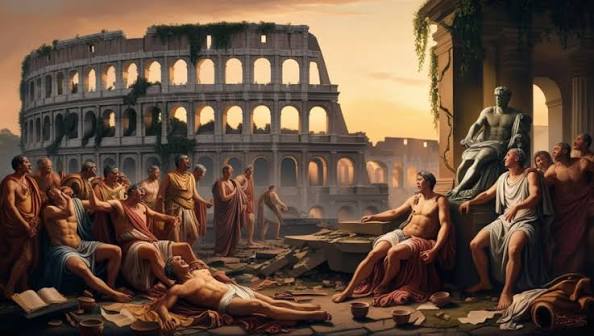
Most empires don’t fall because of a single invasion. They fall because internal dysfunction—corruption, civil strife, elite infighting—has already hollowed them out. The external enemy is often the final push, not the root cause. When the Western Roman Empire collapsed in 476 CE, it had already suffered decades of political instability, economic stagnation, and a reliance on barbarian mercenaries. The Visigoths’ sack of Rome in 410 was a symptom, not the disease.
Elite Overproduction: The Turchin Model
Peter Turchin, a scientist who applies mathematical models to history, identified a powerful driver of collapse: elite overproduction. When too many ambitious people compete for too few elite positions, society becomes unstable. This happens because population growth and wealth creation produce more educated, aspirational individuals than the system can accommodate. The result is infighting, factionalism, and eventually rebellion or civil war.
Turchin’s cliodynamics approach charts these cycles with data, showing that the same dynamic recurs across empires and civilizations. It’s a modern, quantitative take on an old idea.
The Grand Theories: From Polybius to Toynbee
The idea that empires cycle through birth, growth, maturity, decline, and fall dates back to antiquity. The Greek historian Polybius described a cycle of constitutions: monarchy, tyranny, aristocracy, oligarchy, democracy, mob rule, chaos, and then a new monarchy. The 14th-century Arab historian Ibn Khaldun introduced the concept of asabiyyah—group solidarity that binds a rising tribe or people together, but decays as urban luxury and individualism set in.
Edward Gibbon’s monumental ‘The History of the Decline and Fall of the Roman Empire’ blamed ‘barbarism and religion.’ Oswald Spengler’s ‘The Decline of the West’ and Arnold Toynbee’s ‘A Study of History’ proposed grand cyclical theories, though modern scholars criticize their deterministic methods. Still, the core insight remains: empires have a lifespan, and trying to defy that is a fool’s errand.
Decline or Transformation?
Not all historians accept the word ‘fall.’ Some argue that Rome didn’t fall—it transformed. The Western Empire gave way to the Byzantine Empire and the Catholic Church’s temporal power, both of which carried Roman ideas forward. Similarly, the British Empire morphed into the Commonwealth, a voluntary association of former colonies.
This distinction matters. If empires can transform rather than simply collapse, the lessons change. It’s not about avoiding decline but about managing it—transitioning to a more sustainable form of power.
Why This Matters Today
The United States is often called an empire—or less pejoratively, a hegemon. Scholars like Paul Kennedy, Niall Ferguson, and Amy Chua draw direct parallels between the U.S. and Rome or Britain. Meanwhile, China’s rise and Russia’s imperial ambitions show that the empire game is far from over. Even if the word ’empire’ carries heavy baggage, the dynamics of controlling far-flung territories and populations remain relevant.
Climate change, resource scarcity, and mass migration are modern pressure points that echo historical triggers of collapse. When borders become too costly to guard, when the center’s wealth doesn’t reach the periphery, when internal divisions outpace external threats—those are the moments when empires crack.
Lessons for the Present
So what can we learn from the graveyards of empires?
First, fiscal discipline matters. Overextending the military without a matching economic base is a recipe for ruin. Second, internal health is more important than any external enemy. A society that manages inequality, keeps institutions strong, and provides pathways for ambition is less likely to fall into the elite-overproduction trap.
Third, flexibility beats rigidity. Empires that adapt—like the Ottomans, who survived six centuries by changing with the times—outlast those that cling to old structures. But even adaptation has limits. The Ottomans couldn’t stop the Age of Discovery from rerouting trade away from the Mediterranean, just as Britain couldn’t stop the rise of new economic powers.
Finally, no empire is permanent. The British Empire, at its peak, ruled a quarter of the world. It’s now a small island nation with a few overseas territories. The Soviet Union, which dominated half of Europe, dissolved in 1991. The cycle continues.
The rise and fall of great empires is not a story of inevitable doom but of recurring patterns. Economics, internal cohesion, and flexibility determine how long any power lasts. The empires that endure the longest are not necessarily the largest or mightiest, but those that learn to adapt. As we watch today’s superpowers navigate these same pressures, the lessons of history remain a vital guide.
Summary
- Empires are multi-ethnic, hierarchical entities that rise through conquest and extract resources from peripheries.
- Most empires follow a lifespan of roughly 250 years, but the range is wide.
- Common decline drivers: fiscal crisis, overextension, internal decay, and elite overproduction.
- Grand theories from Polybius to Turchin explain cyclical patterns, but historical determinism is debated.
- Modern parallels: the U.S., China, and Russia offer case studies in imperial overreach and adaptation.
FAQ
Q: What defines an empire?
A: An empire is a large, multi-ethnic political entity where a central power controls distant territories through conquest, maintaining control via military force, economic extraction, and administration.
Q: How long do empires typically last?
A: Historian Sir John Glubb observed an average of about 250 years, but the range is huge—from the Mongol Empire’s 160 years to the Byzantine Empire’s 1,100.
Q: What are the most common causes of empire collapse?
A: Fiscal crisis from overextension, internal dysfunction (corruption, civil strife), and elite overproduction—where too many ambitious people compete for few top positions.
Q: Is the U.S. an empire?
A: Many scholars describe the U.S. as a contemporary empire or hegemon, drawing comparisons to Rome and Britain, though it lacks formal colonies and exercises power through economic and military influence.
Q: Can empires avoid falling?
A: History suggests that empires can extend their lifespans by adapting, maintaining fiscal health, and addressing internal inequalities, but no empire lasts forever.