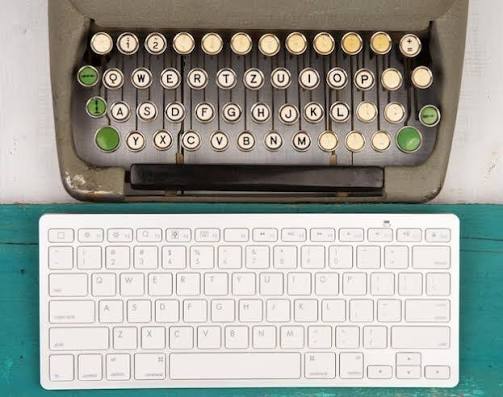
Every day, millions of fingers dance across QWERTY keyboards, tapping out emails, documents, and messages without a second thought. But there’s a story that’s been circling for decades: that the layout was deliberately designed to slow typists down, preventing the mechanical jams of early typewriters. It’s a neat, conspiratorial tale and it’s almost certainly wrong.
The truth is more mundane but far more interesting. QWERTY wasn’t a plot to throttle human speed; it was an engineer’s pragmatic solution to a very real mechanical problem. And the myth’s persistence says more about how we love a good story than about the keyboard itself.
The Birth of a Keyboard
In the 1860s, Christopher Latham Sholes a Milwaukee newspaper editor and part-time inventorn was tinkering with a machine that could put words on paper faster than a pen. With help from printer Carlos Glidden and machinist Samuel Soulé, he developed one of the first practical typewriters. On July 14, 1868, he received U.S. Patent No. 207,559 for his invention.
Sholes’ early prototypes were arranged alphabetically. Keys for A through Z sat in two neat rows. But there was a problem: when a typist hit two keys quickly, the typebars—metal arms that strike the ribbon—could collide and jam. Common letter pairs like “th” or “er” were often adjacent on the alphabetical layout, making jams frequent and frustrating.
So Sholes did what any good inventor would: he experimented. He shuffled the keys around, testing different arrangements, often with the help of telegraph operators who were among the first skilled typists. The result was a layout that spread out commonly used letter pairs, reducing the risk of clashing typebars. The 1878 Remington No. 2, the first commercially successful typewriter, featured this new layout—the one we now call QWERTY, named for the first six letters on the top row.
The “Slow Down” Myth Takes Root
Somewhere along the line, that practical fix morphed into a myth: QWERTY was designed to slow typists down. The logic seemed plausible—if you make the keyboard awkward, people can’t type fast enough to jam it. But the evidence doesn’t support it.
No primary source from Sholes or Remington mentions slowing anyone down. In fact, speed was a selling point. Early advertisements touted the typewriter’s ability to produce “perfectly legible” documents “with a speed almost equal to ordinary handwriting.” If the goal were to slow typists, why would they market it as fast?
The myth appears to have gained traction in the 1980s and 1990s, when computer history became a popular topic. Oversimplified retellings in books and articles turned a mechanical fix into a conspiracy. But the historical record offers no such claim.
What QWERTY Actually Did
The real genius of QWERTY was its handling of the “home row”—the middle row of keys where your fingers rest. Sholes arranged it so that common letters were distributed between hands, encouraging alternation. For example, the left hand handles QWERT and the right handles YUIOP. This alternation actually increases typing speed, not the opposite.
Moreover, the home row was designed to be convenient for touch typing, a skill that was just emerging. Frank McGurrin, a court stenographer, popularized touch typing in the 1880s by demonstrating that he could type at high speeds without looking at the keys. His public contests showed that QWERTY could be used efficiently—and that speed was a feature, not a bug.
Why the Myth Endures
If the evidence is so clear, why does the myth persist? Partly because it’s a satisfying underdog story: a flawed design that we’re stuck with, a hidden agenda by manufacturers, a reason for our typos. It also connects to a kernel of truth—QWERTY isn’t the most efficient layout possible. Later designs, like the Dvorak Simplified Keyboard (1936) by August Dvorak, claimed to reduce finger travel and increase speed. But Dvorak’s own studies were often funded by himself, and a famous 1944 U.S. Navy study that supposedly proved Dvorak’s superiority was later found to be methodologically flawed.
Even if Dvorak or modern layouts like Colemak are more efficient, switching costs are steep: retraining muscle memory, remapping software, and buying new hardware. QWERTY’s dominance is a classic example of path dependence—once a standard is established, it’s hard to dislodge, even if alternatives are better.
The Real Takeaway
QWERTY wasn’t a conspiracy to slow you down. It was a clever engineering solution to a mechanical problem, refined through trial and error. Its quirks—the left-hand bias, the overused top row—are the legacy of 19th-century metal arms, not a secret plot. And while the myth persists, the truth is more impressive: a design that solved a real problem, stuck around for over a century, and still works today.
The QWERTY keyboard is not a relic of deliberate sabotage. It’s a testament to how a practical fix can become an enduring standard—and how a good story can overshadow the truth. So the next time you type a fast message, remember: your keyboard was never trying to slow you down. It was trying to keep up with you.
Summary
- QWERTY was designed to reduce mechanical jams by separating common letter pairs, not to slow typists down.
- No primary source from Sholes or Remington mentions slowing typists; speed was actually a selling point.
- The myth became popular in the 1980s-90s but lacks documentary evidence.
- The home row was designed to encourage hand alternation, which increases typing speed.
- QWERTY’s persistence is due to path dependence, not because it’s the most efficient layout.
FAQ
Q: Did QWERTY really slow typists down?
A: No. The layout was designed to prevent mechanical jams by separating common letter pairs, not to reduce typing speed. In fact, it was marketed as a speed-enhancing device.
Q: Why did Sholes change the alphabetical layout?
A: The alphabetical layout caused frequent jams because adjacent keys were often used in quick succession. Sholes rearranged the keys to minimize these collisions.
Q: Is there any evidence for the “slow down” claim?
A: No. No letters, patents, or advertisements from Sholes or Remington suggest slowing typists was a goal. The claim appears to have originated in the 1980s-90s in popular tech history.
Q: What is the Dvorak keyboard?
A: The Dvorak Simplified Keyboard, designed in 1936, was meant to increase typing speed by reducing finger travel. However, studies supporting it were often flawed, and it never displaced QWERTY due to switching costs.
Q: Why do we still use QWERTY?
A: It’s a classic case of path dependence. Once QWERTY became the standard in the late 19th century, retraining users and changing hardware became too costly, even if alternatives are more efficient.