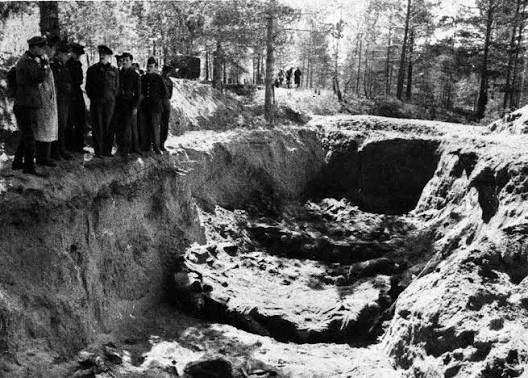
In April 1943, German soldiers advancing through the Smolensk region stumbled upon a horror that would haunt the twentieth century. In the Katyn Forest, they found mass graves filled with the bodies of Polish officers, their hands bound, each shot in the back of the head. The discovery set off a propaganda war between two totalitarian regimes, each eager to pin the atrocity on the other. But the truth, buried for fifty years, pointed to a crime ordered by Joseph Stalin himself.
The Forest and the Graves
The Katyn Forest, a quiet expanse of birch and pine near the Russian city of Smolensk, became the silent witness to one of the largest single massacres of World War II. In the spring of 1940, Soviet secret police—the NKVD—executed nearly 22,000 Polish prisoners of war and civilians. Most were military officers, but the dead also included intellectuals, police officers, and clergy. They were shot in the back of the head in soundproofed rooms, loaded onto trucks, and buried in layered pits, their bodies stacked like cordwood.
The victims came from three main POW camps: Kozelsk, Starobelsk, and Ostashkov. The largest group, about 8,000 to 8,500 officers, was held at Kozelsk. Families back in Poland received no word of their fate; they were simply told the men had been moved to unknown locations. Many assumed their loved ones were still alive in Soviet camps, unaware that the NKVD had already carried out the executions.
The Order and Its Rationale
The decision to murder these men was not the act of a rogue commander but a deliberate policy approved at the highest level of the Soviet state. On March 5, 1940, NKVD chief Lavrentiy Beria submitted a formal note to the Politburo, recommending the execution of the Polish prisoners. He described them as “hardened and uncompromising enemies of Soviet power” who posed a permanent threat—potential leaders of a future Polish resistance or an Allied-backed army. The Politburo approved unanimously, and Stalin signed the order.
The executions took place over several weeks in April and May 1940. In Katyn, and at two other sites—Kalinin (now Tver) and Kharkiv—the NKVD carried out the killings with brutal efficiency. The selection of Katyn was deliberate: the forest’s remoteness made it easy to conceal the crime.
The Nazi Discovery and the Propaganda War
For three years, the massacre remained a secret. Then, in April 1943, German forces occupying the region discovered the graves. They immediately announced the find, inviting international forensic experts, including a delegation from the Polish Red Cross, to examine the site. The Germans used the discovery as a propaganda weapon against the Soviet Union, broadcasting details to the world.
The Soviet response was swift and indignant. They accused the Germans of committing the atrocity themselves, claiming the Nazis had occupied the area in 1941 and killed the prisoners then. To bolster their case, the Soviets broke diplomatic relations with the Polish government-in-exile in London when it requested an investigation by the International Red Cross—a move that only deepened Polish suspicions.
In 1944, after Soviet forces recaptured the region, a Soviet-led commission headed by Nikolai Burdenko concluded that the Germans were guilty. This version—the “Burdenko Commission” report—became the official Soviet narrative, taught in schools and repeated in histories for decades. The Nazis, for their part, were no less cynical; Joseph Goebbels used the massacre to stoke anti-Soviet sentiment, but his propaganda machine had no interest in the truth.
The Cover-Up That Lasted Half a Century
The lie held for nearly fifty years. During World War II, the Western Allies, knowing the Soviets were guilty, chose to suppress the issue to maintain unity against Germany. Winston Churchill privately admitted Soviet responsibility but publicly avoided the topic. At the Nuremberg Trials in 1945-46, the Soviets included Katyn in their indictment against German defendants, but the prosecution’s case collapsed when the defense produced evidence pointing to Soviet guilt. The tribunal never ruled on the matter.
For Poles, Katyn became a symbol of Soviet oppression—a wound that festered through the Cold War. The Polish government-in-exile and later the anti-communist opposition kept the memory alive, but the official Soviet line remained unchanged.
Acknowledgment and Its Limits
The truth finally emerged with the collapse of the Soviet Union. In April 1990, Soviet President Mikhail Gorbachev formally admitted Soviet responsibility and handed over documents to Polish President Wojciech Jaruzelski. Two years later, Russian President Boris Yeltsin released the key archival documents, including the Beria note, confirming Stalin’s personal involvement.
In 2010, the Russian State Duma officially recognized the massacre as a Stalinist crime. But the acknowledgment has been partial and fraught. In 2015, Russia’s Investigative Committee closed the case without naming any perpetrators as defendants. And in 2022, Russia’s Supreme Court refused to recognize the massacre as a crime against humanity, citing the “rehabilitation” of its perpetrators. The echoes of the Katyn lie persist in Russia’s official memory.
The Weight of the Dead
The Katyn massacre remains one of the most brutal chapters of World War II—a crime that was not only hidden but deliberately blamed on the enemy. For Poland, the massacre and its cover-up shaped national identity and memory. The 2010 Smolensk air disaster, which killed Polish President Lech Kaczyński and 95 others en route to a Katyn memorial ceremony, deepened the trauma. The forest at Katyn, once a place of death, now stands as a cemetery and a reminder of what happens when power is wielded without accountability.
The Katyn massacre is a case study in the mechanics of denial. For fifty years, a lie was maintained by a superpower, and the truth was sacrificed for political expediency. The dead, however, could not be silenced forever. Their memory, kept alive by families and historians, finally forced the world to confront the crime. Yet the recent rulings in Russia show that the battle over history is never truly over. Katyn stands as a permanent warning: when a state commits atrocity and blames another, the truth may be delayed, but it cannot be buried forever.
Summary
- In spring 1940, the Soviet NKVD executed approximately 21,857 Polish prisoners of war and civilians, including officers, intelligentsia, police, and clergy, at Katyn and other sites.
- The executions were authorized by the Soviet Politburo on March 5, 1940, on the recommendation of NKVD chief Lavrentiy Beria, and signed by Stalin.
- The massacre was discovered by German forces in April 1943, who used it for propaganda; the Soviets blamed the Nazis, a lie maintained until 1990.
- The Soviet cover-up collapsed with Gorbachev’s 1990 admission and Yeltsin’s 1992 release of key documents.
- Russia’s recent legal rulings have refused to recognize the massacre as a crime against humanity, leaving the legacy of the crime contested.
FAQ
Q: Who ordered the Katyn massacre?
A: The executions were ordered by the Soviet Politburo on March 5, 1940, on the recommendation of NKVD chief Lavrentiy Beria, and signed by Joseph Stalin.
Q: How many people were killed?
A: Approximately 21,857 Polish prisoners of war and civilians were executed, with the largest group—around 8,000 to 8,500 officers—killed at Katyn.
Q: Why did the Soviets blame the Nazis?
A: The Soviet government denied responsibility for decades, claiming the Germans committed the massacre in 1941. This false narrative was maintained officially to avoid political fallout and was reinforced by the 1944 Burdenko Commission.
Q: When did the Soviet Union admit guilt?
A: In April 1990, Soviet President Mikhail Gorbachev formally admitted Soviet responsibility and handed over documents to Polish President Wojciech Jaruzelski.
Q: What is Russia’s current position on Katyn?
A: In 2010, the Russian State Duma recognized the massacre as a Stalinist crime, but in 2015 the Investigative Committee closed the case without naming perpetrators, and in 2022 the Supreme Court refused to recognize it as a crime against humanity.