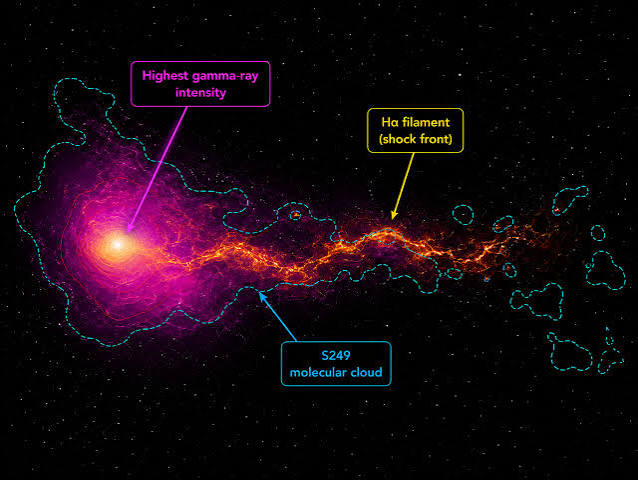
In a cosmic first, astronomers have stumbled upon a remarkable find: two supernova remnants that originated from the same binary star system. The discovery, made while studying the well-known Jellyfish Nebula, reveals that both stars in a massive binary system exploded as supernovae—a phenomenon long predicted but never before observed. This accidental finding not only reshapes our understanding of stellar evolution but also offers a rare glimpse into the violent lives and deaths of binary stars.
The new remnant, located near the Jellyfish Nebula (IC 443) in the constellation Gemini, about 5,000 light-years from Earth, is the second supernova remnant from the same system. The explosions occurred at different times, separated by hundreds of thousands to millions of years, making the detection a fortuitous alignment of timing and observation. As astronomers continue to probe the cosmos, this discovery underscores the serendipitous nature of scientific exploration and the hidden treasures that await in well-studied regions of the sky.
A Cosmic Coincidence: The Accidental Discovery
The research team was not searching for a second supernova remnant. They were focused on IC 443, one of the most studied supernova remnants in the Milky Way, known for its jellyfish-like shape and bright filaments. While examining the region in detail, they noticed an adjacent structure that didn’t fit the expected pattern. Further analysis revealed it to be a separate supernova remnant, and the evidence pointed to a stunning conclusion: both remnants originated from two stars that once orbited each other in a binary system.
This accidental discovery highlights the role of serendipity in astronomy. Even in well-mapped regions, new instruments and techniques can reveal hidden features. The team’s initial goal was to study IC 443, but their careful observations led to a groundbreaking find that had been overlooked for decades.
The Life and Death of Binary Stars
Most massive stars—perhaps 50 to 70%—exist in binary or multiple-star systems. When two massive stars orbit each other, their life cycles are intertwined. Both stars eventually exhaust their nuclear fuel and explode as supernovae, but the timing is crucial. The first explosion can strip material from the companion, alter its orbit, and even accelerate its evolution. The second explosion may occur millions of years later, by which time the first remnant has often faded into the interstellar medium.
This discovery provides a rare observational anchor for theoretical models of binary star evolution. It confirms that both members of a massive binary system can indeed explode as supernovae, a prediction that had never been directly observed. The existence of two remnants from the same system offers a unique laboratory to study the effects of one supernova on its companion star.
What This Means for Gravitational Wave Research
If both stars exploded as core-collapse supernovae, they likely left behind neutron stars or black holes. The system could eventually evolve into a neutron star–neutron star or neutron star–black hole binary, which are prime sources for gravitational wave detectors like LIGO and Virgo. This discovery could help refine predictions about the formation of such systems, providing valuable insights into the progenitors of gravitational wave events.
By studying the remnants, astronomers can infer the masses and explosion mechanisms of the original stars, which in turn informs models of how compact object binaries form. This accidental find may have far-reaching implications for our understanding of the universe’s most violent phenomena.
Cosmic Recycling: Heavy Elements and Star Formation
Supernovae are cosmic recyclers, enriching the interstellar medium with heavy elements like carbon, oxygen, iron, and gold. Two supernovae in the same region would have injected a double dose of these elements into the surrounding gas, potentially influencing star formation in that area. This discovery connects to broader questions about galactic chemical evolution and how elements are distributed across the cosmos.
The presence of two remnants so close together suggests that the region has undergone significant chemical enrichment, which could trigger the formation of new stars with higher metallicity. This, in turn, affects the evolution of subsequent stellar generations, creating a complex feedback loop that shapes galaxies over time.
Observational Techniques: Uncovering Hidden Remnants
The discovery likely relied on multi-wavelength observations, combining data from X-ray, radio, and optical telescopes. Archival data from observatories like Chandra and XMM-Newton may have been crucial in identifying the second remnant. By comparing images across different wavelengths, astronomers can distinguish between overlapping structures and identify distinct remnants.
The fact that this remnant was hidden in plain sight for so long underscores the importance of re-examining known objects with new tools and techniques. As telescopes become more sensitive and surveys cover more of the sky, we can expect more accidental discoveries that challenge our current understanding of the cosmos.
The accidental discovery of twin supernovae from a single binary star system is a testament to the unpredictable nature of scientific exploration. It not only confirms a long-standing prediction about binary star evolution but also opens new avenues for research in gravitational wave astronomy and galactic chemical evolution. As we continue to scan the skies, this find reminds us that the universe is full of surprises, waiting to be uncovered by curious minds.
Summary
- Astronomers accidentally discovered a second supernova remnant near the Jellyfish Nebula (IC 443), revealing that both stars in a binary system exploded as supernovae.
- This is the first confirmed case of a ‘double supernova’ from the same binary star system, a phenomenon predicted but never observed.
- The explosions occurred at different times, separated by hundreds of thousands to millions of years, making the detection a rare cosmic coincidence.
- The discovery provides insights into binary star evolution, gravitational wave progenitors, and the chemical enrichment of galaxies.
- The find highlights the role of serendipity in astronomy and the value of re-examining known objects with advanced instruments.
FAQ
Q: What is a supernova remnant?
A: A supernova remnant is the glowing shell of gas and dust that expands outward after a star explodes as a supernova. It remains visible for tens of thousands to hundreds of thousands of years.
Q: How common are binary star systems?
A: Most massive stars (50-70%) are in binary or multiple-star systems, making it likely that many supernovae occur in such systems, but detecting two remnants from the same system is extremely rare.
Q: Why is this discovery significant?
A: It is the first confirmed case of two supernovae from the same binary system, providing direct evidence for a long-standing prediction and offering insights into stellar evolution and gravitational wave sources.
Q: Could this system produce gravitational waves?
A: If the supernovae left behind neutron stars or black holes, the system could eventually become a binary compact object, which would be a source of gravitational waves detectable by LIGO and Virgo.
Q: How was the second remnant discovered?
A: The team was studying IC 443 and noticed an adjacent structure that turned out to be a separate remnant. Multi-wavelength observations and archival data helped confirm its origin.