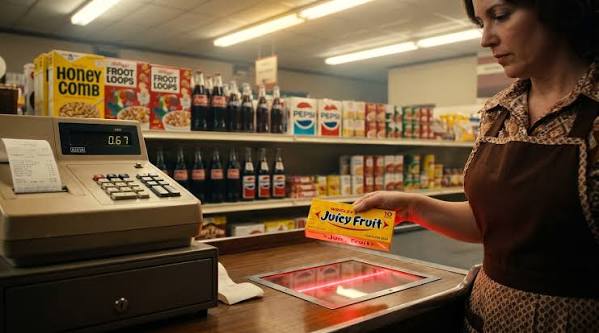
On June 26, 1974, a cashier at a Marsh supermarket in Troy, Ohio, scanned a 10-pack of Wrigley’s Juicy Fruit chewing gum. That single beep marked the first commercial use of the barcode, a technology that would quietly become the backbone of global retail. Today, over a billion products carry a barcode, and the system that started as a way to speed up checkout lines has reshaped everything from inventory management to the rise of big-box stores like Walmart.
But the barcode wasn’t a sudden flash of genius. It was the result of decades of ideas, failures, and a pressing industry crisis. In the 1960s, supermarkets were drowning in labor costs, and checkout was the slowest, most error-prone part of the store. This article tells the story of how a simple pattern of lines solved that problem—and changed the world in ways its inventors never imagined.
The Problem: Slow Checkouts and Manual Counting
Imagine a grocery store in 1960. A cashier manually reads the price tag on each item—often a small, smudged sticker—and types it into a cash register. Mistakes happen. Lines stretch down the aisles. And at the end of the day, the store owner has no idea what actually sold unless someone physically counts the shelves.
This wasn’t just an inconvenience. By the late 1960s, labor costs accounted for roughly half of a supermarket’s operating expenses, and checkout was the most labor-intensive part of the business. The National Association of Food Chains (NAFC) was so concerned that in 1969 they commissioned a study on automating the checkout process. The industry needed a way to identify products quickly, accurately, and without human error.
The Idea That Took 20 Years to Catch On
The concept of encoding product data in a visual pattern wasn’t new. In 1948, two graduate students at Drexel Institute of Technology—Bernard Silver and Norman Joseph Woodland—had an idea. Overhearing a grocery store executive lamenting the need for automatic product identification, they began experimenting. Woodland, inspired by Morse code, extended the dots and dashes into thin and thick lines. His most ambitious design was a “bullseye” pattern of concentric circles, which could be read from any direction. They patented it in 1952 but couldn’t make it work reliably with the technology of the time. They sold the patent to Philco in 1962, and it sat mostly unused.
Meanwhile, the railroad industry tried its own version in the 1960s, called KarTrak. It used colored stripes on railcars, but the system proved unreliable—dirt and weather made the codes unreadable—and it was eventually abandoned. These early failures highlight a key lesson: a good idea isn’t enough; you need the right technology and industry buy-in.
The UPC: A Standard for Everyone
The breakthrough came in the early 1970s. The grocery industry’s Ad Hoc Committee—formed in 1970 by major retailers and manufacturers—set strict requirements. Any system had to be printable on tiny packages, readable by low-cost scanners, and standardized across all manufacturers. Without a common standard, a store would need different systems for different suppliers, which was a non-starter.
IBM’s George Laurer took Woodland’s concepts and refined them into a rectangular, machine-readable format: the Universal Product Code, or UPC. This linear barcode encodes 12 digits. The first digit indicates the product category; the next five identify the manufacturer; the following five identify the specific product; and the final digit is a “check digit” that allows the scanner to detect errors.
Why rectangular instead of bullseye? The committee tested both IBM’s design and RCA’s bullseye. The bullseye was harder to print reliably on packages, and IBM had strong lobbying power with major retailers. In 1973, the UPC was formally adopted as the grocery industry standard.
The First Scan and the Slow Road to Adoption
The first public scan at the Marsh supermarket was a carefully orchestrated publicity stunt. A 10-pack of Wrigley’s Juicy Fruit gum—chosen because it was small and easy to scan—was the first item to cross the scanner. That pack of gum now sits in the Smithsonian Institution.
But the revolution didn’t happen overnight. By 1977, only about 200 stores had scanners. The early machines cost tens of thousands of dollars (in 1970s money), and items had to be oriented a specific way to be read—a major operational headache. For years, the barcode seemed like an expensive experiment.
The tipping point came in the early 1980s when large chains like Walmart and Kmart began mandating that their suppliers put UPC codes on all products. This created a powerful incentive: if you wanted to sell to these big retailers, you had to comply. By the mid-1980s, most grocery and mass merchandise items carried barcodes.
How the Barcode Changed Retail from the Inside Out
The barcode didn’t just speed up checkout—it transformed retail operations.
Point-of-sale revolution: Scanners linked electronic cash registers to a central database. When a cashier scanned an item, the price was instantly looked up, eliminating manual entry errors and enabling real-time price changes.
Inventory tracking in real time: Before barcodes, inventory was counted by hand. Now, every scan updated the store’s records instantly. This gave retailers a clear picture of what was selling, what wasn’t, and when to reorder.
Automatic reordering and supply chain management: With accurate data, stores could automate reordering. This was a prerequisite for just-in-time manufacturing and the sophisticated logistics that power modern supply chains.
Power shift to retailers: For the first time, retailers had hard data on sales. This shifted the balance of power between manufacturers and retailers. Retailers could negotiate better terms, manage shelf space based on sales data, and demand that manufacturers produce what consumers actually wanted.
The rise of big-box retail: Walmart’s entire business model—everyday low prices, massive distribution centers, and efficient logistics—depends on barcode-driven data. Without barcodes, the big-box store as we know it would be impossible.
The Global Standard: GS1
Today, the system is managed by GS1, the organization formerly known as the Uniform Code Council. Over a billion products are registered with GS1 codes, and the standard has expanded beyond retail to health care, logistics, and even airline baggage handling. The barcode has become so ubiquitous that we barely notice it—but it’s there, on everything from a pack of gum to a shipping container.
Challenges and the Road Ahead
The barcode wasn’t without its critics. Some worried about privacy and surveillance, as the data could be used to track purchases. Others pointed out that early scanners were error-prone and required careful alignment. But the system proved resilient and adaptable.
Today, the barcode is facing competition from newer technologies like QR codes and RFID tags, which can store more data and be read from a distance. Yet the simple linear barcode remains in use because it’s cheap, reliable, and universally accepted. It’s a reminder that sometimes the simplest solution is the most enduring.
The barcode began as a solution to a grocery store’s labor problem, but it grew into a global infrastructure that touches every product we buy. Its success wasn’t just about the technology—it was about standardization, industry cooperation, and the willingness of big players to force adoption. The next time you hear that beep at the checkout, remember: you’re hearing the echo of a revolution that started with a single pack of gum.
Summary
- The first barcode scan was on June 26, 1974, at a Marsh supermarket in Troy, Ohio—a pack of Wrigley’s Juicy Fruit gum.
- The UPC code was developed by IBM’s George Laurer, building on earlier concepts from Bernard Silver and Norman Joseph Woodland.
- The grocery industry adopted the UPC as a standard in 1973 after a committee chose it over RCA’s bullseye design.
- Adoption was slow; by 1977 only 200 stores had scanners, but large retailers like Walmart forced mass adoption in the 1980s.
- Barcodes enabled point-of-sale systems, real-time inventory tracking, automatic reordering, and the rise of big-box retail.
FAQ
Q: Who invented the barcode?
A: The barcode was not invented by a single person. Bernard Silver and Norman Joseph Woodland conceived the idea in the 1940s and patented a circular “bullseye” design in 1952. Later, George Laurer at IBM developed the rectangular UPC format that became the standard.
Q: Why was the first scanned item a pack of gum?
A: The pack of Wrigley’s Juicy Fruit gum was chosen for the first scan because it was small, easy to handle, and had a smooth surface that made it ideal for testing the new scanner.
Q: What does a UPC barcode contain?
A: A UPC-A barcode encodes 12 digits: the first digit indicates the product category, the next five identify the manufacturer, the following five identify the product, and the last digit is a check digit used for error detection.
Q: How does a barcode scanner work?
A: A barcode scanner shines a laser or LED light on the barcode. The black bars absorb light, while the white spaces reflect it. The sensor reads the pattern of reflected light and converts it into a digital signal that a computer can interpret.
Q: Are barcodes still used today?
A: Yes, barcodes remain widely used because they are cheap, reliable, and universally accepted. Newer technologies like QR codes and RFID tags exist, but the linear barcode is still the standard for most retail products.