Tag: invention

  • The Surprising Origins of the Barcode: How a Beach Sand Idea Scanned Its Way into Every Store

    The Surprising Origins of the Barcode: How a Beach Sand Idea Scanned Its Way into Every Store

    Every day, billions of times, a small pattern of black and white lines gets scanned at checkout counters around the world. It’s so common that we barely notice it. But the barcode’s journey from a flash of insight on a Miami beach to the ubiquitous technology it is today took over 25 years and nearly failed multiple times.

    The story begins in 1948, not in a high-tech lab, but with a casual conversation overheard by a graduate student. That moment sparked an idea that was decades ahead of its time—an idea that would eventually require lasers, microprocessors, and industry-wide cooperation to become a reality. This is the tale of how a simple concept, born from Morse code and sand, revolutionized retail and inventory management.

    But the barcode’s origins are full of surprises: the inventors sold their patent for a fraction of its eventual worth, the original design looked nothing like the bars we see today, and the first product ever scanned was a pack of gum that now sits in the Smithsonian. Let’s unwrap this history and see how a beach day changed the world of commerce.

    The Problem: Grocery Stores Were Drowning in Manual Work

    In the late 1940s, supermarkets were booming. But every can of soup, box of cereal, and bottle of milk had to be individually stamped with a price, and at checkout, a clerk would read each tag and type it into a cash register. This process was slow, error-prone, and made it nearly impossible to track inventory in real time. As stores grew larger and stocked more items, the need for automation became urgent.

    The grocery industry was actively seeking a solution. They wanted a way to connect physical products to digital data—a concept that was still in its infancy. Computers were room-sized, expensive, and used mainly by the military and large corporations. Lasers didn’t exist in practical form, and solid-state electronics were barely on the horizon. Yet, the industry was already dreaming of a system that could automatically read product information at checkout.

    The Beach Idea: Morse Code in the Sand

    In 1948, Bernard Silver, a graduate student at Drexel Institute of Technology (now Drexel University), overheard a conversation where a grocery store executive asked the dean to research a system for automatically reading product information at checkout. Silver mentioned this to his friend Norman Joseph Woodland, and the two began brainstorming.

    Woodland, a gregarious and inventive character who had worked on the Manhattan Project during WWII, took the problem seriously. The breakthrough came during a winter trip to Miami in 1948-49. Sitting on the beach, he started tracing Morse code patterns in the sand—dots and dashes. Then, in a flash of insight, he pulled the dots and dashes downward, extending them into thin and thick lines. That simple transformation created a linear code that could be scanned.

    The original design, however, was not linear. Woodland and Silver filed a patent for a “Classifying Apparatus and Method” in 1949, which featured a bullseye pattern—concentric circles—because it could be scanned from any direction. They envisioned using a 500-watt incandescent light bulb and a vacuum tube photomultiplier to read the code. But that technology was too slow, too hot, and too unreliable for practical use. The idea was genuinely ahead of its time.

    The Patent That Went Nowhere

    The patent (#2,612,994) was granted on October 7, 1952. But Woodland and Silver couldn’t find a buyer willing to develop it. Eventually, they sold it to Philco, a Philadelphia electronics company, for $15,000—a modest sum even then. Philco later sold it to RCA, but no commercial use materialized. The patent expired in 1962, and the barcode seemed destined for the dustbin of history.

    Woodland later joked about the sale, noting that he’d spent more than $15,000 on a single vacation. But at the time, it seemed like a reasonable deal for an idea that had no practical application.

    The Long Road to Adoption: Lasers, RCA, and IBM

    It took roughly 25 years for the enabling technologies to catch up. In the 1960s, RCA revived the concept, using Woodland’s circular bullseye design, and tested it with Kroger grocery stores. But the printing and scanning technology was still unreliable. The circular pattern was hard to print consistently, and the scanners couldn’t read it accurately enough.

    In the early 1970s, IBM entered the picture. Woodland was now an IBM employee, and he worked on a linear format that would become the Universal Product Code (UPC). The grocery industry formed the Uniform Grocery Product Code Council (now GS1) to select a standard. IBM’s linear code won over RCA’s circular design partly because printing linear codes was easier and more reliable—bars could be printed with standard ink, while circles required more precise printing.

    In 1973, the grocery industry selected the IBM/UPC linear format as the standard. The first commercial scan followed on June 26, 1974, at a Marsh supermarket in Troy, Ohio. The product was a 10-pack of Wrigley’s Juicy Fruit gum. That pack of gum now resides in the Smithsonian Institution’s National Museum of American History.

    The Adoption Paradox: Everyone Must Participate

    The barcode system only works if everyone participates. Manufacturers must print codes on their products, and retailers must install scanners. Early adopters faced high costs—the first scanner at the Marsh store cost roughly $4,000 (about $25,000 in today’s dollars)—with benefits that depended on industry-wide cooperation. It was installed as a publicity stunt/experiment, not because the store expected immediate return on investment.

    Despite these challenges, by the late 1970s, most supermarkets had adopted the system. The barcode had become a standard part of retail.

    The Human Story: Who Got the Credit?

    Norman Joseph Woodland (1921-2012) is the most prominent figure in the barcode’s history. He received the National Medal of Technology from President George H.W. Bush in 1992 for his work. Bernard Silver (1924-1963), however, is often overlooked. He died young at age 38 in a car accident and never saw the barcode succeed commercially. The two men sold their patent for a pittance, a classic “inventor doesn’t profit” narrative.

    But their idea changed the world. Today, barcodes are scanned billions of times daily, not just for checkout but for inventory tracking, shipping, and countless other applications. From a beach in Miami to the Smithsonian, the barcode’s journey is a testament to how a simple idea, combined with the right timing and technology, can revolutionize an industry.

    The barcode’s origins are a reminder that great inventions often take time to become practical. Woodland and Silver’s idea was brilliant, but it needed lasers, microprocessors, and industry cooperation to truly take off. Their story also highlights the unpredictability of innovation: the inventors didn’t profit much, but their contribution is immortalized in every scan. Next time you check out at a store, take a moment to appreciate the decades of effort and ingenuity behind that little pattern of lines.

    Summary

    • The barcode was invented in 1949 by Norman Joseph Woodland and Bernard Silver, who were inspired by Morse code traced in the sand.
    • Their original patent featured a bullseye pattern, not linear bars, but the linear format became the standard due to easier printing.
    • The patent was sold for $15,000 and expired before any commercial use, but the idea was revived in the 1960s and 1970s with better technology.
    • The first commercial barcode scan was on a pack of Wrigley’s Juicy Fruit gum in 1974, now housed in the Smithsonian.
    • The barcode succeeded because of industry-wide cooperation, despite early skepticism and high costs.

    FAQ

    Q: Who invented the barcode?
    A: The barcode was invented by Norman Joseph Woodland and Bernard Silver, who filed a patent in 1949. Woodland was inspired by Morse code while sitting on a Miami beach.

    Q: Why was the original design a bullseye pattern?
    A: The bullseye pattern (concentric circles) was chosen because it could be scanned from any direction, unlike linear bars which require alignment. However, linear bars proved easier to print reliably, so the linear format was adopted.

    Q: How much did the inventors sell their patent for?
    A: They sold the patent to Philco for $15,000 in 1952. Philco later sold it to RCA, but the patent expired before any commercial use.

    Q: What was the first product scanned with a barcode?
    A: The first product scanned was a 10-pack of Wrigley’s Juicy Fruit gum at a Marsh supermarket in Troy, Ohio, on June 26, 1974. That pack of gum is now in the Smithsonian.

    Q: Why did it take so long for barcodes to become popular?
    A: The technology needed to read barcodes—such as lasers and affordable computing—didn’t exist until the 1970s. Also, the system required industry-wide adoption, which took time and cooperation.
  • The Shopping Cart Was a Hard Sell: Sylvan Goldman’s 1937 Revolution

    The Shopping Cart Was a Hard Sell: Sylvan Goldman’s 1937 Revolution

    In 1937, a supermarket owner in Oklahoma City watched a customer struggle with a heavy hand basket, set down a few items, and walk out with less than she might have bought. That moment and a folding chair in his office led Sylvan Goldman to build a device that would reshape retail forever. But when he first rolled out his invention, shoppers refused to touch it. Men thought it looked effeminate. Women said it reminded them of baby strollers. Older customers found it plain intimidating.

    Goldman didn’t give up. He hired actors to push the carts around his stores, modeling the behavior until shoppers followed. Within a few years, the shopping cart became as standard as the cash register. This is the story of how a busted chair and a wire basket turned into a multi-billion-dollar retail infrastructure—and why the cart’s biggest battle wasn’t mechanical, but cultural.

    The Problem with Self-Service

    Before supermarkets, grocery shopping was a conversation. You handed a list to a clerk behind a counter, and they fetched items from shelves you couldn’t touch. Then came self-service—Piggly Wiggly opened in 1916, and suddenly customers roamed aisles, picking their own goods. It was liberating, but it created a bottleneck: how much could you carry in a hand basket?

    Not much. The typical purchase topped out at a few dollars’ worth of goods—maybe five or six items. Sylvan Goldman, who owned the Humpty Dumpty chain in Oklahoma and Texas, saw this as a sales killer. Every customer who left early because their arms were full was money walking out the door. If he could let people carry more, they’d buy more. Simple math.

    Goldman later said the idea came to him while watching a customer struggle, then noticing a folding chair in his office. Why not put a basket on wheels? He sketched a design: a metal frame with two wire baskets—one above, one below—that could collapse for storage. In 1937, he filed a patent for a “Folding Basket Carriage for Self-Service Stores.” The U.S. Patent Office granted it in April 1940 as Patent No. 2,196,914.

    The Flop That Almost Was

    Goldman installed his new carts in his Humpty Dumpty stores and waited for customers to embrace them. They didn’t. The carts sat unused near the entrance. Men refused to push what looked like a baby carriage. Women—many of whom had pushed strollers all day—didn’t want to push another one at the grocery store. Elderly shoppers found the contraption unwieldy and embarrassing.

    The invention was a technical success and a social failure. Goldman could have shelved it. Instead, he tried a trick that would later be called social proof marketing. He hired men and women—often actors—to stroll through his stores pushing the carts, filling them with groceries, and chatting about how convenient they were. Shoppers watched, saw that it was normal, and slowly started grabbing carts themselves.

    It worked. Within a few years, shopping carts were ubiquitous in American supermarkets. Goldman’s company, Folding Carrier Corporation (later Unarco), manufactured them, and he licensed the patent widely, collecting royalties that made him a wealthy man.

    The Cart as Sales Machine

    The shopping cart wasn’t just a convenience. It was a deliberate sales-engineering tool. Once customers could push a cart, they weren’t limited by arm strength—they were limited by store size and their own willpower. Supermarkets responded by expanding aisles and stocking more impulse items. The cart effectively removed a physical ceiling on purchases, and retailers reaped the rewards.

    Goldman’s insight was purely commercial: if customers can carry more, they will buy more. The cart was a direct sales multiplier. It changed consumer psychology—a bigger cart invites more stuff. That’s why modern stores still use oversized carts, even for small trips. The design has barely changed in 80 years, a testament to its fundamental utility.

    Overcoming the Gender Barrier

    Why did shoppers reject the cart initially? The reasons were cultural, not practical. For men, pushing a wheeled contraption felt like a blow to their masculinity—it was women’s work, tied to child-rearing. For women, it felt like they were back at home with a stroller, not shopping as independent consumers. Goldman’s actor gambit sidestepped these anxieties by making the cart look fashionable and normal.

    This episode reveals a broader truth about innovation: new technologies often fail not because they don’t work, but because they clash with social norms. The shopping cart’s victory wasn’t just about engineering—it was about social engineering. Goldman understood that to change behavior, you sometimes have to show people what the new behavior looks like.

    The Cart’s Legacy and Evolution

    Goldman’s patent covered the folding/nesting mechanism, not the idea of a wheeled basket. Earlier, simpler carts existed in the 1930s, but Goldman’s design was the first practical, storable version. He defended his patent aggressively, suing competitors, which shaped how the industry licensed cart technology.

    After selling his supermarket chain to what became Safeway, Goldman kept the cart manufacturing business. He lived to see the cart evolve: child seats arrived in 1947, plastic versions followed, and in his later years, he helped pioneer motorized scooters for disabled shoppers. Today, we have self-driving carts from Amazon and Caper AI, but the core concept—a basket on wheels—remains untouched.

    The cart also created new jobs and problems: cart retrievers, coin locks, electronic wheels to prevent theft. Suburbanization made the cart essential—without a car to haul groceries, the cart would’ve been pointless. It’s a story about infrastructure as much as invention.

    Why This Story Matters

    The shopping cart is so mundane that we rarely think about it. But it’s a perfect case study in how innovation spreads. It wasn’t the first wheeled basket, and Goldman wasn’t a lone genius in a vacuum. He was a retailer who understood a simple economic truth and had the persistence to overcome cultural resistance. He didn’t just invent a product—he invented a way to make people use it.

    Goldman died in 1984, but his cart rolls on in every supermarket, big-box store, and warehouse club. Next time you grab one, remember: it took actors, a folding chair, and a man who refused to take no for an answer to get you pushing that cart.

    Sylvan Goldman’s shopping cart wasn’t an overnight success. It was a flop that required clever marketing to overcome gendered and generational resistance. But once it caught on, it transformed retail by removing the physical limits on what shoppers could buy. The cart’s design has barely changed in eight decades—a sign that some inventions are so right that they don’t need reinvention. Goldman’s story reminds us that the hardest part of innovation isn’t always the idea; it’s convincing people to change their habits.

    Summary

    • Sylvan Goldman invented the folding shopping cart in 1937 after watching a customer struggle with a hand basket; he combined a wire basket with a folding chair’s frame.
    • Initial reception was poor—men found it effeminate, women saw it as a baby stroller—so Goldman hired actors to push carts, modeling the behavior until shoppers adopted it.
    • The cart was a sales-engineering tool: bigger carts led to bigger purchases, and supermarkets expanded to accommodate them.
    • Goldman’s patent covered the folding mechanism, not the wheeled basket, and he enforced it aggressively, licensing it widely.
    • The cart’s basic design has remained unchanged for over 80 years, evolving only with additions like child seats and plastic materials.

    FAQ

    Q: Was Sylvan Goldman the first to invent a shopping cart?
    A: Not exactly. There were earlier, cruder wheeled baskets in the 1930s, but Goldman’s design was the first practical, folding version that could be nested for storage. His patent specifically covered the folding mechanism, which made it commercially viable.

    Q: Why did people initially reject the shopping cart?
    A: Men thought pushing a cart looked effeminate, women felt it resembled a baby stroller, and older customers found it intimidating. The resistance was cultural, not practical—Goldman overcame it by hiring actors to use the carts in his stores.

    Q: How did Goldman make money from the cart?
    A: He licensed his patent to other manufacturers and retailers, collecting royalties. He also ran his own cart manufacturing company, Folding Carrier Corporation, later known as Unarco.

    Q: What happened to Sylvan Goldman’s supermarket chain?
    A: He sold his Humpty Dumpty chain to a company that eventually became part of Safeway, but he kept the rights to the cart manufacturing business, which remained profitable.

    Q: How has the shopping cart evolved since 1937?
    A: Child seats were added in 1947, plastic versions appeared later, and motorized scooters for disabled shoppers were pioneered with Goldman’s involvement. Today, companies like Amazon are testing self-driving carts, but the fundamental design remains unchanged.

  • The Pencil’s Hidden History: How Graphite, War, and a French Revolution Created the Modern No. 2

    The Pencil’s Hidden History: How Graphite, War, and a French Revolution Created the Modern No. 2

    Think about the last time you picked up a pencil. Maybe it was to jot a quick note, mark a crossword, or fill in a bubble on a test. That simple wooden stick with a graphite core is so common that we rarely give it a second thought. Yet its journey from a lump of rock in an English valley to the standardized No. 2 in your desk drawer is a tale of war, ingenuity, and industrial revolution.

    This is not a story about a mundane office supply. It’s a story about how a French blockade forced a scientist to invent a new way to make pencils, how a misnomer about lead stuck for centuries, and how standardized testing shaped the pencil you use today. By the end, you’ll never look at a pencil the same way again.

    The Accidental Discovery: Borrowdale’s Treasure

    In 1564, something extraordinary was found in Borrowdale, England—a massive deposit of pure graphite. It was soft, dark, and could be cut into sticks. Locals first used it to mark sheep, but it wasn’t long before artists and merchants realized its potential for writing and drawing.

    But there was a catch. This graphite was so valuable that the British Crown seized control of the mines. Thieves faced severe punishment, and the graphite was extracted under armed guard. Britain had a global monopoly on solid graphite for over a century, and they guarded it fiercely.

    And here’s a quirk of history: people called it “plumbago,” meaning “lead ore,” because it looked like lead. The term “lead pencil” stuck, even though pencils never contained lead. That’s why we still ask for a “lead” pencil today, despite the fact that the core is actually graphite.

    The French Problem: A Blockade and a Call for Innovation

    Fast forward to the 1790s. France is at war with Britain, and the British navy has blockaded French ports. This cuts off France’s access to high-quality Borrowdale graphite. The French had only low-grade, powdery graphite—useless for making solid pencil sticks.

    The French government, desperate for writing instruments for its military and bureaucracy, put out a call: find a way to make pencils from this inferior graphite.

    Enter Nicolas-Jacques Conté, a scientist, army officer, and all-around innovator. He had already worked on military balloons, so he was used to solving problems under pressure. His solution was elegant: grind the powdery graphite into a fine dust, mix it with clay and water to form a paste, shape it into rods, and then fire them in a kiln. The result was a pencil core that was both smooth and usable.

    By adjusting the ratio of clay to graphite, Conté could control the hardness and darkness of the mark. More clay meant a harder, lighter pencil; more graphite meant a softer, darker one. This was a breakthrough. It meant you could produce pencils of consistent quality, and it didn’t require the rare, pure graphite from England.

    Conté patented his method in 1795, but he wasn’t the only one with the idea. Joseph Hardtmuth in Austria had developed a similar technique around 1790, and he went on to found the Koh-I-Noor company. There’s some debate over who came first, but Conté’s patent was instrumental in spreading the technology.

    The Industrial Revolution and the Rise of Mass Production

    For most of history, pencils were luxury items. They were used by artists, surveyors, and merchants—people who needed precise marks. But the 19th century brought two forces that would change everything: the expansion of public education and the growth of bureaucracy.

    As schools became more common, teachers needed cheap, reliable writing tools for students. Railroads, governments, and businesses required record-keeping on an unprecedented scale. The demand for pencils skyrocketed.

    Enter Joseph Dixon, an American inventor. In 1822, he developed a milling process that could mass-produce pencil slats and grooves, cutting costs dramatically. Then, in 1861, Eberhard Faber opened the first major pencil factory in New York City, bringing German craftsmanship to the American market.

    Prices plummeted. In the 1820s, a pencil might cost 25 cents—a significant sum. By the 1860s, you could buy one for a few cents. The pencil became the first truly mass-produced writing tool, well before the typewriter or the ballpoint pen.

    The Eraser: A Patent Battle

    In 1858, Hymen Lipman had a simple idea: why not attach a small eraser to the end of a pencil? He patented it, and it seemed like a winning concept. But the patent was challenged in court, and in 1875, the U.S. Supreme Court ruled in Reckendorfer v. Faber that combining a pencil and an eraser was not a patentable invention—you were just putting two existing things together. The patent was invalidated.

    This was an early landmark case in patent law, establishing that mere combination of known elements, without a new and useful result, doesn’t qualify for a patent. So the attached eraser became fair game for all manufacturers, and it became a standard feature.

    The Birth of the “No. 2”

    The number on a pencil refers to its hardness grade. In the U.S. system, the scale runs from 1 (softest and darkest) to 4 (hardest and lightest). A No. 2 pencil is the sweet spot—dark enough to be easily read, but hard enough to erase cleanly. On the European scale, it’s known as HB, which stands for “hard-black.”

    But why did No. 2 become the standard? The answer lies in standardized testing. In the 1970s, Scantron machines were introduced to grade multiple-choice tests. These machines used optical mark recognition to detect where students had filled in bubbles. The graphite in a No. 2 pencil has the right density to reflect light in a way that the machines can read reliably. So No. 2 became the default for bubble sheets, and it’s been the go-to for tests ever since.

    The Pencil by the Numbers

    Pencils are remarkable tools, and the numbers are mind-boggling:

    • A single pencil can draw a line roughly 35 miles long.
    • The average pencil can write about 45,000 words.
    • About 2 billion pencils are produced annually in the U.S. alone.

    The wood of choice for most pencils is incense cedar, particularly from California. It sharpens cleanly and doesn’t splinter, making it ideal. But the heavy logging of cedar forests led to supply concerns by the mid-20th century. Manufacturers turned to alternative woods like jelutong from Southeast Asia, and today, some pencils are made from plastic or resin composites. Modern pencil companies are increasingly using sustainably sourced wood and recycled materials.

    The Pencil’s Legacy

    From a guarded mine in England to a standardized tool for millions of students, the pencil’s history is a testament to human ingenuity in the face of adversity. The French blockade forced Conté to innovate, and his clay-and-graphite method laid the foundation for every pencil made today. The industrial revolution made pencils affordable, and standardized testing made No. 2 the universal choice.

    Next time you pick up a pencil, remember the story embedded in that simple wooden shaft. It’s a story of war, science, and the relentless march of progress. And it all started with a bunch of sheep and a lump of rock.

    The pencil is more than a writing tool; it’s a little piece of history. From the Borrowdale mines to the French kilns, from the factory floors of the 19th century to the Scantron machines of the 20th, each pencil carries a legacy of innovation. So the next time you use a No. 2, know that you’re holding a small miracle of problem-solving that spans centuries.

    Summary

    • Graphite was discovered in Borrowdale, England in 1564, and was initially used to mark sheep.
    • France’s blockade during the Revolutionary Wars cut off access to English graphite, prompting Nicolas-Jacques Conté to invent a method of mixing powdered graphite with clay.
    • Conté’s 1795 patent allowed control of pencil hardness and darkness, forming the basis of modern pencils.
    • Mass production in the 19th century (Dixon, Faber) made pencils affordable for the masses.
    • The No. 2 pencil became standard due to its balance of darkness and erasability, and its compatibility with Scantron machines.

    FAQ

    Q: Why are pencils called ‘lead’ pencils if they don’t contain lead?nA: When graphite was first discovered, it was mistaken for lead ore and called ‘plumbago.’ The name stuck, even though pencils never contained lead.nnQ: What does the ‘No. 2’ mean on a pencil?nA: It’s a hardness grade. In the U.S., the scale runs from 1 (softest, darkest) to 4 (hardest, lightest). No. 2 is the middle ground, offering a balance of darkness and erasability. It corresponds to HB on the European scale.nnQ: Why did the French need to invent a new pencil-making method?nA: During the French Revolutionary Wars, Britain blockaded France, cutting off access to high-quality English graphite. France had only low-grade, powdery graphite, which couldn’t be used to make solid pencil sticks. Conté’s invention allowed them to use that powder by mixing it with clay.nnQ: Is it true that the pencil eraser attachment was not patentable?nA: Yes, in 1875 the U.S. Supreme Court ruled that combining a pencil and an eraser was not a patentable invention because it was just combining two existing items without a new and useful result.nnQ: How far can a single pencil write?nA: A single pencil can draw a line roughly 35 miles long and can write about 45,000 words.

  • The Wooden Tube That Changed Medicine: A History of the Stethoscope

    The Wooden Tube That Changed Medicine: A History of the Stethoscope

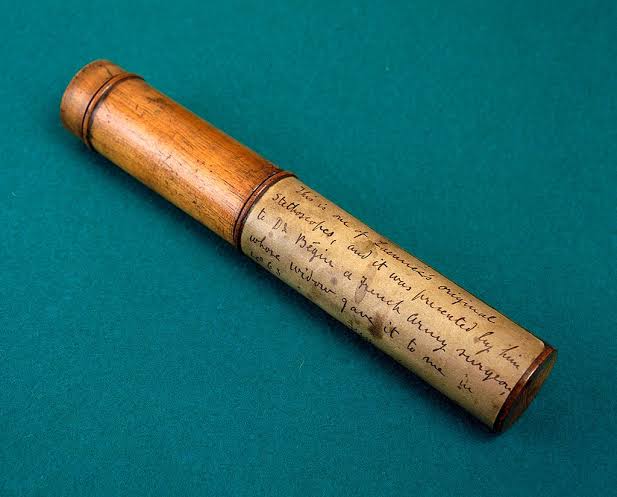
    In 1816, a young French doctor named René Laënnec faced an awkward problem. A female patient with heart trouble was too overweight for him to press his ear directly against her chest the standard method of listening to the lungs and heart at the time. Embarrassed and frustrated, Laënnec remembered a schoolyard trick: sound travels through solid objects. He rolled a quire of paper into a tight cylinder, placed one end on her chest, and put his ear to the other. To his astonishment, he heard her heart sounds “much more clearly and distinctly” than ever before.

    That rolled paper was the first stethoscope, an invention that would transform medicine from an art of guesswork into a science of listening. Yet while Laënnec is often credited as the sole inventor, the stethoscope’s story is actually a chain of forgotten contributors—from Hippocrates’s ear-on-chest listening to the modern acoustic design by David Littmann. Each step brought the instrument closer to what we now take for granted: a doctor’s ability to hear inside the body.

    Before the Stethoscope: Listening with Bare Ears

    For centuries, physicians had only their senses to diagnose illness. They would ask patients about symptoms, look at their bodies, feel for lumps, and—when they needed to hear the heart or lungs—press an ear directly against the chest. This is called immediate auscultation, from the Latin for “listening” (auscultare). It was a practice that dated back to Hippocrates around 400 BCE, who described hearing a “succession” sound like shaking a half-filled bottle inside the chest of a patient with fluid in the lungs.

    But direct listening had serious drawbacks. It was socially awkward, especially with female patients, who might be modest about exposing their chests. It was unhygienic, as doctors came into contact with skin, sweat, and potential infections. And it was imprecise: sounds from different parts of the lung or heart were hard to distinguish, and an obese patient’s chest wall muffled the sounds altogether.

    The first step toward solving this came from an unlikely source: a Viennese physician named Leopold Auenbrugger. In 1761, he published a book describing percussion—tapping the chest with fingers and listening to the resulting sound to determine if organs were solid or filled with air. His method was largely ignored for decades until it was translated and promoted by Jean-Nicolas Corvisart, Napoleon’s personal physician, in 1808. Corvisart was also Laënnec’s mentor, and his advocacy of percussion helped create a culture of systematic physical diagnosis in Paris.

    The Eureka Moment: A Rolled Paper Cylinder

    The story of the stethoscope’s invention is well documented because Laënnec himself described it in his 1819 treatise De l’auscultation médiate. In 1816, at the Hôpital Necker in Paris, he was consulted by a young woman with heart palpitations. She was overweight, and direct auscultation was both impractical and improper. Laënnec recalled a childhood memory: children scratching one end of a wooden beam and hearing the sound clearly at the other end, demonstrating that sound travels efficiently through solid materials.

    He quickly rolled a quire of paper (about 24 sheets) into a tight cylinder, tied it with string, and applied one end to her chest. The result was immediate and dramatic. He could hear the heart sounds with remarkable clarity, much better than with direct ear contact. This was the birth of mediate auscultation—listening through an instrument.

    Laënnec then refined his design into a hollow wooden tube, about 30 centimeters long and 4 centimeters in diameter, with a funnel-shaped chest piece that could be removed. He named it the stethoscope from the Greek stēthos (chest) and skopein (to examine)—literally a “chest examiner.” In 1819, he published his findings in a landmark book that described the sounds of various lung and heart conditions, correlating them with autopsy findings. This was a revolutionary approach: instead of guessing from symptoms, doctors could now hear specific sounds—rales, rhonchi, crepitations—and match them to physical abnormalities.

    The wooden tube was not immediately embraced. Some physicians ridiculed it as a “toy” or a “trumpet,” arguing that it distanced the doctor from the patient. Others found it difficult to use. But Laënnec’s meticulous correlations, his hundreds of autopsies, and the clear benefit of diagnosing tuberculosis (a disease that killed him in 1826) gradually won over the medical community. The treatise was translated into English and German, spreading the technique across Europe.

    The Forgotten Innovators: Who Made the Stethoscope Practical

    While Laënnec deserves credit for the original invention, the stethoscope we use today is not his wooden tube—it is the product of several lesser-known innovators. These are the “forgotten inventors” who each solved a critical problem.

    Pierre Adolphe Piorry and the Pleximeter

    In 1828, French physician Pierre Adolphe Piorry (1794–1879) introduced the pleximeter, a small plate, often made of ivory or wood, placed on the chest during percussion. This made tapping louder and clearer than using fingers alone. Piorry also modified the stethoscope, making it trumpet-shaped with a wider bell to capture more sound. He was a pioneer in correlating percussion and auscultation findings, but his contributions are often overshadowed by Laënnec’s fame.

    Arthur Leared and the Binaural Stethoscope

    The monaural (single-ear) stethoscope forced doctors to lean awkwardly, one ear to the patient’s chest. In 1851, Irish physician Arthur Leared invented a binaural (two-ear) version, but it was rigid and impractical. The following year, American George Cammann (1804–1863) perfected a flexible binaural stethoscope with two ear tubes that could be worn comfortably. Cammann’s design made the stethoscope practical for routine use, allowing doctors to listen through both ears and hear sounds more clearly. Yet Cammann is barely mentioned in standard histories.

    Rappaport and Sprague: The Bell and Diaphragm

    In the 1940s, cardiologists Maurice Rappaport and Howard Sprague designed a stethoscope that combined two chest pieces: a bell (open cup) for low-frequency sounds like heart murmurs, and a diaphragm (flat plate) for high-frequency sounds like breath sounds. This combination allowed doctors to switch between the two by pressing harder or turning the chest piece. The Rappaport-Sprague design became the standard for decades, but it was heavy and had multiple parts that could leak.

    David Littmann: The Modern Acoustic Stethoscope

    In the 1960s, Harvard cardiologist David Littmann (1906–1981) revolutionized stethoscope design. He created a lightweight instrument with a single chest piece that housed both a bell and a diaphragm, using a sealed acoustic system to minimize sound loss. The Littmann stethoscope became the gold standard, known for its clear acoustics and comfort. Today, most medical students receive a Littmann as their first stethoscope.

    The Stethoscope’s Legacy: How It Changed Medicine

    The stethoscope was not just a new gadget; it fundamentally altered how doctors think. Before Laënnec, medicine relied heavily on patient narratives and subjective impressions. The stethoscope enabled clinicopathological correlation—linking specific sounds to specific diseases confirmed at autopsy. This shifted medicine toward objective, evidence-based diagnosis, a cornerstone of modern practice.

    It also made tuberculosis, the “white plague” of the 19th century, more diagnosable. Laënnec himself used his invention to study the disease, and his early diagnoses likely saved lives even if there was no cure. Ironically, Laënnec contracted tuberculosis from his patients and died of it in 1826, at age 45.

    Socially, the stethoscope was initially controversial because it seemed to depersonalize the doctor-patient relationship. Some critics feared it would replace hands-on care. But over time, it became a symbol of medical professionalism—a doctor’s tool that signals expertise and care.

    The Future: Electronic and Digital Stethoscopes

    Since the 1990s, electronic and digital stethoscopes have emerged. They amplify sounds, filter background noise, and can even record and transmit sounds for telemedicine. Some use Bluetooth to connect to apps that display waveforms or analyze sounds with artificial intelligence. Yet despite these advances, the basic principle remains the same as Laënnec’s rolled paper: capturing the subtle vibrations of the body and translating them into diagnostic information.

    The wooden tube may be a relic, but the stethoscope itself endures as one of medicine’s most iconic and essential tools. And its history reminds us that great inventions are rarely the work of a single genius. They are built on the contributions of many—some famous, some forgotten—who each added a piece to the puzzle.

    The stethoscope’s journey from a rolled paper cylinder to the modern acoustic instrument is a story of incremental innovation. Laënnec’s initial spark was brilliant, but it was Piorry, Cammann, Rappaport and Sprague, and Littmann who made the stethoscope practical, comfortable, and effective. As you listen to a doctor’s stethoscope today, remember the forgotten minds that shaped it—and the humble wooden tube that started it all.

    Summary

    • The stethoscope was invented in 1816 by French physician René Laënnec, who used a rolled paper cylinder to listen to a patient’s chest.
    • Before the stethoscope, doctors used direct ear-to-chest listening, which was awkward, unhygienic, and imprecise.
    • Laënnec’s wooden monaural stethoscope enabled mediate auscultation and led to clinicopathological correlation, transforming medicine into an objective science.
    • Key forgotten innovators include Pierre Piorry (pleximeter), George Cammann (binaural stethoscope), Rappaport and Sprague (bell/diaphragm), and David Littmann (modern acoustic design).
    • The stethoscope remains essential, with electronic and digital versions now available, but its core principle has not changed in over 200 years.

    FAQ

    Q: Who really invented the stethoscope?
    A: René Laënnec is credited with the invention in 1816, but many others improved it. George Cammann made it binaural, Rappaport and Sprague added the bell/diaphragm, and David Littmann refined the modern acoustic design.

    Q: Why was the stethoscope initially criticized?
    A: Some physicians thought it was a toy or that it distanced the doctor from the patient. Others found it hard to use. It gained acceptance after Laënnec’s book was translated and its diagnostic benefits became clear.

    Q: What is mediate auscultation?
    A: It means listening to internal body sounds using an instrument, as opposed to immediate auscultation where the ear is placed directly on the body. The stethoscope made mediate auscultation possible.

    Q: How did the stethoscope change medicine?
    A: It allowed doctors to correlate sounds with autopsy findings, leading to clinicopathological correlation and a more objective, evidence-based approach to diagnosis. It also improved diagnosis of conditions like tuberculosis.

    Q: What is the future of the stethoscope?
    A: Electronic and digital stethoscopes can amplify sounds, filter noise, and transmit data for telemedicine. Some use AI to analyze sounds. But the basic principle remains the same as Laënnec’s original invention.

  • The Basket on Wheels: How Sylvan Goldman’s Shopping Cart Revolutionized Retail

    How a Basket on Wheels Revolutionized Grocery Shopping - Priceonomics

    In June 1937, shoppers at a Humpty Dumpty supermarket in Oklahoma City encountered a strange new contraption: a metal frame with wire baskets mounted on wheels. Most were skeptical. Men thought it looked unmanly; women found it hard to steer. But Sylvan Goldman, the store owner, had a hunch that this odd device would change retail forever.

    Goldman wasn’t trying to be convenient—he was trying to sell more groceries. Before his invention, customers were limited by what they could carry in a hand basket. Once that basket was full, they stopped buying. Goldman realized that if he could make it easier to carry more, people would buy more. His solution was simple, yet it solved a problem that had plagued self-service stores since their inception.

    The shopping cart didn’t just boost sales; it paved the way for supermarkets, big-box stores, and the modern consumer economy. Today, billions of shoppers use carts annually, and the design remains largely unchanged. This is the story of how a folding chair inspired a retail revolution.

    The Problem: Self-Service’s Hidden Bottleneck

    In the early 20th century, grocery shopping was a clerk-mediated affair. You handed a list to a clerk who fetched items from behind the counter. Then, in 1916, Clarence Saunders opened Piggly Wiggly, the first self-service grocery store. Customers could now walk the aisles, pick their own items, and interact with products directly. This was a hit—sales soared because shoppers bought more when they could browse.

    But there was a catch: shoppers could only carry what fit in a hand-held basket, typically 10 to 12 items. Once the basket was full, they headed to the checkout, often leaving with less than they could afford. For store owners, this was a revenue ceiling. They had opened their stores to encourage more purchases, but the physical limitation of carrying capacity capped sales per visit.

    Goldman, who owned the Humpty Dumpty chain with his brother Alfred, saw this problem firsthand. Watching customers struggle with overflowing baskets, he realized that the store’s growth depended on solving this bottleneck. He later recalled, “I thought, if I could find a way to carry more groceries, the customer would buy more.”

    The Eureka Moment: A Folding Chair on Wheels

    Goldman wasn’t an engineer; he was a businessman. But he had an eye for practical innovation. One evening in 1936, he was sitting in his office, staring at a folding chair. The chair’s X-shaped folding mechanism sparked an idea: what if he attached wheels to a frame that could hold baskets? He sketched a design and took it to a local mechanic, Fred Young, who helped build a prototype.

    The original cart was a simple metal frame with two wire baskets—one on top for lighter items, one below for heavier goods. The frame borrowed the folding mechanism from a chair, allowing the cart to collapse for storage. Goldman filed a patent on March 28, 1937, and introduced the cart in June of that year at his store on North Hudson Avenue.

    Early reactions were not encouraging. Men refused to push them, saying they looked like baby carriages. Women complained they were difficult to steer. Goldman didn’t give up. He hired male and female models to push carts through his stores, demonstrating their ease of use. He also stationed greeters at the entrance to hand out carts to customers—a tactic that later became standard retail practice. Within a few months, the carts were a hit, and average purchase sizes jumped by 40 to 50 percent.

    The Cart That Built Supermarkets

    By 1940, Goldman’s carts were in use in over 100 stores across the country. The cart did more than increase sales; it changed the physical layout of stores. Aisles had to be widened to accommodate carts, and shelving was adjusted to make items easy to reach. The cart also encouraged impulse buying—when you can carry more, you’re more likely to toss in that extra snack or magazine.

    The economic impact was staggering. Retailers found that cart users bought not only more items but also more expensive ones, like family-size packages. This shift enabled the rise of supermarkets, which depend on high-volume, cart-based shopping. Without the cart, the big-box stores that dominate today’s retail landscape—Walmart, Target, Costco—would be unthinkable.

    Goldman continued to innovate. In 1946, he introduced a nestable folding cart that could be stacked compactly, and in 1947, he added a child seat. These features became standard, and the basic design has remained largely unchanged for over 75 years.

    The Cultural Ripple Effect

    The shopping cart’s influence extends far beyond the grocery aisle. It reshaped gender roles: by making it easier to carry large loads, it encouraged the weekly shopping trip, which in turn tied women more closely to domestic responsibilities. The cart also became a symbol of consumer abundance, appearing in art—like Andy Warhol’s prints—and in film, such as the iconic cart-pushing scene in The Blues Brothers.

    But the cart also has a darker side. In recent decades, it has become a symbol of homelessness, with carts used as mobile storage for personal belongings. This has led to anti-theft measures, like wheel-locking systems, and social stigma. The cart’s very ubiquity makes it a canvas for both consumer aspiration and social inequality.

    The Evolution: From Wire to Smart Carts

    The shopping cart has evolved from Goldman’s original wire design to today’s plastic models, with a host of improvements: child seats, cup holders, and even anti-theft wheels that lock if the cart is taken beyond a certain boundary. The 21st century has brought smart carts, like Amazon’s Dash Cart and Caper AI’s autonomous carts, which use sensors and screens to streamline checkout. These innovations promise to further transform the shopping experience, but they all trace their lineage back to Goldman’s simple invention.

    Goldman, who later became a successful real estate developer in Oklahoma City, was inducted into the Oklahoma Hall of Fame in 1967. He died in 1984, but his legacy rolls on. Today, an estimated 25,000 shopping carts are manufactured daily worldwide, and billions of shoppers use them every year. All because a grocer looked at a folding chair and saw a way to sell more groceries.

    The shopping cart is more than a retail convenience; it’s a testament to human ingenuity. Sylvan Goldman didn’t just invent a product—he solved a fundamental economic problem, and in doing so, he reshaped the way we shop. The next time you grab a cart at the store, remember: you’re pushing a piece of history that changed the world.

    Summary

    • Sylvan Goldman invented the shopping cart in 1937 to solve the problem of limited carrying capacity in self-service stores.
    • The cart increased average purchase size by 40-50% in early trials, boosting retail sales.
    • Goldman’s design borrowed from folding chair technology and was initially met with skepticism, but he overcame it with demonstrations and greeters.
    • The cart enabled the rise of supermarkets and big-box stores, becoming a staple of modern retail.
    • The cart’s design has evolved with plastic, child seats, and smart technology, but Goldman’s basic principle remains.

    FAQ

    Q: Who invented the shopping cart?
    A: Sylvan Goldman, owner of the Humpty Dumpty supermarket chain, invented the shopping cart in 1937. He filed a patent on March 28, 1937, and introduced the cart in June of that year in Oklahoma City.

    Q: What problem did the shopping cart solve?
    A: Before the cart, shoppers could only carry what fit in a hand-held basket, typically 10-12 items. This limited how much they could buy, capping store sales. The cart allowed shoppers to carry more, increasing sales by 40-50%.

    Q: How did Goldman convince people to use the carts?
    A: Goldman hired male and female models to push carts through his stores, demonstrating their ease of use. He also stationed greeters at the door to hand out carts to customers, a practice that became a standard retail tactic.

    Q: When did the folding cart with a child seat appear?
    A: In 1946, Goldman introduced a nestable folding cart, and in 1947, he added a child seat. These features became standard and are still common today.

    Q: How has the shopping cart evolved?
    A: Carts have evolved from wire to plastic, with improvements like anti-theft wheels and smart carts (e.g., Amazon’s Dash Cart). Despite these changes, the basic design remains similar to Goldman’s original.